

How traffic signals favour cars and discourage walking
- Written by: David Levinson, Professor of Transport, University of Sydney
This is the fifth article in our series, Moving the Masses, about managing the flow of crowds of individuals, be they drivers or pedestrians, shoppers or commuters, birds or ants.
Traffic signals give priority to motor vehicles over pedestrians. This inequality undermines many of the stated goals of transport, health and environment policy.
State and city governments say they want to encourage walking and biking for many reasons:
- it is space efficient
- it has less environmental impact
- it is healthier
- it is safer for other travellers
- it reduces the numbers of cars on the road, so even motorists should be in favour of other people walking.
To help achieve these goals, road management agencies should reprioritise traffic signals to redistribute delays at intersections from pedestrians to cars.
Planners tend to focus on the long-term decisions, like infrastructure and land development. However, it is the shortest of short-term decisions, how many seconds of green light each movement gets at an intersection, that shapes perception of the feasibility of walking or driving to a destination at a given time. This influences the choice of route, destination and mode of travel.
Traffic signal timing involves maths, so has been historically delegated to engineers. But it also involves values and priorities, and so is the proper subject of public policy.
Since the early 20th-century dawn of what Peter Norton calls “Motordom, street space has steadily been regulated and enclosed. This has limited the rights and privileges of pedestrians while promoting those of drivers, in the name of safety and efficiency. But safety and efficiency for whom?
Pedestrians once crossed the street whenever and wherever they wanted. The introduction of signals prioritised the movement of motor vehicles at the expense of pedestrians, which slowed effective walking speed through the city. Pedestrians now spend roughly 20% of their time waiting at intersections. The consequences of making it easier to drive and harder to walk are consistent with the rise of vehicle-dominated cities.
How Barcelona is taking city streets back from cars.How the phases of traffic signals work
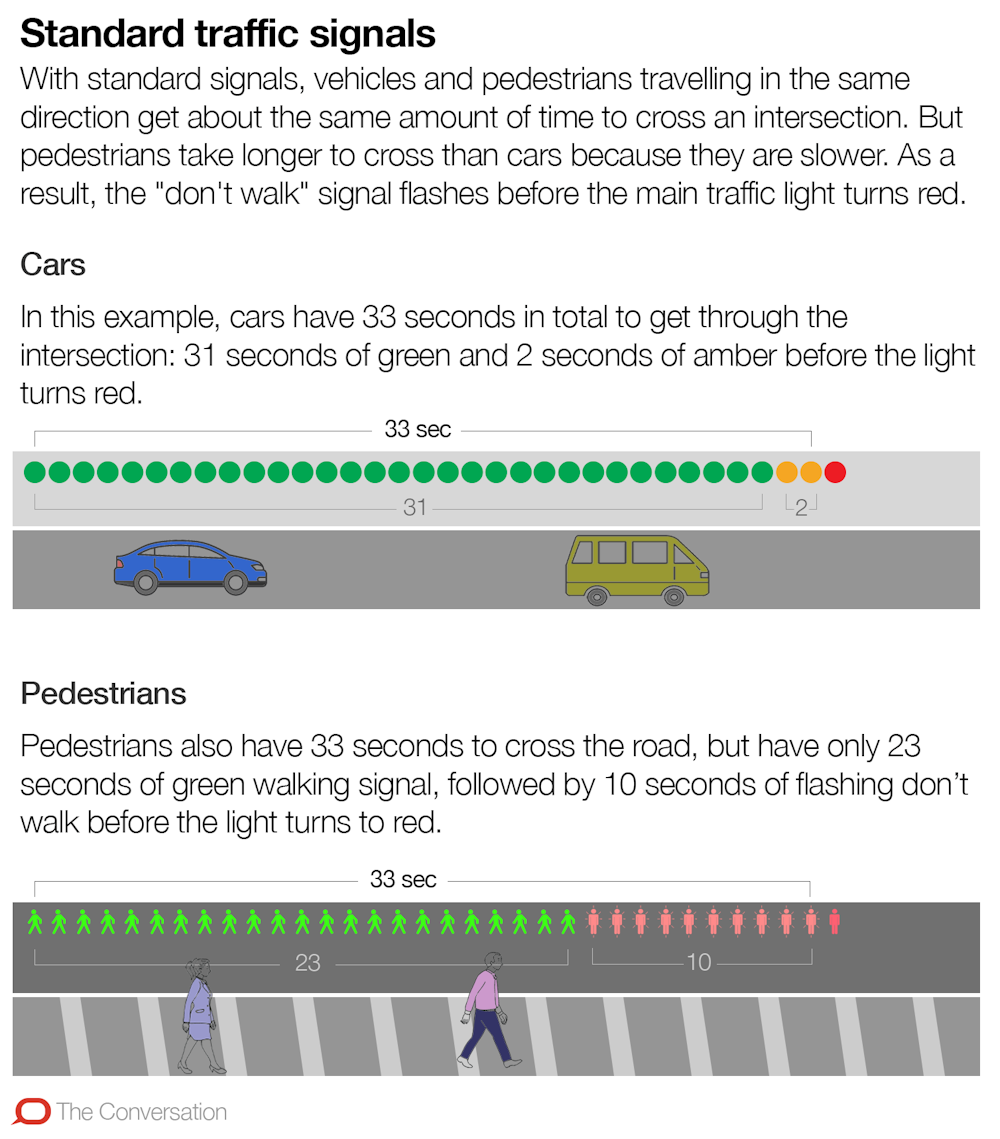
Pedestrians take longer to cross streets than cars because they are slower. As a result, the "don’t walk” signal flashes before the light turns red.
 CC BY-ND
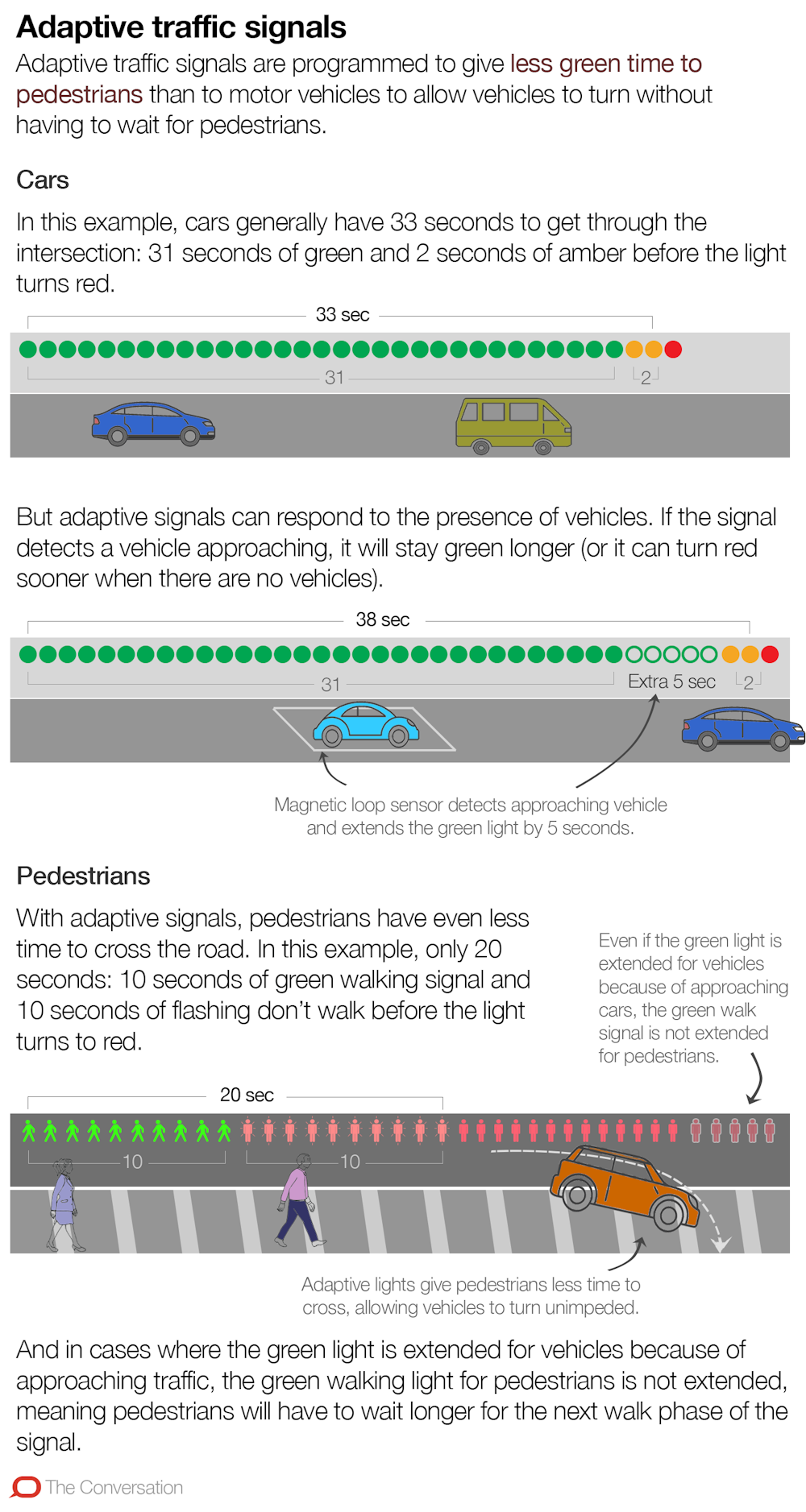
But at many intersections it is worse than that. Traffic signals are set to give less green time to pedestrians on a phase (from the time the light turns green to when it turns red, or from “walk” to “don’t walk”) than to motor vehicles, to give vehicles a protected left turn without having to yield pedestrians. Adaptive signal control also extends the green light for cars when these are detected, but not for pedestrians, who aren’t.
CC BY-ND
But at many intersections it is worse than that. Traffic signals are set to give less green time to pedestrians on a phase (from the time the light turns green to when it turns red, or from “walk” to “don’t walk”) than to motor vehicles, to give vehicles a protected left turn without having to yield pedestrians. Adaptive signal control also extends the green light for cars when these are detected, but not for pedestrians, who aren’t.
 CC BY-SA
The average pedestrian arriving randomly at the intersection waits longer than a car. Several factors guarantee this.
CC BY-SA
The average pedestrian arriving randomly at the intersection waits longer than a car. Several factors guarantee this.
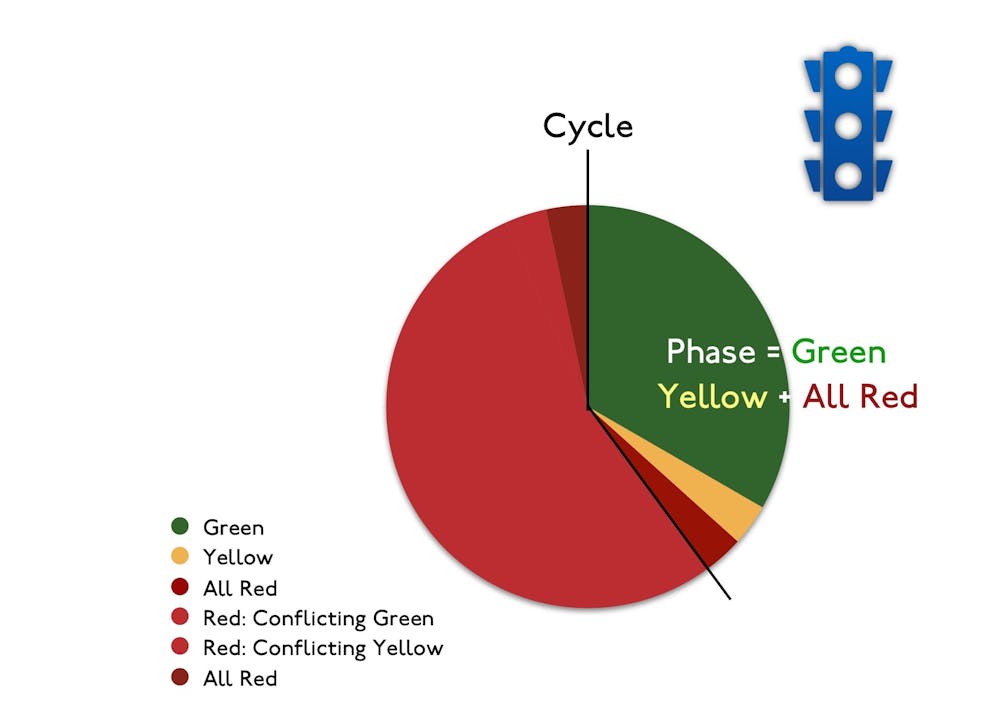 Phases of traffic signals typically mean pedestrians wait longer than cars.
Author provided
1. Cycle length
The cycle length (time from the start of the green light to the start of the next green) tends to be longer at busier intersections and busier times of day. A longer cycle length reduces the number of phases per hour, and thus reduces the lost time associated with each phase, when the intersection is not being effectively used by any approach. Lost time can never be reclaimed, so one understands why engineers might want longer cycle lengths if their main objective is to move cars.
However, long cycle lengths disadvantage pedestrians, who stand out in the open exposed to the elements and the exhaust emissions of cars, motorcycles, trucks and buses. Even more significantly, people consistently misperceive travel delay, so the wait feels even longer than it actually is.
2. Actuation/‘beg buttons’
While some signals are “fixed time”, modern signals are “actuated”. This means they respond to the presence of vehicles by adjusting the phasing and perhaps the cycle time.
Either a camera detects approaching vehicles or, more commonly, a sensor in the road, often a magnetic loop. This automatically allows the signal to stay green longer if it detects a vehicle approaching, or turn red sooner when there are no vehicles.
In contrast, for pedestrians, they must push a button to get a walk signal. If they arrive a second too late, they have to wait the entire cycle to get a walk signal. If there are many pedestrians, they don’t get a longer walk signal.
Pushing the “beg button” (so called as the pedestrian must request the signal) twice does not make it come faster or stay green longer. Ten, or a hundred, pedestrians do not make the “walk” light come faster either. The beg button is often positioned out of the way, requiring the pedestrian to walk further than would otherwise be required. A few seconds here, a few seconds there, add up.
There is a reason that traffic engineers don’t allocate automatic pedestrian phases. Suppose the car only warrants a six-second phase but a pedestrian requires 18 seconds to cross the street at a walking speed of 1 metre per second. Giving an automatic pedestrian phase even if there are no pedestrians will delay cars. And there is no sin worse than delaying a car.
3. Co-ordination
Phases of traffic signals typically mean pedestrians wait longer than cars.
Author provided
1. Cycle length
The cycle length (time from the start of the green light to the start of the next green) tends to be longer at busier intersections and busier times of day. A longer cycle length reduces the number of phases per hour, and thus reduces the lost time associated with each phase, when the intersection is not being effectively used by any approach. Lost time can never be reclaimed, so one understands why engineers might want longer cycle lengths if their main objective is to move cars.
However, long cycle lengths disadvantage pedestrians, who stand out in the open exposed to the elements and the exhaust emissions of cars, motorcycles, trucks and buses. Even more significantly, people consistently misperceive travel delay, so the wait feels even longer than it actually is.
2. Actuation/‘beg buttons’
While some signals are “fixed time”, modern signals are “actuated”. This means they respond to the presence of vehicles by adjusting the phasing and perhaps the cycle time.
Either a camera detects approaching vehicles or, more commonly, a sensor in the road, often a magnetic loop. This automatically allows the signal to stay green longer if it detects a vehicle approaching, or turn red sooner when there are no vehicles.
In contrast, for pedestrians, they must push a button to get a walk signal. If they arrive a second too late, they have to wait the entire cycle to get a walk signal. If there are many pedestrians, they don’t get a longer walk signal.
Pushing the “beg button” (so called as the pedestrian must request the signal) twice does not make it come faster or stay green longer. Ten, or a hundred, pedestrians do not make the “walk” light come faster either. The beg button is often positioned out of the way, requiring the pedestrian to walk further than would otherwise be required. A few seconds here, a few seconds there, add up.
There is a reason that traffic engineers don’t allocate automatic pedestrian phases. Suppose the car only warrants a six-second phase but a pedestrian requires 18 seconds to cross the street at a walking speed of 1 metre per second. Giving an automatic pedestrian phase even if there are no pedestrians will delay cars. And there is no sin worse than delaying a car.
3. Co-ordination
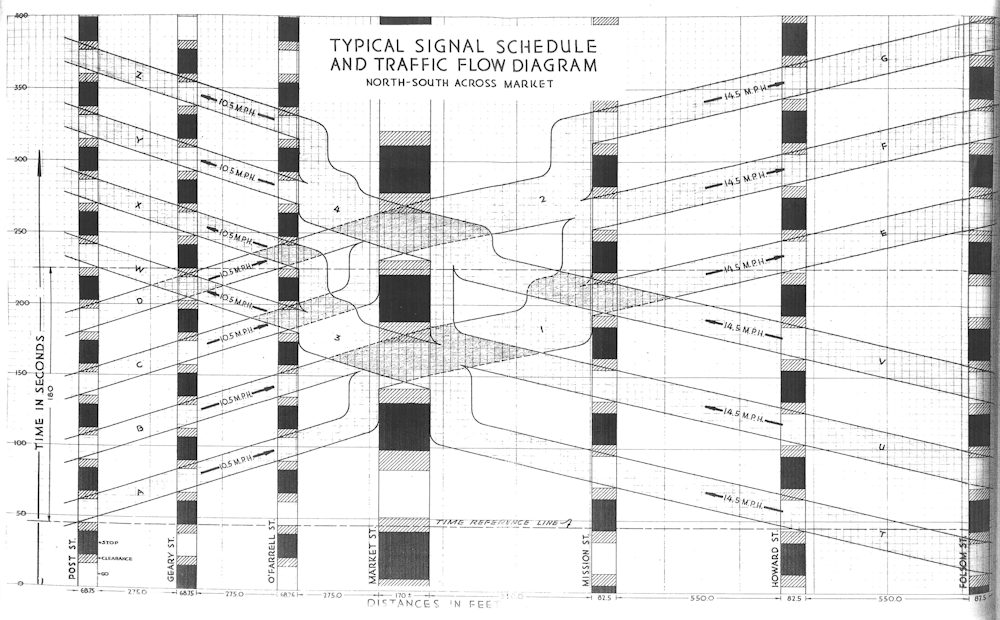 A 1929 traffic engineer’s signal schedule and traffic flow diagram across Market Street, San Francisco (click to enlarge). Green wave set to 10.5mph (about 17km/h).
City of San Francisco
First introduced in 1922 in New York City, traffic signal coordination aims to ensure vehicles arrive at the traffic signal when it is green, so they don’t have to stop. By correctly timing signals in sequence, platoons of vehicles move together through a “green wave”.
Let’s say the wave is set for a speed of 40km/h. As long as a car accelerates from the first signal to 40km/h and maintains that, it should hit the following lights on their green phase.
This is relatively easy to maintain on a single road, but is more difficult on a network, especially a complex, asymmetric network. It also works against the idea of actuation, as interruptions to the pattern (extending or contracting phases) change the window in which cars can hit a green light at a given speed.
Of course, just because cars can make a green wave at a speed of 40km/h doesn’t mean pedestrians will make a green wave unless they travel at exactly a divisor of 40km/h (e.g. exactly 5km/h) between intersections. This means that pedestrians will more likely wait at red lights at intersections timed for cars.
Policies to improve the life of pedestrians
One of the world’s most widely deployed traffic signal control systems, the Sydney Coordinated Adaptive Traffic System (SCATS), was developed in Australia. Just as Australia led the way in traffic control to move cars more smoothly, it should lead in pedestrian-oriented traffic control. Those concerned about pedestrians should insist on a number of steps:
pedestrians, like vehicles, should be counted automatically at controlled intersections
there should be a pedestrian phase for every movement
traffic signal algorithms must give equal or greater weight to pedestrian time than to vehicle time
pedestrians should get the maximum feasible green time on a phase, rather than the minimum, so pedestrians arriving when the light is green can take advantage of it, and slower pedestrians are not intimidated by cars
pedestrians should get a “leading interval” so they can step into the street on a “walk” signal before cars start to move on a green light, increasing their visibility to drivers
pedestrian phases should be automatic, even if no actuator is pushed– the actuator should make the pedestrian phase come sooner and last longer
many more intersections should have an all-pedestrian phase (known as a “Barnes Dance”) so pedestrians can cross intersections diagonally without having to wait twice.
Pedestrians cross diagonally at some the world’s busiest intersections, including Oxford Circus in the heart of London since 2009.Numerous other steps could be taken to improve the life of the pedestrian and thus increase their number. Certainly, we can demand more patience from drivers as well.
The advent of autonomous vehicles over the next few decades is unlikely, by itself, to eliminate the need for traffic control. But autonomous vehicles should help increase throughput at intersections, losing less time than human drivers, and leading to cars behaving far more safely.
You can find other articles in the series here.
A 1929 traffic engineer’s signal schedule and traffic flow diagram across Market Street, San Francisco (click to enlarge). Green wave set to 10.5mph (about 17km/h).
City of San Francisco
First introduced in 1922 in New York City, traffic signal coordination aims to ensure vehicles arrive at the traffic signal when it is green, so they don’t have to stop. By correctly timing signals in sequence, platoons of vehicles move together through a “green wave”.
Let’s say the wave is set for a speed of 40km/h. As long as a car accelerates from the first signal to 40km/h and maintains that, it should hit the following lights on their green phase.
This is relatively easy to maintain on a single road, but is more difficult on a network, especially a complex, asymmetric network. It also works against the idea of actuation, as interruptions to the pattern (extending or contracting phases) change the window in which cars can hit a green light at a given speed.
Of course, just because cars can make a green wave at a speed of 40km/h doesn’t mean pedestrians will make a green wave unless they travel at exactly a divisor of 40km/h (e.g. exactly 5km/h) between intersections. This means that pedestrians will more likely wait at red lights at intersections timed for cars.
Policies to improve the life of pedestrians
One of the world’s most widely deployed traffic signal control systems, the Sydney Coordinated Adaptive Traffic System (SCATS), was developed in Australia. Just as Australia led the way in traffic control to move cars more smoothly, it should lead in pedestrian-oriented traffic control. Those concerned about pedestrians should insist on a number of steps:
pedestrians, like vehicles, should be counted automatically at controlled intersections
there should be a pedestrian phase for every movement
traffic signal algorithms must give equal or greater weight to pedestrian time than to vehicle time
pedestrians should get the maximum feasible green time on a phase, rather than the minimum, so pedestrians arriving when the light is green can take advantage of it, and slower pedestrians are not intimidated by cars
pedestrians should get a “leading interval” so they can step into the street on a “walk” signal before cars start to move on a green light, increasing their visibility to drivers
pedestrian phases should be automatic, even if no actuator is pushed– the actuator should make the pedestrian phase come sooner and last longer
many more intersections should have an all-pedestrian phase (known as a “Barnes Dance”) so pedestrians can cross intersections diagonally without having to wait twice.
Pedestrians cross diagonally at some the world’s busiest intersections, including Oxford Circus in the heart of London since 2009.Numerous other steps could be taken to improve the life of the pedestrian and thus increase their number. Certainly, we can demand more patience from drivers as well.
The advent of autonomous vehicles over the next few decades is unlikely, by itself, to eliminate the need for traffic control. But autonomous vehicles should help increase throughput at intersections, losing less time than human drivers, and leading to cars behaving far more safely.
You can find other articles in the series here.
Authors: David Levinson, Professor of Transport, University of Sydney
Read more http://theconversation.com/how-traffic-signals-favour-cars-and-discourage-walking-92675


 Daily Bulletin


.png)