

Why methane should be treated differently compared to long-lived greenhouse gases
- Written by: Dave Frame, Professor of Climate Change, Victoria University of Wellington
New research provides a way out of a longstanding quandary in climate policy: how best to account for the warming effects of greenhouse gases that have different atmospheric lifetimes.
Carbon dioxide is a long-lived greenhouse gas, whereas methane is comparatively short-lived. Long-lived “stock pollutants” remain in the atmosphere for centuries, increasing in concentration as long as their emissions continue and causing more and more warming. Short-lived “flow pollutants” disappear much more rapidly. As long as their emissions remain constant, their concentration and warming effect remain roughly constant as well.
Our research demonstrates a better way to reflect how different greenhouse gases affect global temperatures over time.
Cost of pollution
The difference between stock and flow pollutants is shown in the figure below. Flow pollutant emissions, for example of methane, do not persist. Emissions in period one, and the same emissions in period two, lead to a constant (or roughly constant) amount of the pollutant in the atmosphere (or river, lake, or sea).
With stock pollutants, such as carbon dioxide, concentrations of the pollutant accumulate as emissions continue.
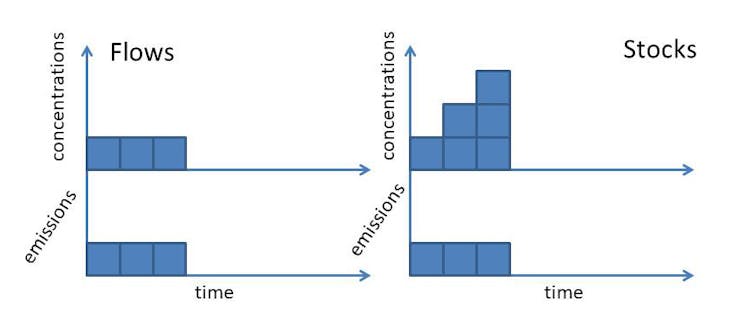 Flow and stock pollutants over time. In the first period, one unit of each pollutant is emitted, leading to one unit of concentration. After each period, the flow pollutant decays, while the stock pollutant remains in the environment.
provided by author, CC BY
Flow and stock pollutants over time. In the first period, one unit of each pollutant is emitted, leading to one unit of concentration. After each period, the flow pollutant decays, while the stock pollutant remains in the environment.
provided by author, CC BY
The economic theory of pollution suggests different approaches to greenhouse gases with long or short lifetimes in the atmosphere. The social cost (the cost society ought to pay) of flow pollution is constant over time, because the next unit of pollution is just replacing the last, recently decayed unit. This justifies a constant price on flow pollutants.
In the case of stock pollutants, the social cost increases with constant emissions as concentrations of the pollutant rise, and as damages rise, too. This justifies a rising price on stock pollutants.
Read more: Cows exude lots of methane, but taxing beef won't cut emissions
A brief history of greenhouse gas “equivalence”
In climate policy, we routinely encounter the idea of “CO₂-equivalence” between different sorts of gases, and many people treat it as accepted and unproblematic. Yet researchers have debated for decades about the adequacy of this approach. To summarise a long train of scientific papers and opinion pieces, there is no perfect or universal way to compare the effects of greenhouse gases with very different lifetimes.
This point was made in the first major climate report produced by the Intergovernmental Panel on Climate Change (IPCC) way back in 1990. Those early discussions were loaded with caveats: global warming potentials (GWP), which underpin the traditional practice of CO₂-equivalence, were introduced as “a simple approach … to illustrate the difficulties inherent in the concept”.
The problem with developing a concept is that people might use it. Worse, they might use it and ignore all the caveats that attended its development. This is, more or less, what happened with GWPs as used to create CO₂-equivalence.
The science caveats were there, and suggestions for alternatives or improvements have continued to appear in the literature. But policymakers needed something (or thought they did), and the international climate negotiations community grasped the first option that became available, although this has not been without challenges from some countries.
Better ways to compare stocks and flows
An explanation of the scientific issues, and how we address them, is contained in this article by Michelle Cain. The approach in our new paper shows that modifying the use of GWP to better account for the differences between short- and long-lived gases can better link emissions to warming.
Under current policies, stock and flow pollutants are treated as being equivalent and therefore interchangeable. This is a mistake, because if people make trade-offs between emissions reductions such that they allow stock pollutants to grow while reducing flow pollutants, they will ultimately leave a warmer world behind in the long term. Instead, we should develop policies that address methane and other flow pollutants in line with their effects.
Then the true impact of an emission on warming can be easily assessed. For countries with high methane emissions, for example from agriculture, this can make a huge difference to how their emissions are judged.
For a lot of countries, this issue is of secondary importance. But for some countries, particularly poor ones, it matters a lot. Countries with a relatively high share of methane in their emissions portfolios tend to be either middle-income countries with large agriculture sectors and high levels of renewables in their electricity mix (such as much of Latin America), or less developed countries where agricultural emissions dominate because their energy sector is small.
This is why we think the new research has some promise. We think we have a better way to conceive of multi-gas climate targets. This chimes with new possibilities in climate policy, because under the Paris Agreement countries are free to innovate in how they approach climate policy.
Improving the environmental integrity of climate policy
This could take several forms. For some countries, it may be that the new approach provides a better way of comparing different gases within a single-basket approach to greenhouse gases, as in an emissions trading scheme or taxation system. For others, it could be used to set separate but coherent emissions targets for long- and short-lived gases within a two-basket approach to climate policy. Either way, the new approach means countries can signal the centrality of carbon dioxide reductions in their policy mix, while limiting the warming effect of shorter-lived gases.
The new way of using global warming potentials demonstrably outperforms the traditional method in a range of emission scenarios, providing a much more accurate indication of how stock and flow pollutants affect global temperatures. This is especially so under climate mitigation scenarios.
Well designed policies would assist sectoral fairness within countries, too. Policies that reflect the different roles of stock and flow pollutants would give farmers and rice growers a more reasonable way to control their emissions and reduce their impact on the environment, while still acknowledging the primacy of carbon dioxide emissions in the climate change problem.
An ideal approach would be a policy that aimed for zero emissions of stock pollutants such as carbon dioxide and low but stable (or gently declining) emissions of flow pollutants such as methane. Achieving both goals would mean that a farm, or potentially a country, can do a better, clearer job of stopping its contribution to warming.
Authors: Dave Frame, Professor of Climate Change, Victoria University of Wellington


 Daily Bulletin


