

How does altitude affect the body and why does it affect people differently?
- Written by: Brendan Scott, Senior Lecturer (S&C), Murdoch University
Every year, thousands of people travel to high-altitude environments for tourism, adventure-seeking, or to train and compete in various sports. Unfortunately, these trips can be marred by the effects of acute altitude sickness, and the symptoms vary from person to person. To understand why people are affected differently, we have to look at how the body is affected by altitude.
Read more: From Kilimanjaro to Everest: how fit do you have to be to climb a mountain?
How is ‘altitude’ different to sea level?
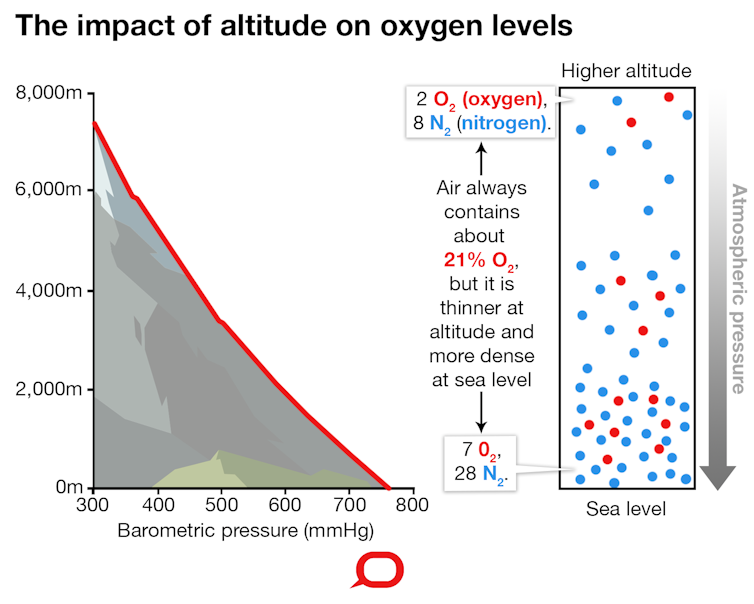
Air is comprised of different molecules, with nitrogen (79.04%) and oxygen (20.93%) making up the majority of each breath we take. This composition of air remains consistent, whether we are at sea level or at altitude.
However, with altitude, the “partial pressure” of oxygen in this air (how many molecules of oxygen are in a given volume of air) changes. At sea-level, the partial pressure of oxygen is 159 mmHg, whereas at 8,848m above sea level (the summit of Mt Everest), the partial pressure of oxygen is only 53 mmHg.
At high altitudes, oxygen molecules are further apart because there is less pressure to “push” them together. This effectively means there are fewer oxygen molecules in the same volume of air as we inhale. In scientific studies, this is often referred to as “hypoxia”.
 Author provided/The Conversation, CC BY-ND
What happens in the body in high altitudes?
Within seconds of exposure to altitude, ventilation is increased, meaning we start trying to breathe more, as the body responds to less oxygen in each breath, and attempts to increase oxygen uptake. Despite this response, there’s still less oxygen throughout your circulatory system, meaning less oxygen reaches your muscles. This will obviously limit exercise performance.
Within the first few hours of altitude exposure, water loss also increases, which can result in dehydration. Altitude can also increase your metabolism while suppressing your appetite, meaning you’ll have to eat more than you feel like to maintain a neutral energy balance.
When people are exposed to altitude for several days or weeks, their bodies begin to adjust (called “acclimation”) to the low-oxygen environment. The increase in breathing that was initiated in the first few seconds of altitude exposure remains, and haemoglobin levels (the protein in our blood that carries oxygen) increase, along with the ratio of blood vessels to muscle mass.
Despite these adaptations in the body to compensate for hypoxic conditions, physical performance will always be worse at altitude than for the equivalent activity at sea level. The only exception to this is in very brief and powerful activities such as throwing or hitting a ball, which could be aided by the lack of air resistance.
Read more:
Tall tales misrepresent the real story behind Bhutan’s high altitude tigers
Why do only some people get altitude sickness?
Many people who ascend to moderate or high altitudes experience the effects of acute altitude sickness. Symptoms of this sickness typically begin 6-48 hours after the altitude exposure begins, and include headache, nausea, lethargy, dizziness and disturbed sleep.
These symptoms are more prevalent in people who ascend quickly to altitudes of above 2,500m, which is why many hikers are advised to climb slowly, particularly if they’ve not been to altitude before.
It’s difficult to predict who will be adversely affected by altitude exposure. Even in elite athletes, high levels of fitness are not protective for altitude sickness.
There’s some evidence those who experience the worst symptoms have a low ventilatory response to hypoxia. So just as some people aren’t great singers or footballers, some people’s bodies are just less able to cope with the reduction in oxygen in their systems.
There are also disorders that impact on the blood’s oxygen carrying capacity, such as thalassemia, which can increase the risk of symptoms.
But the best predictor of who may suffer from altitude sickness is a history of symptoms when being exposed to altitude previously.
How are high-altitude natives different?
People who reside at altitude are known to have greater capacity for physical work at altitude. For example, the Sherpas who reside in the mountainous regions of Nepal are renowned for their mountaineering prowess.
High-altitude natives exhibit large lung volumes and greater efficiency of oxygen transport to tissues, both at rest and during exercise.
While there is debate over whether these characteristics are genetic, or the result of altitude exposure throughout life, they provide high-altitude natives with a distinct advantage over lowlanders during activities in hypoxia.
So unless you’re a sherpa, it’s best to ascend slowly to give your body more time to adjust to the challenges of a hypoxic environment.
Author provided/The Conversation, CC BY-ND
What happens in the body in high altitudes?
Within seconds of exposure to altitude, ventilation is increased, meaning we start trying to breathe more, as the body responds to less oxygen in each breath, and attempts to increase oxygen uptake. Despite this response, there’s still less oxygen throughout your circulatory system, meaning less oxygen reaches your muscles. This will obviously limit exercise performance.
Within the first few hours of altitude exposure, water loss also increases, which can result in dehydration. Altitude can also increase your metabolism while suppressing your appetite, meaning you’ll have to eat more than you feel like to maintain a neutral energy balance.
When people are exposed to altitude for several days or weeks, their bodies begin to adjust (called “acclimation”) to the low-oxygen environment. The increase in breathing that was initiated in the first few seconds of altitude exposure remains, and haemoglobin levels (the protein in our blood that carries oxygen) increase, along with the ratio of blood vessels to muscle mass.
Despite these adaptations in the body to compensate for hypoxic conditions, physical performance will always be worse at altitude than for the equivalent activity at sea level. The only exception to this is in very brief and powerful activities such as throwing or hitting a ball, which could be aided by the lack of air resistance.
Read more:
Tall tales misrepresent the real story behind Bhutan’s high altitude tigers
Why do only some people get altitude sickness?
Many people who ascend to moderate or high altitudes experience the effects of acute altitude sickness. Symptoms of this sickness typically begin 6-48 hours after the altitude exposure begins, and include headache, nausea, lethargy, dizziness and disturbed sleep.
These symptoms are more prevalent in people who ascend quickly to altitudes of above 2,500m, which is why many hikers are advised to climb slowly, particularly if they’ve not been to altitude before.
It’s difficult to predict who will be adversely affected by altitude exposure. Even in elite athletes, high levels of fitness are not protective for altitude sickness.
There’s some evidence those who experience the worst symptoms have a low ventilatory response to hypoxia. So just as some people aren’t great singers or footballers, some people’s bodies are just less able to cope with the reduction in oxygen in their systems.
There are also disorders that impact on the blood’s oxygen carrying capacity, such as thalassemia, which can increase the risk of symptoms.
But the best predictor of who may suffer from altitude sickness is a history of symptoms when being exposed to altitude previously.
How are high-altitude natives different?
People who reside at altitude are known to have greater capacity for physical work at altitude. For example, the Sherpas who reside in the mountainous regions of Nepal are renowned for their mountaineering prowess.
High-altitude natives exhibit large lung volumes and greater efficiency of oxygen transport to tissues, both at rest and during exercise.
While there is debate over whether these characteristics are genetic, or the result of altitude exposure throughout life, they provide high-altitude natives with a distinct advantage over lowlanders during activities in hypoxia.
So unless you’re a sherpa, it’s best to ascend slowly to give your body more time to adjust to the challenges of a hypoxic environment.
Authors: Brendan Scott, Senior Lecturer (S&C), Murdoch University


 Daily Bulletin


