

Proposed NSW logging laws value timber over environmental protection
- Written by: Oisín Sweeney, Senior Ecologist at the National Parks Association of NSW, Research Fellow, University of Sydney
New South Wales is revamping its logging laws for the first time in two decades, drafting regulations that will govern more than two million hectares of public native forest.
Among the changes are proposals to permit logging in exclusion zones – part of the reserve system – and dramatic increases to the scale and intensity of logging, putting several threatened species at direct risk.
NSW can implement these changes unilaterally. But if it does, NSW will effectively be asking the federal government to agree to changes that directly contradict the federal Threatened Species Strategy and several species recovery plans, and reduce the extent of the reserve system.
Read more: Native forest protections are deeply flawed, yet may be in place for another 20 years
Regional Forest Agreements
The federal government has arrangements with the states called Regional Forest Agreements (RFAs). They provide certainty to logging operations by accrediting state logging rules under federal environment law. No other industry gets this treatment – but RFAs are now expiring after having been in place for 20 years.
But the proposed changes to NSW logging laws clearly prioritise timber extraction over environmental protection. In 2014 the NSW government extended wood supply agreements with timber companies, locking in a commitment to logging at a certain level. The changes are cited as necessary to meet these wood supply agreements.
This means abandoning commitments made under the National Forest Policy Statement in 1992, including the concept of ecologically sustainable forest management. This is a fundamental shift and, because of the impacts on the reserve system and threatened species, against the national interest.
Read more: Money can't buy me love, but you can put a price on a tree
Overlogging is behind the changes
In its 2016 Forestry Industry Roadmap the NSW government made a dual commitment to maintain logging levels without eroding environmental protection. However, the NSW Natural Resources Commission tasked with finding a way to do this reported “it is not possible to meet the government’s commitments around both environmental values and wood supply”.
The commission therefore recommended the NSW government “remap and rezone” old-growth forest and rainforest to increase the area that can be logged and make up timber shortfalls.
There are three kinds of zones that make up protected forest reserves. The first zone requires an act of state parliament to revoke, but the second and third can be revoked by the state forestry minister.
To further increase timber supply, headwater stream buffers – areas around waterways that cannot be logged – will be reduced from 10 metres to five.
The new laws also permit the logging of giant trees up to 140cm in diameter, or 160cm in the case of blackbutt and alpine ash (preferred timber species).
Northeast NSW to see the biggest changes
In northeast NSW, a new “intensive harvesting zone” will cover 140,000 hectares of coastal forests between Taree and Grafton. These forests are in the Forests of East Australia global biodiversity hotspot and many are included in a proposed Great Koala National Park.
Read more: Forests of eastern Australia are the world’s newest biodiversity hotspot
This will see 45-hectare patches of forest cleared of all but a smattering of small trees. The intensity of logging everywhere else in the “selective” harvesting zone will, on average, double.
Implications for wildlife and forest ecosystems
The new proposals move towards a retention model where habitat features are to be retained in clumps over several logging cycles. This “retention approach” is good in theory, but is undermined by the landscape-wide intensification of logging – particularly in the intensive zone – and the need to maximise timber production, not the conservation of forest species.
Although hollow-bearing trees are to be retained, no younger trees – which will eventually replace their elders – are required to be protected. This means the inevitable loss of hollow-bearing trees, exacerbated by logging rezoned old-growth. There is no longer any requirement to protect eucalypt nectar trees, vital resources for the critically endangered regent honeyeater and swift parrot.
A report on the proposals from the Threatened Species Expert Panel reveals that almost no data was available to design the new environmental protections, and there was great uncertainty as to whether they will work. One panel member commented:
The intensive harvesting zones are being formally introduced to prop up an unsustainable wood supply arrangement at the expense of the environment.
It is frustrating trying to be part of the solution when the underlying driver of the wood supply agreements fundamentally restricts any chance of a balanced approach.
The federal government has a problem
The federal government has already committed to extending Regional Forest Agreements with the states. Yet besides potentially reducing the size of the reserve network, NSW’s proposals directly threaten federally-listed species.
Conservation advice for the marsupial greater glider clearly states the impact of habitat loss and fragmentation through intensive logging.
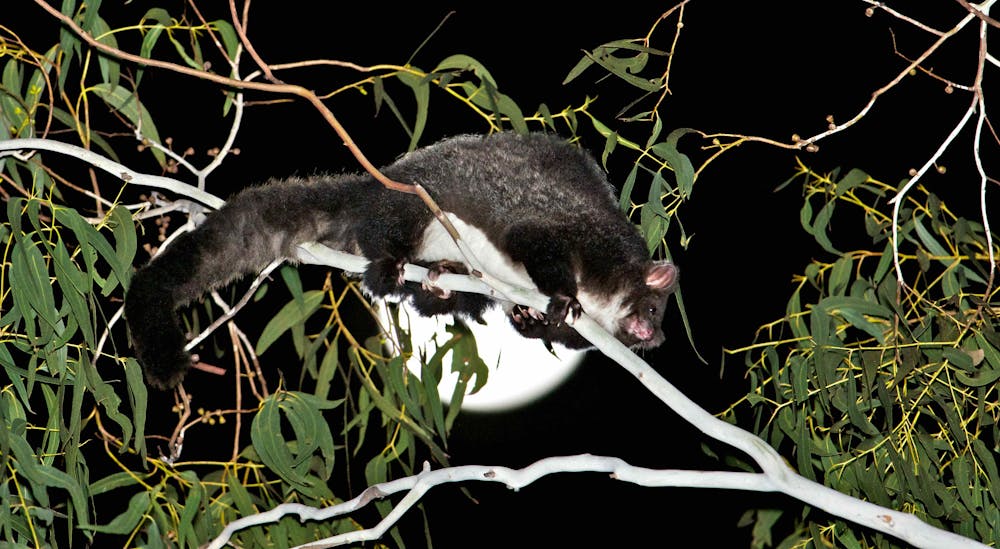 Greater gliders (Petauroides volans) are vulnerable to loss of tree hollows and habitat fragmentation, which will both be exacerbated under NSW’s proposals.
Dave Gallan
Greater gliders (Petauroides volans) are vulnerable to loss of tree hollows and habitat fragmentation, which will both be exacerbated under NSW’s proposals.
Dave Gallan
Koalas prefer large trees and mature forests, yet the intensive logging zone will cover almost half of identified high quality koala habitat. Legally, loggers will only have to keep 10 trees of 20cm diameter per hectare – far too few and too small for koalas.
The national recovery plan for the swift parrot proposes the retention of all trees over 60cm diameter – clearly incompatible with the proposed intensive harvesting zone – while the recovery plan for the regent honeyeater identifies all breeding and foraging habitat as critical to survival.
Recent research has predicted a 31% probability of swift parrot extinction in the next 20 years, and a 57% probability for the regent honeyeater. Both birds are priority species under the Australian government’s Threatened Species Strategy.
Public feedback on the proposed changes is invited until June 29. After that, the federal government must decide whether it deems the proposals to be consistent with national environment law in a new Regional Forest Agreement. Signing off on these changes will cast serious doubt on the federal government’s commitment to the national environmental interest.
Read more: Australia might water down illegal logging laws – here's why it's a bad idea
The author would like to acknowledge the contribution of Dailan Pugh, OAM and co-founder of the North East Forest Alliance, to this article.
Authors: Oisín Sweeney, Senior Ecologist at the National Parks Association of NSW, Research Fellow, University of Sydney


 Daily Bulletin


