

Australia's dangerous obsession with the Anglosphere
- Written by: Dennis Altman, Professorial Fellow in Human Security, La Trobe University
Over the past three weeks the ABC program Four Corners has presented special reports on American politics, which involved one of our best journalists, Sarah Ferguson, travelling to the US on special assignment. I watched these programs and I enjoyed them. But in part I enjoyed them because they covered ground that is already familiar.
If the same effort had gone into bringing us in-depth special reports from, say, Jakarta or Mumbai they would have been less familiar, but perhaps more interesting. Most important they would not be stories already covered by major English language media to which we have extraordinary access.
 Neal Stephenson’s 1995 novel The Diamond Age coined the term ‘Anglosphere’.
Goodreads
Neal Stephenson’s 1995 novel The Diamond Age coined the term ‘Anglosphere’.
Goodreads
As we struggle to make sense of a changing world order, in which the role of the US seems less defined and dependable, our fascination with things American continues to grow. It is one of the ironies of current Australian life that preoccupation with “the Anglosphere”, a favourite phrase of former prime minister Tony Abbott’s, is in practice shared by many who regard themselves as progressive.
What is the Anglosphere? The Merriam-Webster Dictionary defines it as “the countries of the world in which the English language and cultural values predominate”, clearly referring to Britain, the United States, Canada, Australia and New Zealand. A surprisingly recent term, it was coined by the science-fiction writer Neal Stephenson in his 1995 novel The Diamond Age, and then picked up by a number of conservative commentators.
The Churchillian notion of near-mythical bonds created by the English language and British heritage has always attracted Australian conservatives. Chris Berg from the Institute of Public Affairs wrote in 2012:
Our heritage is not something to be ashamed of. It is not a coincidence the oldest surviving democracies are in the Anglosphere. Or that a tradition of liberty, stretching back to the Magna Carta, has given English-speaking nations a greater protection of human rights and private property. We ought to be proud, not bashful. Sure, it’s more fashionable to talk of the ‘Asian century’. But the Anglosphere will shape Australia’s cultural and political views for a century. It’s a shame only conservatives feel comfortable talking about it.
Read more: Friday essay: the politics of the US family sitcom, and why Roseanne rocks
Both former foreign affairs minister Bob Carr and former prime minister Kevin Rudd attacked Abbott’s enthusiasm for the Anglosphere. Prime Minister Malcolm Turnbull is far less likely to invoke the term, and the election of Donald Trump means the idea has gone out of fashion on the right, who are struggling how to respond to a US president who is both their worst fears and their greatest hopes made flesh.
Yet despite 50 years of governments talking about Australia as part of Asia, now somewhat rebadged in the concept of the Indo-Pacific, our cultural guardians continue to behave as if nothing has changed. We may be wary of Trump’s America, and a little bemused by the reappearance of Little Britain, but we still look unreflectively to the US and Britain for intellectual guidance.
The Anglo obsession
Take the ABC’s flagship talk program, Q&A. In the week of the Sydney Writers Festival, Q&A ran a panel on which four of the five writers worked and lived in New York, and the bulk of the questions were about Trump. The following week they included a British Tory novelist, Stanley Johnson, whose real claim to fame seemed to be that he was Boris Johnston’s father.
This was in part a reflection of the extraordinary emphasis on American writers at the festival, and the scarcity of writers from other parts of the world. But it was particularly notable in a year when the festival’s theme was power, and only some of the invited writers, such as Chinese-Canadian Yiwei Xue, might have taken part in a discussion of the different ways power is played out in, say, China, India, Saudi Arabia.
 Alexis Okeowo, Richard McGregor, Masha Gessen, Katy Tur and Wesley Morris on Q&A.
Screenshot from Youtube
Alexis Okeowo, Richard McGregor, Masha Gessen, Katy Tur and Wesley Morris on Q&A.
Screenshot from Youtube
The obsession continues. The Monthly recently announced a weekly dispatch from the US, because “the number of Australians reporting from the United States has dwindled”. Unlike, of course, the Australian reporters based in Beijing, Delhi or Sao Paulo. And the Melbourne Writers Festival is already promoting the first of its guests, with prominent Americans such as Ronan Farrow, Emily Nussbaum, Ta-Nehisi Coates and David Neiwart, although it deserves credit for also highlighting a number of Australian and international writers.
A common language means that inevitably we will be more aware of writers in English and the cultural fashions of New York, London and Hollywood. We have access to the richest and most diverse range of cultural production in the world, and we grow up reading, viewing and interfacing with the Anglo metropolis.
Read more: We're laughing in an echo chamber: it's time to rethink satire
But Australia is not Britain or the United States, and there is a paradox that we are more and more obsessed with them even as their relative importance in the world, and certainly in our region of the world, declines.
The intelligentsia recite “Trump, Brexit” as a summary of everything wrong with global politics – occasionally they will refer to Putin – but somehow the setbacks for democracy in countries closer to us, such as Thailand and the Philippines, are rarely mentioned.
Thus the experienced and progressive journalist, David McKnight, begins his book, Populism Now!, with quotations from Bernie Sanders and Jeremy Corbyn. Predictably, they are quickly contrasted to Trump and Brexit.
What is striking about these tropes is that they show so little interest in countries where there may be more useful progressive models for Australia, even if, like Germany, they don’t speak English. A few years ago, Andrew Scott pointed to some interesting public policies in Scandinavia, but these are largely ignored. We pay relatively little attention to either Canada or New Zealand, although they share more similarities with us than either of the major Anglospheric powers.
Read more: We can learn a lot about public policy from the Nordic nations
Similar issues arise in the current debates about whether and how “Western civilisation” should be taught in our universities. A full course in “Western civilisation” would of course examine the complex interaction between Europe and the rest of the world, and the extent to which these interactions shaped our assumptions of liberal progress.
If students are led to ponder the extent to which the foundation of the United States depended upon slavery, or why Nazism could arise in one of the great centres of Western culture, they may be better prepared to develop an understanding of the world less dominated by the preoccupations of London and New York.
Culture shapes politics
Our political debates are inevitably coloured by the cultural dominance of Anglo-American literature, film and music. All small countries face questions of how to develop their own culture while open to the rest of the world. In Australia, language is both a barrier and an opportunity.
It is no surprise that our film and television viewing is heavily American: of the top ten grossing films in Australia only two, from the Harry Potter and Lord of the Rings series, are not unambiguously American. Only three Australian films, led by Crocodile Dundee, make the top 50.
 Avatar is the highest-grossing film of all time in Australia.
IMDB
Avatar is the highest-grossing film of all time in Australia.
IMDB
Television is more complex; the ABC in particular is fond of British material, although Australian-made programs regularly win high ratings, heavily skewed towards sports and reality shows. SBS offers an extraordinary range of non-English language programs, often from countries with small diasporas in Australia; how many Scandinavian-noir series can there be?
There is a great deal to relish about the dominance of the US in our cultural imagining, whether it be jazz, The Good Fight or the cartoons of The New Yorker. But the problems arise when we echo American rhetoric to respond to very different political realities in Australia.
This is clearest in foreign policy debates, where successive governments have accepted an American view of the world even while insisting that Australia must work within its own region. Because so much of our view of the world comes to us through American and, to a lesser extent, British eyes, we are uncritical of the dominant view of Washington and Whitehall, and its implicit assumptions that they represent forces of good.
There was a certain irony in Australian military operations in Afghanistan taking place under the aegis of NATO: the North Atlantic Treaty Organisation. But Australia has a bipartisan record of sending troops overseas to win the gratitude of our “great and powerful friends”.
With an American president who seems uninterested in traditional alliances and unmoved by appeals to protect democracy or human rights, one might expect the government would be more conscious of the reality that US and Australian interests will not always converge. On the contrary: they seem to be working harder to align us with the United States.
In the short run it might pay off: it seems to have for steel exports, although the trickle of asylum seekers on Manus who are accepted by the US suggests that Trump’s objections carried weight. But the inability of the major parties to view the United States dispassionately, as a great power with interests that will often diverge from ours, is increasingly hobbling our foreign policy.
This is where culture and foreign policy meet: alarm bells about Chinese influence ignore the far greater sway of American, to a lesser extent British, influence on our everyday lives. Yes, China is a repressive authoritarian state which is trying to increase its global influence. Yes, we should be cautious about their expansion. But too often we view this through an American prism, rather than making the effort to understand how the shifting power relations are being understood in countries in our region.
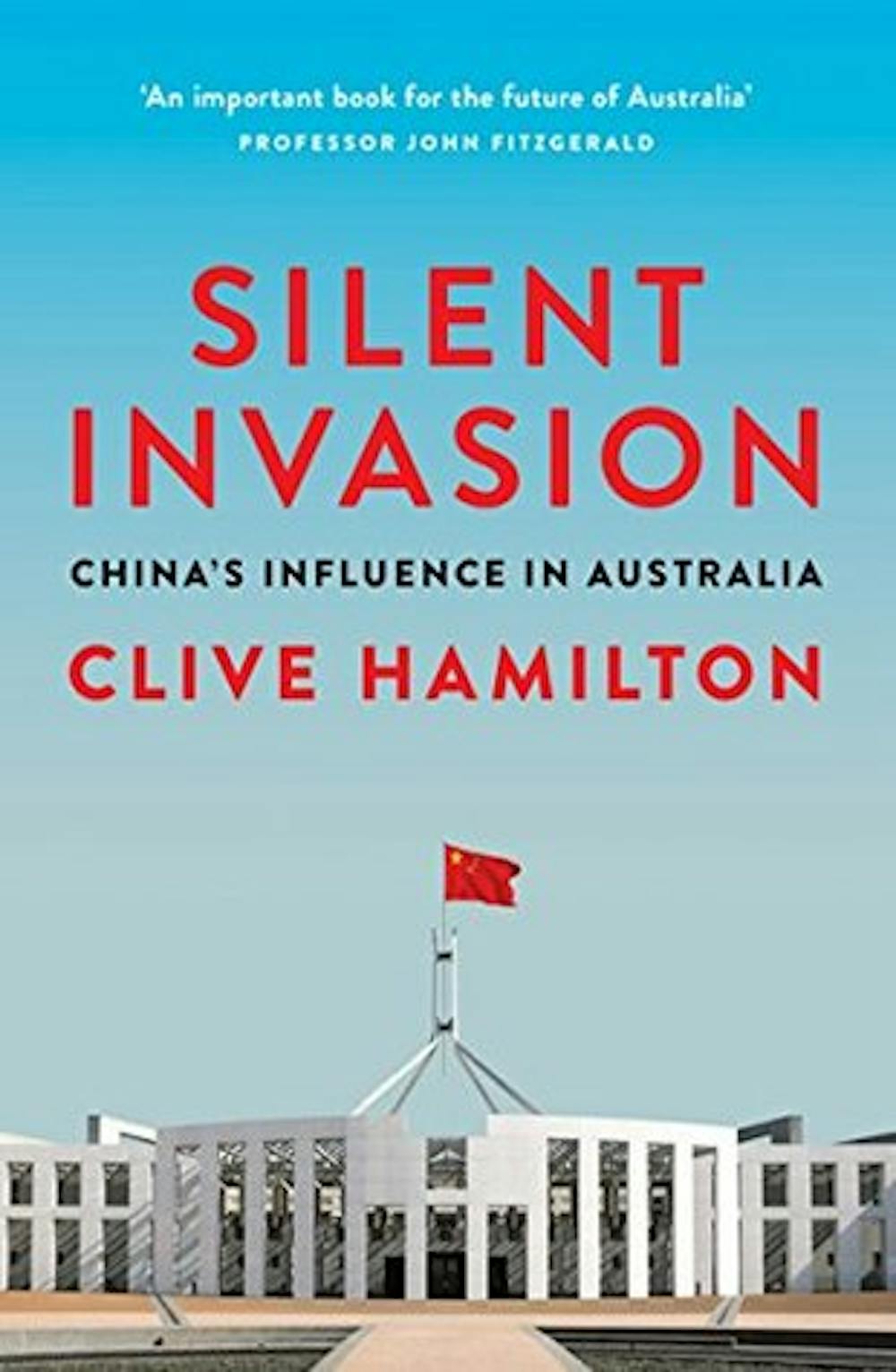 Clive Hamilton’s Silent Invasion raised alarm bells about the influence of the Chinese Communist Party in Australia.
Goodreads
Clive Hamilton’s Silent Invasion raised alarm bells about the influence of the Chinese Communist Party in Australia.
Goodreads
Of course our diplomats know this, but for its size Australia has an under-resourced foreign service. We are less well represented abroad than most other members of the G20. But politicians reflect larger cultural assumptions, and the major parties are united in seeing the world through an America-centric focus.
Except for occasional feeds from Al Jazeera on SBS television news, we rely heavily on American and British reports for our understanding of the outside world. The ABC does its best to cover overseas stories with reporters based around the world, but its network is small and under-resourced. Inevitably, overseas news will come to reflect the preoccupations of New York, London and Los Angeles.
Broadening our horizons
If we want a serious discussion about populist politics and the threat of “illiberal democracy”, there are far more examples to draw on than Trump and Brexit: Hungary, the Philippines, Venezuela and Turkey are all examples of countries where authoritarian governments are increasingly threatening human rights and freedom of expression.
There are writers in all these countries, whose insights would be somewhat different to those from New York and whose voices might shake some of the assumptions on which we base our picture of the larger world. I recognise that institutions like writers festivals and the Wheeler Centre depend heavily on publishers, and that publishing in New York and London dominates the Australian market.
But there are many people within Australia who can speak with authority about a larger world. SBS Radio broadcasts in 74 languages, yet despite the language of diversity, it is rare for speakers from most of the countries represented to be asked onto mainstream platforms.
Our political culture shares many elements with Britain and the United States, and there are good reasons to uphold the basic values and understandings of individual freedom that are part of a common legacy. But these values are not unique to “the Anglosphere”, and often they are more honoured in rhetoric than practice.
The danger of aligning ourselves with the Anglosphere is that it distorts the complexity of the greater world and aligns us with policies that are neither in our national interest nor that of a more just world. Just as republicans can enjoy the spectacle of a royal wedding without abandoning the idea of an Australian head of state, we need to remind ourselves that Trump is, literally, not our president.
Authors: Dennis Altman, Professorial Fellow in Human Security, La Trobe University
Read more http://theconversation.com/friday-essay-australias-dangerous-obsession-with-the-anglosphere-97443


 Daily Bulletin


