

Science makes art. But could art save the Australian manufacturing industry?
- Written by: Cori Stewart, Director, Business Development and Associate Professor Creative Industries, Queensland University of Technology
Making science for people is a series that explores how humanities, arts and social sciences expertise works to create value with science and technology.
Today’s article explores how technology is changing the face of art – a process that has broad implications for manufacturing and industry.
The “hand-made” nature of artistic works has been highly valued by humans over thousands of years. But digital capability is changing art – not just how art is designed; also how it is made.
Now we’re at the point where the art and design industry in Australia is demanding “mass customisation” of artworks. Some companies have started to address this using the latest generation of robotics technologies – but making the technology work in the right way needs input from creative expertise.
Done right, this mashup of creativity with technology could strengthen manufacturing capability in Australia.
Read more: Robot sculpture, coming to a gallery near you
Gap between design and production
There is a tremendous gap between the ease of digital design and manufacture of bespoke objects.
When computer assisted design rapidly evolved in the late 1990s, it meant that previously impossible to conceive ideas could find a form on the computer screen.
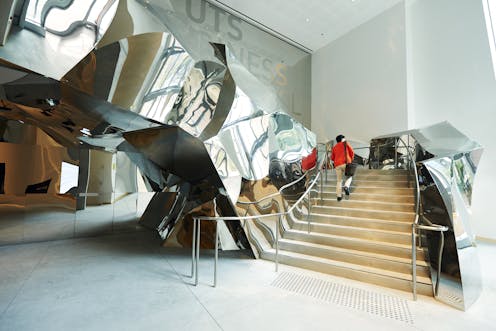
But the act of actually creating computer-designed works can be more difficult – and costly. Architect firm Gehry Partners used digital design software to design a “crumpled mirrored” staircase for the University of Technology Sydney. But when creative company UAP manufactured that staircase (shown in the photo above, and animation below), they had to employ a thousand year old technique of meticulously hand beating every surface until it matched the shape of the computer model.
The ‘crumpled mirrored staircase’.Reproducing or re-sizing works of art can also present manufacturing challenges. Originally, artisans would carefully measure the original object and then hand craft the copies, sometimes adjusting the scale. Now, modern scanning technology can create highly accurate computer models of such objects – but the same problem of how to manufacture the new objects presents itself.
The technology to take a digital design into a mechanical fabrication process exists, but it is normally too costly for one-off pieces and is reserved for mass production.
This is where robots come into play.
Read more: Creating research value needs more than just science – arts, humanities, social sciences can help
Robots that see
For a robot to make something where the starting form and desired final shape are not fixed – that’s complex.
Traditionally, robots have been used for manufacturing tasks where the shape of the object being worked on is very well understood. For example, robots can be used to remove the excess metal (a process known as “fettling”) after metal casting of car engine blocks. A robot can be programmed to do this as the desired final shape of the engine block is known: without visual information, the robot can move the engine block over a grinder to remove any excess metal.
Robotic fettling of a known object.But many of the objects created by artists do not have a detailed computer model for the robot to work from. Also, works of art are typically not uniform or predictable in shape. So any robot working on a piece of art will first need to see it from all angles, and accurately discover its shape.
The technology to see, or scan objects exists now. In fact you may have it on the smart phone you own right now.
3D cameras that scan objects in detail are already on the latest smart phones.But the next challenge is determining how to work on the object: could a robot transform an object it sees into one that is desired (a piece of art)? We’re not too far off this goal.
Read more: Robot sculpture, coming to a gallery near you
Robots might create jobs
Many people fear job losses associated with introducing robots into production facilities. However the number of jobs can actually increase when robots are used in mass customisation.
In our own discussions with UAP – the company that made the Gehry Partners staircase – they tell us that since adopting robotic technology, staff numbers have grown at a rate of six new appointments for every piece of new robotic machinery purchased. Existing staff are working in new technologies; for example, pattern-makers are using their expert sculpting skills in virtual reality and sending these digital works direct to robotic manufacture.
The products UAP are making with robots include artworks like Poll (by Emily Floyd), and architectural facades that will soon be installed on busy city streets in Australia.
This sort of mass customisation manufacturing may also be suited to products such as customised stents for arteries, or even production and preparation of better looking fruit and vegetables for niche food markets like airlines. The workforce may grow as a result.
Read more: An exploding creative economy shows innovation policy shouldn't focus only on STEM
Let’s invest in creative skills
Design is a fundamental creative manufacturing capability.
Currently in Australia, government manufacturing policies and investment programs have a firm focus on supporting science and technology companies such as aerospace companies printing jet engines, or biomedical science entities growing parts of the human anatomy. And while the strategic importance of robotics to our manufacturing future is well established and funded, this is not the case for design.
Creative capabilities in art and design firms should be more strategically included in this investment.
Read more: We can rebalance Australia's economy with creative industries
Recent data shows digital creative services are growing at nearly three times the rate of the overall workforce and attracting 30% above the average Australian wage.
Right now, Australian governments should be targeting the innovation capability of the creative industries, and expanding the value art and design already add to Australia’s manufacturing industry.
Authors: Cori Stewart, Director, Business Development and Associate Professor Creative Industries, Queensland University of Technology


 Daily Bulletin


