

Why Trump’s liberal demolition job and authoritarian outreach is about China
- Written by: Reuben Steff, Lecturer in International Relations and Security Studies, University of Waikato
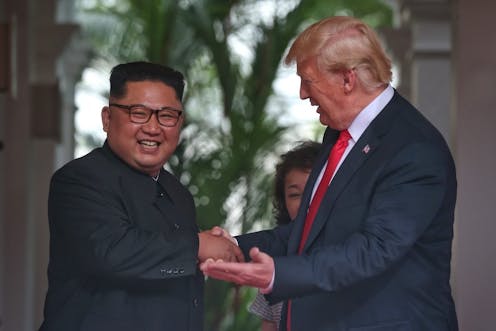
It is obvious that US President Donald Trump is comfortable engaging with dictators and even US adversaries.
In contrast, he displays indifference – if not hostility – towards the liberal rules-based order that has served US interests since World War II. Issues like human rights, trade, climate change, and even America’s democratic allies have all been criticised or undermined by the president during his time in office.
Read more: As the US leaves the UN Human Rights Council, it may leave more damage in its wake
The general explanation for the president’s behaviour is that it stems from his personality. He seems to see something he respects in “strongmen”, whether it is Duterte, Putin, Xi, Erdogan or Kim.
But is the explanation that simple or is there something else at work? Is there a strategy that, President Trump and his allies believe, serves America’s geopolitical interests? If there is, it’s about China.
America’s ideological problem
Consider that there are a number of states throughout the Asia-Pacific and across Eurasia that may soon be “up for grabs” as US-China tensions escalate and states hedge their position. Clearly, Washington wants as many states as possible to maintain their strategic distance from Beijing and lean towards the US. This is a task that will become more difficult as China’s power continues to rise and America finds it harder to reassure its allies that it can maintain its dominance in the region.
A number of these states have authoritarian governance systems, forms of illiberal democracy or may be trending in this direction. They do not share America’s governing liberal ideology. This ideological difference could complicate America’s efforts to keep these states out of China’s orbit, which claims to have no interest in the domestic affairs of other states.
Read more: China and the US vie for friendship with the Philippines, while Duterte hedges
US foreign policy since the end of the Cold War cannot have reassured authoritarian and illiberal states that Washington’s ideological values play only a minor role in it. US foreign policy, at times, has looked like that of a revolutionary power intent on transforming the international system in its own image. After all, the Bush administration appeared to believe that the only way for the world to be safe was for liberalism and democracy to triumph everywhere, which could usher in a global democratic peace. This is an assumption with some empirical support.
Furthermore, the immense power of the US may have made it difficult for non-liberal states to feel assured that even if they complied with US demands to give up their weapons of mass destruction (which they perceive as a critical deterrent to US intervention), they might still face further requests and threats. As Libya’s dictator Muammar Gaddafi found out in 2011, even a regime change can be a consequence.
Addressing a disadvantage
So how does all this tie back to America’s competition with China for the allegiance of states across the world? What could encourage authoritarian and illiberal states, in particular, to lean towards China in the years to come and accelerate the emergence of a bipolar US-China system?
Firstly, America’s power provides it with immense discretion to act and the capacity to undermine and enact regime change against illiberal states. Since 2003, we’ve seen this in Iraq, Afghanistan and Libya. Secondly, it is US ideology, and their fears that US power will be used for ideological ends - that is, to militarily intervene against illiberal states to try replace their regimes with liberal ones. The first point can generate concern all on its own but it’s further magnified by the second point.
To illiberal states, US liberalism has compelled Washington in the past to go abroad “in search of monsters to destroy” – and they are the ideological “monsters”.
Therefore, a case can be made that if the US credibly communicates that it is not motivated by liberal impulses, it will reduce these ideational concerns. It will increase (by how much is debateable) incentives for states to lean towards the US. Thus, American liberalism, rather than being seen as a source of strength, could leave the US disadvantaged as China’s power rises.
Trump’s challenge to the liberal order
Trump’s recent behaviour towards the G7 is consistent with this. It further communicates the point to authoritarian and illiberal states that this administration does not care about a state’s ideological stripes. This approach even gives President Trump more room to manoeuvre to attempt his own “Nixon to China” initiatives towards Moscow (if he can overcome domestic opposition) and Pyongyang.
Rapprochement with North Korea could reunify the Korean peninsula in a way that benefits the US at China’s expense (as well as eliminating a nuclear threat). With respect to Russia, it could stop Moscow’s drift towards China, and eliminate the prospects of Eurasia coming under the effective domination of a China-Russia led de facto alliance. Removing liberal ideology from the picture removes one roadblock towards these geopolitical initiatives.
The Trump administration appears to believe there is little material costs to adopting this approach. America’s traditional liberal allies lack the will to pay for their own defence and thus cannot constitute a true challenge to US global power. They can issue rhetoric and voice their opposition to US foreign policy but President Trump, rightly or wrongly, does not view these as meaningful forms of influence.
Ultimately, to the US president, liberalism is an ideology with no clear foreign policy benefit. To him it is one that could, at worst, act to drive states towards China, accelerating the emergence of a bipolar world order. This is one consistent element of the president’s strategy. The faster we reconcile ourselves to this, the quicker we will be able to grapple with the implications his foreign policy has for the existent liberal international order.
Authors: Reuben Steff, Lecturer in International Relations and Security Studies, University of Waikato


 Daily Bulletin


