

We need a bank of DNA from dirt and water to protect Australia's environment
- Written by: Simon Jarman, Associate professor, Curtin University
Measuring biodiversity used to mean laboriously collecting samples and manually identifying the plants, animals and fungi. This might involve careful inspection under a microscope to spot identifying features. This takes a lot of time and generally requires an expert who has specific knowledge of each group of organisms.
In the last decade, however, DNA sequencing technology has revolutionised this process. We can now identify the species present in an area faster, cheaper and more accurately by measuring “environmental DNA” (eDNA), collected from soil, water or even air.
Read more: Monster hunt: using environmental DNA to survey life in Loch Ness
But the explosion of eDNA brings with it some problems. The technology is developing so fast – and the research is so fragmented – that it’s difficult for scientists to compare past work with their own. In our recent correspondence in Nature Ecology & Evolution, we argue that some simple forward-thinking solve these issues.
How “eDNA” works
The development of “environmental DNA” metabarcoding has transformed scientists’ ability to measure the diversity of multicellular life.
Substrates such as soil, water and even air contain DNA fragments left behind by organisms. Reading the sequences of a carefully-chosen subset of these DNA fragments enables taxonomic identification of the organisms. Reference databases for identifying the species belonging to the “DNA barcodes” of each species are now well established.
This analysis has led to many innovative ways of analysing biodiversity. For example, mammal diversity can be determined from DNA taken from blowflies that have touched the mammals. Diversity of indoor arthropods can be determined from eDNA collected by robotic vacuum cleaners.
Sampling a bucket of seawater from near a coral reef allows the fish species present in the area to be identified from eDNA without even seeing them. More than 200 papers based on eDNA metabarcoding have been published since 2012. The field is now so well established that its first comprehensive textbook was published a couple of months ago.
A major enabler of eDNA research has been rapid advancements in high throughput DNA sequencing. However rapidly-changing high-technology means that research methods quickly become redundant. When new DNA sequencing systems are adopted, past experiments cannot be replicated because the equipment is no longer manufactured.
Another problem is that eDNA metabarcoding does not have universal standards that would allow datasets generated by different technologies to be compared. This lack of comparability limits eDNA metabarcoding research to end-point analysis using one specific methodology.
We need biobanking
Our solution is “eDNA biobanking”. “Biobanking” in medicine is the standardised sampling, curation and long-term storage of healthy and diseased human tissues. Centralising sample storage allows comparisons that are impossible with single studies. Biobanking eDNA means that old and new samples can be combined and analysed with the contemporary technologies of the future.
Read more: We reconstructed the genome of the 'first animal'
Ecosystem monitoring based on metabarcoding of biobanked eDNA will provide records of contemporary biodiversity for future research. This will be particularly useful where industries such as mining, forestry and fisheries move into new areas: biobanking can provide a biodiversity baseline, and allow the impact of new development to be assesed.
We anticipate that in the near future, regulatory bodies such as Environment Protection Agencies will require samples to be biobanked. This will allow the true effects of environmentally-damaging incidents such as oil spills to be measured against the undisturbed baseline.
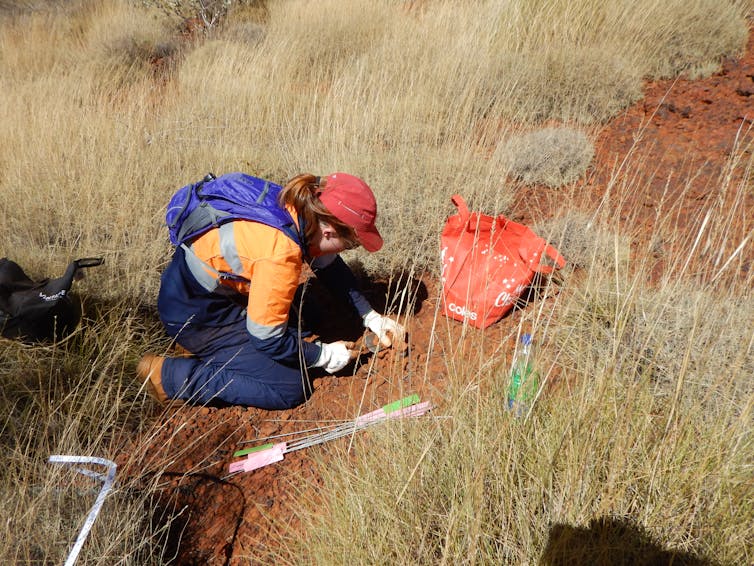 Sampling soil for eDNA analysis.
This demonstrates the value of eDNA biobanking to long-term ecosystem monitoring. Many environmental regulatory bodies depend on annual updates of ecosystem health. Yearly updates are only possible to a limited extent with eDNA metabarcoding because at some point the underlying technology becomes obsolete.
For example, the diet of Adelie penguins is used to measure biodiersity in the Southern Ocean. A 2013 DNA-based study of the diet of Adelie penguins produced data showing geographic and inter-annual changes in dietary biodiversity. However, these results cannot be compared to any future studies because this DNA sequencing technology has been discontinued.
Read more: Ancient DNA changes everything we know about the evolution of elephants
The lack of comparability among environmental DNA studies is a significant problem. It will not be solved until we adopt a systems of reference standards that allow comparisons among studies. For the foreseeable future, the best solution is environmental DNA biobanking. This will ensure that eDNA technologies will be “future-proofed”, allowing best-practice stewardship of our environment.
Authors: Simon Jarman, Associate professor, Curtin University


 Daily Bulletin


