

How to break up with plastics (using behavioural science)
- Written by: Kim Borg, Doctoral Candidate & Research Officer at BehaviourWorks Australia, Monash Sustainable Development Institute, Monash University
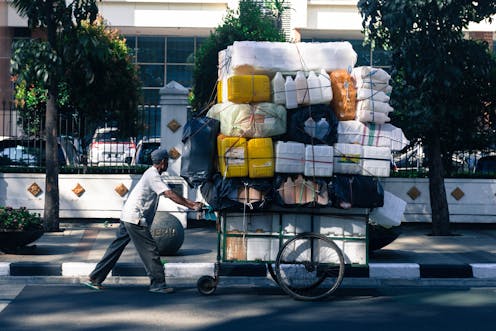
Australia is responsible for over 13 thousand tonnes of plastic litter per year. At the end of June 2018, the Australian government released an inquiry report on the waste and recycling industry in Australia. One of the recommendations was that we should phase out petroleum-based single-use plastics by 2023.
This means a real social shift, because the convenient plastic products that we use once and throw away are ubiquitous in Australia.
Read more: In banning plastic bags we need to make sure we're not creating new problems
Bans, as Coles and Woolworths recently adopted for plastic bags, are one option – but are not suitable for every situation. They can also feel like an imposition, which can inspire backlash if the community is not on board. Behavioural science can offer a path to curb our plastic use.
Technology alone is not the solution
First off, plastic is not evil: it’s flexible, durable, waterproof and cheap. The issue is the way we dispose of it. Because plastic is so versatile it has been adopted across a range of single-use “throw away” consumer products.
Many people are working on technological solutions to our plastic problems. These range from better recycling techniques and biodegradable “plastics” made from algae or starch, to (my favourite) using the wax moth caterpillar or “mutant bacteria” to consume plastic waste.
But these options are slow and expensive. They can also have other environmental impacts such as greenhouse gas emissions and resource consumption.
There are lots of reusable alternatives to many single-use products. The challenge is getting people to use them.
Behavioural science to the rescue
My research involves applying insights from various disciplines (like economics, psychology, sociology or communication) to understand how governments and businesses can encourage people to change their behaviour for environmental, social and economic benefits.
Read more: Plastic-free campaigns don't have to shock or shame. Shoppers are already on board
Research has found that simply providing information through awareness campaigns is unlikely to change behaviour. What media attention and campaigning can do is increase the public visibility of an issue. This can indirectly influence our behaviour by making us more open to other interventions and by signalling social norms – the unwritten rules of acceptable behaviour.
Successful behaviour change campaigns must empower individuals. We should be left feeling capable of changing, that changing our behaviour will impact the problem, and that we are not alone. One positive example is modelling sustainable behaviours, like using KeepCups or beeswax wraps, in popular TV shows.
Once we’re aware of an issue, we may need a little help to move from intention to action. One strategy for providing this push is a small financial disincentive, like Ireland’s famous “plastax” on single-use plastic bags. Many cafés also offer discount coffees to reward bringing reusable cups.
We can also encourage retailers to “change the default”. Japan increased the refusal rate of plastic bags to 40% after six months of cashiers simply asking people if they wanted a bag.
This approach could be used for other products too. For example, imagine your drink not coming with a straw unless you specifically ask for it. This would cut down on waste, while also avoiding the unintended consequences of banning a product that is important for people with a disability.
Given that there is already strong support for reducing our reliance on single-use plastics, another simple solution would be to provide prompts in key locations, like carparks and workplaces, to remind people to bring their reusables.
While we may have the best of intentions to carry reusables, our old habits can often get in the way. Defaults and prompts can help to bring our good intentions in line with our actual behaviours.
Consumer demand also encourages manufacturers to make more convenient reusable options, like collapsible coffee cups and metal keychain straws. Businesses can also make reusables more accessible by introducing product-sharing schemes like the Freiburg Cup in Germany or Boomerang Bags in Australia.
No ‘one size fits all’ solution
Different situations need different solutions. Product sharing or reusable coffee cups might work in an office or café where the same customers return regularly, but would be impractical at a gallery or museum where customers vary each day.
For societal-level change multiple approaches are more effective than any one initiative alone. For example, if we wanted to phase out plastic cutlery nationally, we could start with an awareness campaign that encourages people to carry reusable alternatives. Then, once the community is on board, implement a small fee with some reminder prompts, and finally move to a ban once the majority have already changed their behaviour.
Read more: Ten 'stealth microplastics' to avoid if you want to save the oceans
The key to successfully phasing out our reliance on single-use plastic products is to change the norm. The more we talk about the problem and the solutions, the more businesses will seek out and offer alternatives, and the more likely we are to mobilise together.
Authors: Kim Borg, Doctoral Candidate & Research Officer at BehaviourWorks Australia, Monash Sustainable Development Institute, Monash University
Read more http://theconversation.com/how-to-break-up-with-plastics-using-behavioural-science-99741
&media=https://www.dailybulletin.com.au/https://images.theconversation.com/files/227337/original/file-20180712-27024-g44m2p.jpg?ixlib=rb-1.1.0&q=45&auto=format&w=496&fit=clip&description=How%20to%20break%20up%20with%20plastics%20(using%20behavioural%20science) "Pin It")

 Daily Bulletin


