

how Tasmania's Aboriginal people reclaimed a language, palawa kani
- Written by: Kristyn Harman, Senior Lecturer in History; Graduate Research Coordinator, School of Humanities; Course Coordinator, Diploma of History, University of Tasmania
Truganini’s death in Hobart in May 1876 attracted worldwide attention. She was widely, but wrongly, believed to have been the last Aboriginal person to have survived the Tasmanian genocide. Her demise symbolised the devastating impacts of British imperialism on Indigenous peoples.
Yet Tasmanian Aboriginal people continue to live on the Bass Strait Islands, in rural and urban Tasmania and elsewhere. Their culture, although severely disrupted by the British invasion, persists. Part of this survival is the resurrection of a language, palawa kani, that is used by some Tasmanian Aboriginal people. Recently there have been calls to use the Aboriginal name nipaluna for Hobart, and other places are already using dual names.
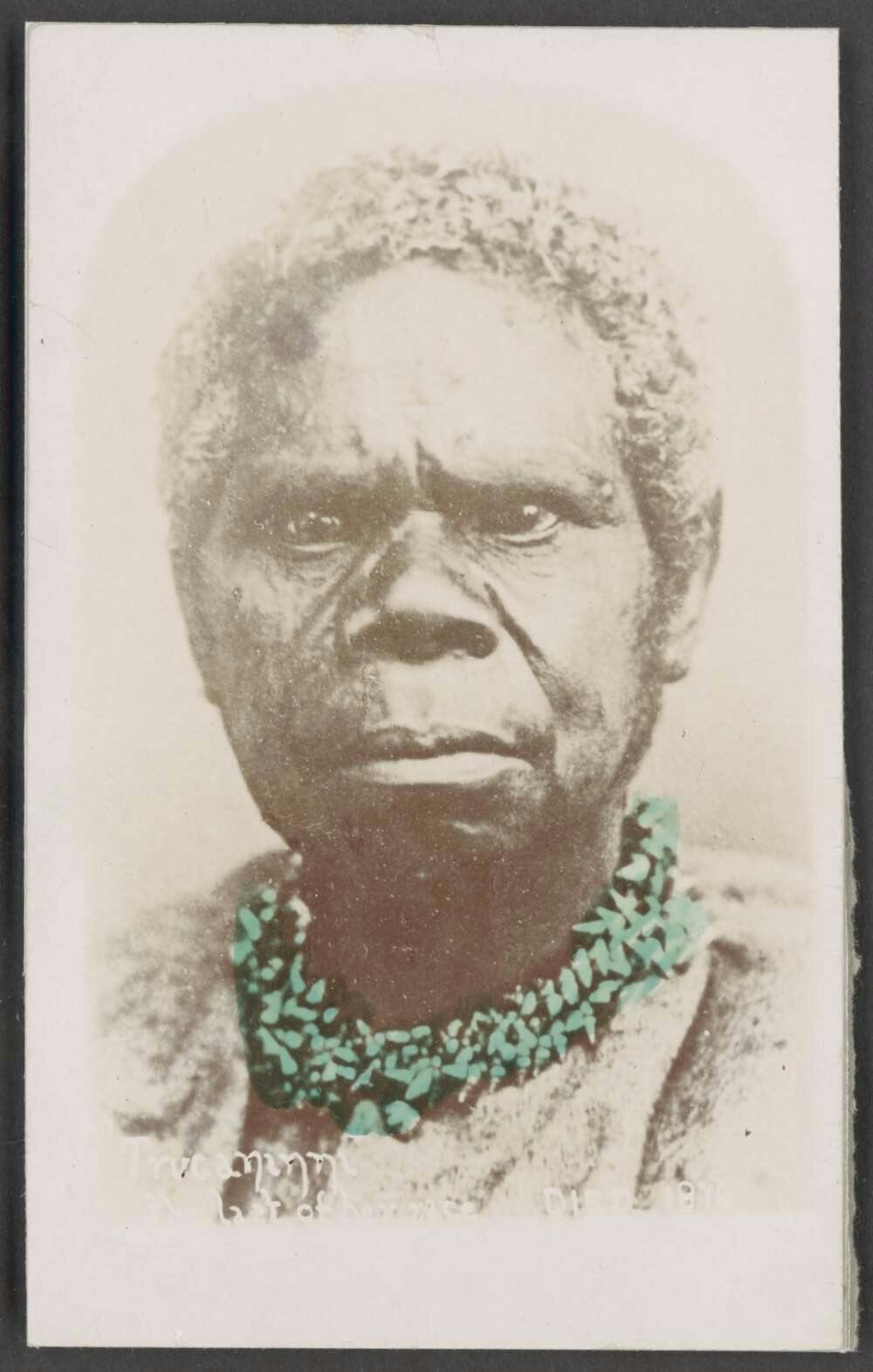 Truganini in 1866.
National Library of Australia
Truganini in 1866.
National Library of Australia
Across Australia, an estimated 250 Indigenous Australian languages and hundreds more dialects were spoken before the British arrived. The cultural disruption caused by invasion has resulted in more than half of these languages vanishing.
In parts of the country, Aboriginal people and linguists have been working to preserve and restore some of the country’s original languages. In this wider context of language preservation and renewal, a reconstructed Tasmanian Aboriginal language has recently emerged. Palawa kani (“Tasmanian Aboriginal people speak”), is based on surviving spoken and written remnants of the island’s original languages. The written form of palawa kani has only lower case letters following a decision by the Tasmanian Aboriginal Centre to discontinue capitals.
Read more: Explainer: the evidence for the Tasmanian genocide
Word collectors
In 1981, linguists Terry Crowley and Robert Dixon estimated that between eight and 12 different languages, some mutually unintelligible, were spoken by Tasmanian Aboriginal people prior to invasion. They used a variety of colonial records to arrive at this estimate.
Maritime explorers, missionaries and colonial officials wrote Tasmanian Aboriginal words and phrases in their journals. Some, like botanist Allan Cunningham, jotted down lists of words. Others, such as Quaker missionaries James Backhouse and George Washington Walker, also wrote down the lyrics to Tasmanian Aboriginal songs.
Between 1829 and 1834, the Conciliator of Aborigines, George Augustus Robinson, travelled the island with an entourage of Aboriginal people, including Truganini, and white servants. They aimed to capture Tasmanian Aboriginal people who had survived the Vandemonian War, which had been fought between Aboriginal people and the British colonists. Robinson relied on interpreters, but he and his white companions learned some Tasmanian Aboriginal languages. Robinson wrote down over 4,500 Tasmanian Aboriginal words. His white servant, James Gravenor, later spoke some words in Truganini’s Aboriginal language at her burial.
Many Tasmanian Aboriginal words continued to be used by those living on the Bass Strait islands. Tasmanian Aboriginal singer Ronnie Summers grew up on Cape Barren Island. He has written, for example, about how “yolla” is an Aboriginal word for short-tailed shearwaters.
South of Hobart, Fanny Cochrane Smith continued to use some of her Tasmanian Aboriginal language. Famously, in 1899 and 1903, she was recorded singing several songs and speaking in this language.
Recording of Fanny Cochrane Smith singing in her Aboriginal language in 1899.Since the 1990s, Tasmanian Aboriginal people including Theresa Sainty, Jenny Longey and June Sculthorpe have worked to restore language to their community. palawa kani has been built from words and songs passed down Aboriginal families as well as phrases and words recorded in colonial documents. It is a composite language that has been embraced by some, but not all, Tasmanian Aboriginal people.
Reclaiming culture
Today, Tasmanian Aboriginal people are using palawa kani in different contexts. These include educational settings, during ceremonies and at official functions. Digital materials, posters and flash cards have been produced. People are encouraged to use palawa kani in their homes. Language learning is also supported by palawa kani being used in the award-winning animated television series Little J and Big Cuz.
Gradually people living in and beyond the wider Tasmanian community are becoming used to hearing or seeing palawa kani. In 2014, Tasmanian Aboriginal musician Dewayne Everettsmith’s debut album Surrender included melaythina, the first song released in palawa kani. More recently, in April 2018, the oratorio A Tasmanian Requiem premiered in Hobart. It included palawa kani, English and Latin. On approaching the ningina tunipri Tasmanian Aboriginal gallery at the Tasmanian Museum and Art Gallery in Hobart, visitors hear palawa kani.
Read more: A Tasmanian Requiem is a musical reckoning, and a pathway to reconciliation
Around Tasmania, some national parks and other significant landmarks now have dual names. Examples include Mt Wellington, near Hobart, which is also known by its Aboriginal name kunanyi and Asbestos Range National Park in the north of the state. The latter was renamed Narawntapu National Park in 2000, prior to the Tasmanian Aboriginal Centre discontinuing the use of upper case letters in palawa kani.
The word nipaluna, for Hobart, came from a word recorded by Robinson on 16 January 1830. The Conciliator wrote in his journal that his Aboriginal informant Woorrady (Wooreddy) told him Hobart was called nib.ber.loon.ne. On 11 July, Robinson recorded the name for Hobart as niberlooner. Different spellings were common in the 19th century for Aboriginal and English words. Those working on palawa kani have had to take these variations into account.
Present day use of palawa kani goes beyond dual place naming. It is also being used as a language of protest. Earlier this year, in February 2018, a television advertisement spoken in palawa kani went to air to protest against the Tasmanian Government’s plans to reopen some four-wheel drive tracks in the remote Arthur Pieman Conservation Area in Tasmania’s north west.
Despite not all Tasmanian Aboriginal people embracing palawa kani, the reemergence of an Aboriginal language in Tasmania is providing the island’s first peoples with a culturally distinctive, unique voice.
Authors: Kristyn Harman, Senior Lecturer in History; Graduate Research Coordinator, School of Humanities; Course Coordinator, Diploma of History, University of Tasmania


 Daily Bulletin


