

How to reduce slavery in seafood supply chains
- Written by: Trevor J Ward, Adjunct professor, University of Technology Sydney
Seafood is one of the most-traded foods in the world. The sector employs at least 260 million workers globally, and some 3 billion people rely on seafood as a primary source of protein.
The US State Department and other credible sources have consistently identified the seafood sector as a significant contributor to the global incidence of modern slavery. Widespread forced labour has been reported in the seafood industry in 47 countries.
Part of the problem is that global seafood supply chains are long and complex. That’s why my colleagues and I have developed a five-stage framework, published today in Science Advances, that identifies the risk for specific products, all the way from ocean or farm to the supermarket shelf.
What slavery might look like
Companies can’t always be sure they’re buying and selling products that have been produced without forced labour. A single catch of fish may be caught in one country, processed in another and repackaged in a third before being shipped somewhere else for sale.
Some 65-70% of exported seafood is produced in developing countries where labour costs are relatively low. Work in distant water fleets, aquaculture areas and processing hubs can be highly appealing to the rural poor, who may have limited local job opportunities.
Getting to these jobs, however, often requires migration and using labour brokers.
In fishing, labour brokers supply a mix of professional crew from seafaring nations as well as less-skilled and lower-cost crew. Vessels are physically isolated, with working hours determined by ocean conditions and the round-the-clock duties needed to keep a ship operating safely. Payment for work is often a share of the catch value, based on seniority.
The less-skilled crew, who may not speak their colleagues’ language or have any legal standing in the vessel’s flag state, are vulnerable to involuntary and unpaid work. This is particularly the case where the direct employer is a distant labour agent, rather than the vessel’s owner.
Nonetheless, vulnerable conditions alone do not dictate forced labour. Fishing wages provide dignified livelihoods and an escape from poverty for millions of fishers and crew operating in many remote fisheries.
Five steps to reducing slavery
How can we unravel these complex strands to identify slavery? Given the complex international nature of the trade, private companies have an important role to play alongside national regulations.
This is why we developed the five-point Labour Safe Screen. Four of these components are designed to identify the risk of slavery:
- product screening for country-level origins and standing on forced labour in seafood
- a template for mapping the supply chain
- an algorithm for estimating risk in fishing operations
- surveys for collecting proof of protective conditions in the workplace.
The fifth component is a set of principles for minimum protective conditions in the workplace.
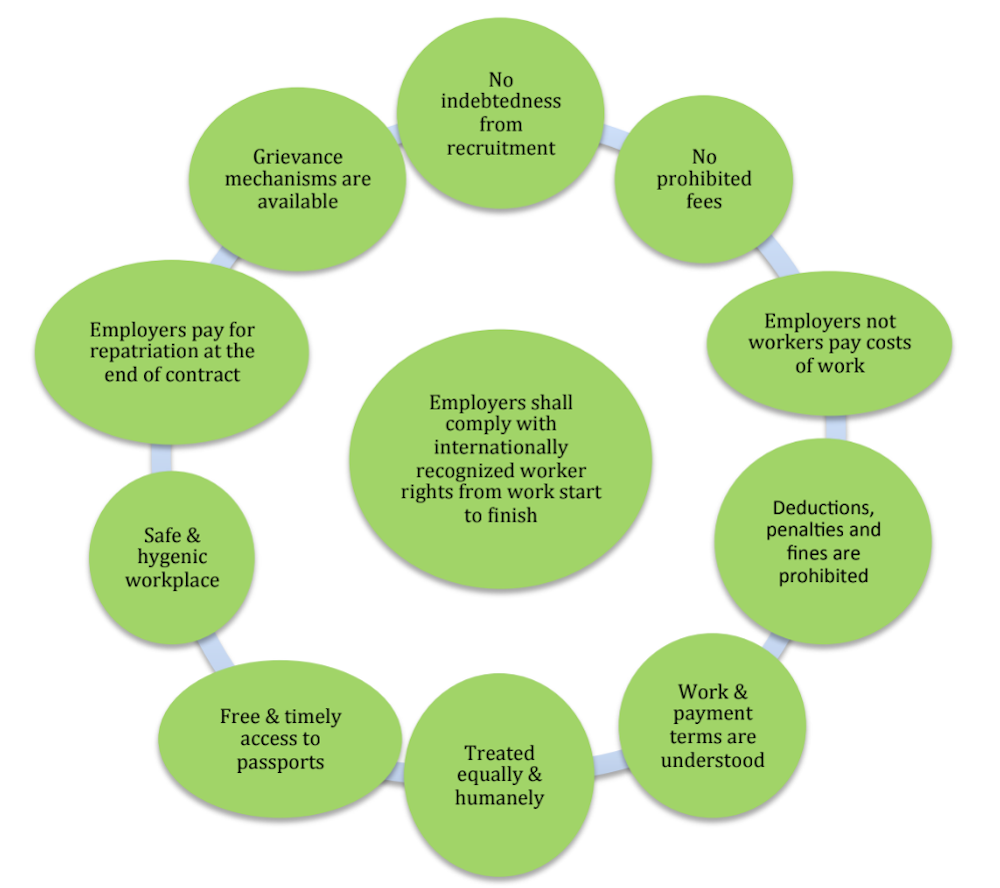 Field-tested principles for minimum conditions to protect workers from forced labour.
Author provided
Field-tested principles for minimum conditions to protect workers from forced labour.
Author provided
Eighteen companies participated in our study and most carry hundreds of seafood products. We developed a tiered approach for screening a large number of their products, with quantitative scoring for persistent risks moving upstream into the supply chain and the workplace.
The majority of human rights data on forced labour in seafood production is available at the country level. While this provides a starting point for risk assessment, extrapolation to a particular product can be misleading.
We found that by triangulating industry and human rights data (from proprietary and public data sources), our framework allowed traders to identify the “pinch” points in their supply lines. They could then pinpoint labour risks where corrective actions could be most efficiently focused.
This approach captures data for each workplace as a product moves through the supply chain, transcending national domains and trans-shipping issues.
The results give traders the tools to identify areas where working conditions are either acceptable, unknown or inadequate.
Although risk-based due diligence does not guarantee that a product is free from forced labour, it does allow screening of large numbers of products. It can also focus attention on the most urgent points for remedial steps.
Ultimately, regulatory oversight is the main ingredient for low risk and makes it easier to focus on minimum protective work conditions. So in situations where the regulatory systems are strict and enforced (as in Australia), then minimum standards are likely to prevail and forced labour is likely to be a low risk.
Ideally, robust risk assessment should be part of a multi-pronged strategy for sustainable and socially responsible seafood. As part of this, we should always include ways to hear directly from workers and their organisations at the front line.
The work described here was jointly undertaken by the authors of the Science Advances paper, including prizewinning front-line workers active in the rescue of seafood workers.
Katrina Nakamura (lead author for the Science Advances paper) assisted with the development of this article.
Authors: Trevor J Ward, Adjunct professor, University of Technology Sydney
Read more http://theconversation.com/how-to-reduce-slavery-in-seafood-supply-chains-100512


 Daily Bulletin


