

New Zealand's most sacred tree is under threat from disease, but response is slow
- Written by: Matthew Hall, Associate Director, Research Services, Victoria University of Wellington
Tāne Mahuta is Aotearoa New Zealand’s largest living being – but the 45m tall, 2,500-year-old kauri tree is under severe threat from a devastating disease.
Nearly a decade after the discovery of kauri dieback disease, it is continuing to spread largely unchecked through the northern part of the North Island. Thousands of kauri trees have likely been infected and are now dead or dying. The Waipoua forest, home of Tāne Mahuta and many other majestic kauri, is reported to be one of the worst affected areas.
For Māori, who trace their whakapapa (lineage) to the origins of the earth, Tāne Mahuta is kin. The threat of losing this tree should electrify the fight against kauri dieback.
Read more: People are 'blind' to plants, and that's bad news for conservation
Call to close the forest
Named after Tāne, the son of Ranginui the sky father and Papatūanuku the earth mother, Tāne Mahuta is a highly revered taonga, or treasure. In Māori mythology, it was Tāne who brought trees and birds to earth.
The loss of this ancestor, with a presence that has been known to move some to tears, is incalculable.
Kauri dieback has been recorded metres from this ancient tree, despite the best efforts of a prevention programme that has been in place since 2009. Much of the focus of the programme has been on encouraging behaviour change by forest users (following paths, washing boots) and upgrading tracks (from mud to boardwalks). A new national pest management plan proposes more of the same.
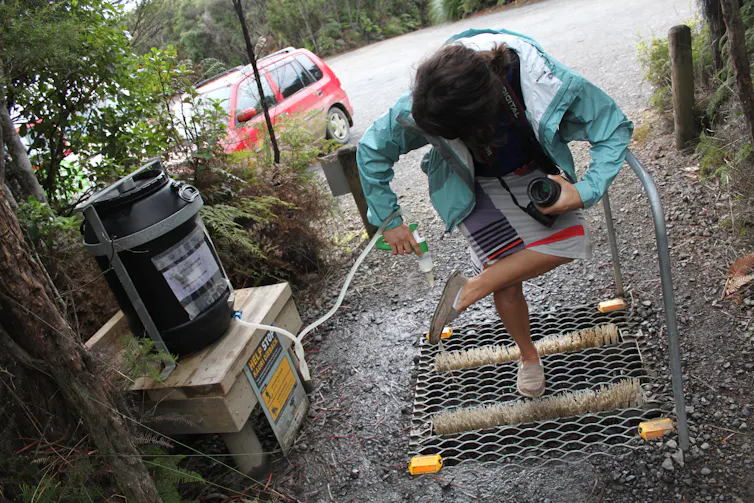 As part of a prevention programme to limit the spread of kauri dieback, visitors to kauri forests are encouraged to spray their shoes with a disinfectant.
Eli Duke/WIkimedia Commons, CC BY-SA
As part of a prevention programme to limit the spread of kauri dieback, visitors to kauri forests are encouraged to spray their shoes with a disinfectant.
Eli Duke/WIkimedia Commons, CC BY-SA
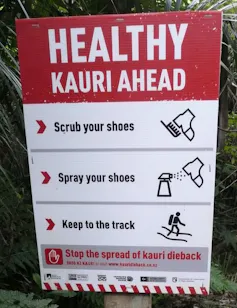 Signs remind visitors in the Waitākere Ranges about precautions against the spread of kauri dieback disease.
from Wikimedia Commons, CC BY-SA
Signs remind visitors in the Waitākere Ranges about precautions against the spread of kauri dieback disease.
from Wikimedia Commons, CC BY-SA
In my view, the most notable, and frustrating, aspect of this programme is the significant resistance to close kauri forest tracks to people, who, along with wild pigs, are one of the major vectors of the disease.
Te Kawerau ā Maki, a Māori tribal group with mana whenua (customary authority) over the land of the Waitākere forest in the Auckland region, have maintained a consistent stance that the only way to protect kauri forests is to close them to humans. In November 2017, they placed a rāhui (temporary closure) over the entire forest area, severely frustrated by the lack of effective action to control kauri dieback by Auckland Council.
A rāhui is not legally enforceable, and it was largely ignored by forest users who continued to enter and spread the disease. Eventually, six months later, Auckland Council voted to close the majority of tracks, but Te Kawerau ā Maki have viewed this as too little, and possibly too late.
Keeping the forest open
In a similar laggardly vein, the Department of Conservation has only just put forward a proposal to close or partially close 24 kauri forest tracks. This proposal is currently going through a consultation process, which seems inappropriate when dealing with an immediate biosecurity crisis.
The proposal does not include the Waipoua forest and the track that leads to Tāne Mahuta, or to other significant kauri such as Te Matua Ngahere. The department says:
the decision to propose track closures is not taken lightly, but has been considered in situations where there is high kauri dieback risk, low visitor use, high upgrade and ongoing maintenance costs, and a similar experience provided in the vicinity.
Tāne mahuta draws hundreds of thousands of tourists to the Waipoua forest area. This, combined with the fact that forest tracks are generally in good condition has led to the decision to keep the forest open. For now, the tangata whenua (local Māori with authority over land) support it.
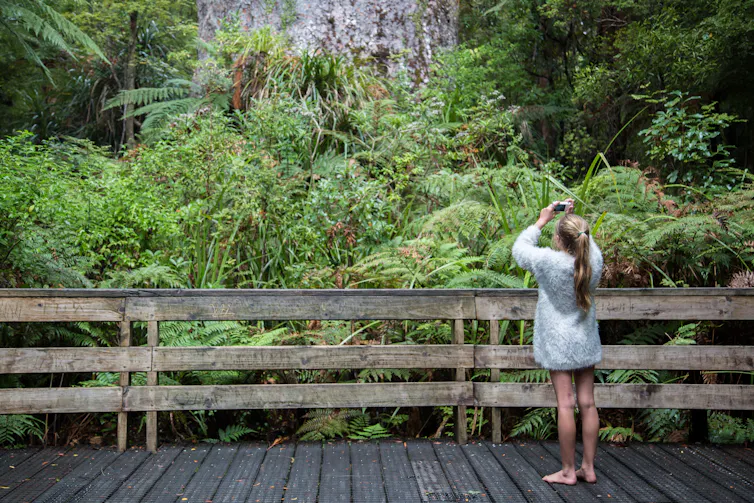 Tāne Mahuta draws hundreds of thousands of visitors to the kauri forests in the north of New Zealand.
from www.shutterstock.com, CC BY-SA
Tāne Mahuta draws hundreds of thousands of visitors to the kauri forests in the north of New Zealand.
from www.shutterstock.com, CC BY-SA
Relinquishing our claims
Although we know that our human presence in kauri forests will lead to the certain death of the trees, many people still wish to venture into the forests, to walk or to hunt, regardless of the consequences.
Whether conscious or not, the value assessment here must be that the right of kauri trees to live and flourish is of lesser value than some fleeting recreation on a weekend afternoon. As people kept blindly tramping into the Waitākere forest, infection rates increased from 8% to 19% in just five years.
What I find most disturbing here is that government agencies tasked with preserving the “intrinsic values” of native species are prepared to let this happen for pragmatic and economic reasons. This is one of those situations where competing values can’t be balanced.
The life and flourishing of kauri must be prioritised above all else, whatever the economic or recreational hit. This means letting go of our claim to kauri trees as “natural and recreational resources” and acknowledging them for what they are – our living, spiritual, intelligent kin.
Kauri or kiwifruit
Pragmatically, our assistance to kauri also necessitates that we re-assess the value we place on the survival of kauri from an economic perspective.
Funding of less than NZ$2 million per year for the kauri dieback programme pales in comparison to the magnitude of the response to recent agricultural biosecurity threats.
In 2010, a huge response to the incursion of a microbial pathogen (Pseudomonas syringae pv. actinidiae, or Psa) in kiwifruit vines saw a NZ$50 million fund created to fight the disease.
In 2015, after a single Queensland fruit fly was caught in a trap in February, a large coordinated response, with local, restrictive biosecurity control orders in place, resulted in eradication in October, at a cost of NZ$13.6 million.
With such funds, it would be much easier to enforce the closure of kauri forests, until more long-term measures, such as improving genetic resistance, become possible.
At the end of last year, Minister for Forestry Shane Jones was quoted expressing a similar opinion, following the government’s announcement that it would attempt to eradicate the cow disease Mycoplasma bovis.
If it’s possible for us to move swiftly and cull diseased cows and stop the transport of potentially diseased cows off private farms, we need a similar level of vigour in safeguarding areas where our kauri are still strong.
For the survival of Tāne Mahuta, we should close off kauri forests immediately and boost funding for the implementation of the dieback management programme.
Authors: Matthew Hall, Associate Director, Research Services, Victoria University of Wellington


 Daily Bulletin


