

Why are the volcanoes on Earth active, but the ones on Mars are not?
- Written by: Helen Maynard-Casely, Instrument Scientist, Australian Nuclear Science and Technology Organisation
This is an article from I’ve Always Wondered, a series where readers send in questions they’d like an expert to answer. Send your question to alwayswondered@theconversation.edu.au
I’ve always wondered why we still have active volcanoes on Earth but those of Mars stopped millions of years ago. What’s the difference between the planets that explains this? – Nial, Sydney
Volcanoes have been an important part of the history of both Earth and Mars. So why do we not see any activity on Mars today?
The quick answer is because Mars is smaller than our planet.
Read more: Discovered: a huge liquid water lake beneath the southern pole of Mars
Twice as high as Everest
Olympus Mons is one of the largest mountains in the solar system – it dwarfs all of the mountains on Earth. It sits on the surface of Mars and dominates the landscape.
As long ago as the 19th century observers like Schiaparelli had noted that the top of Olympus Mons could sit above the red planet’s frequent dust storms.
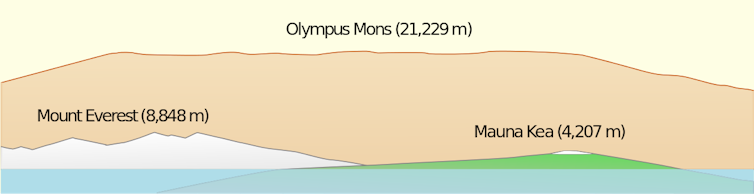 Olympus Mons is way higher and wider than even Mt Everest and the Himalayas.
Wikimedia Commons, CC BY
Olympus Mons is way higher and wider than even Mt Everest and the Himalayas.
Wikimedia Commons, CC BY
Olympus Mons is just one of thousands of volcanoes observed on the surface of Mars, and we know that volcanic activity has shaped the majority of the planet’s surface.
But this is a process that has long since stopped on that planet: the youngest volcanoes on Mars are about 500 million years old. That’s before dinosaurs roamed the Earth.
The lack of currently active volcanoes on Mars is quite puzzling, given we see evidence that volcanoes were active there up from 3.7 billion years ago to 500 million years ago.
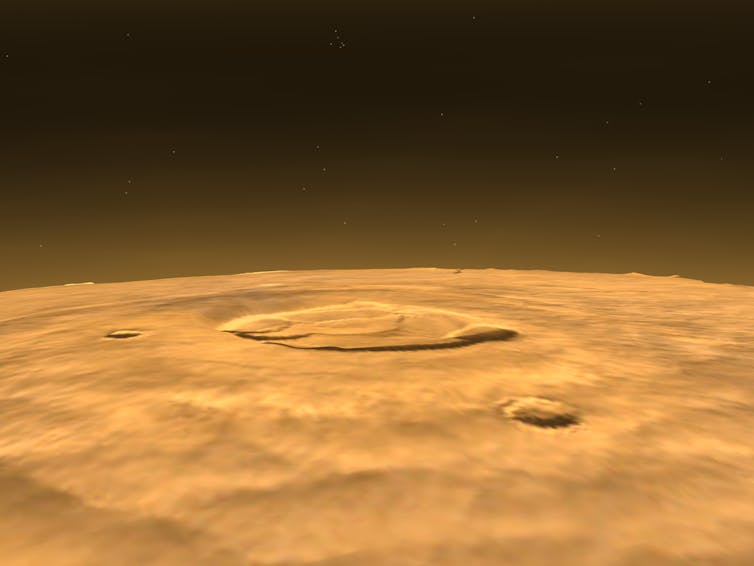 Olympus Mons is an extinct volcano on Mars.
A visualisation by Tom Bridgman/NASA
Olympus Mons is an extinct volcano on Mars.
A visualisation by Tom Bridgman/NASA
It’s about gravity
Both Earth and Mars are terrestrial planets, mostly made up of rock and metal.
But Mars only has a tenth of the mass of Earth. This has a profound effect on gravity: if you weigh 100 kg on Earth you’ll only weigh 38 Kg on Mars.
Low gravity has a dramatic effect on how volcanic eruptions can take place on Mars, as these are driven by buoyancy of the fluid rock, known as magma.
Magma is a really complicated mixture of liquid, solid and gas components, and changes frequently as it moves about a planet’s subsurface. Buoyancy is the contrast in density between the surrounding crust rock and the magma ascending for eruption. A high buoyancy means that the magma comes to the surface quite easily.
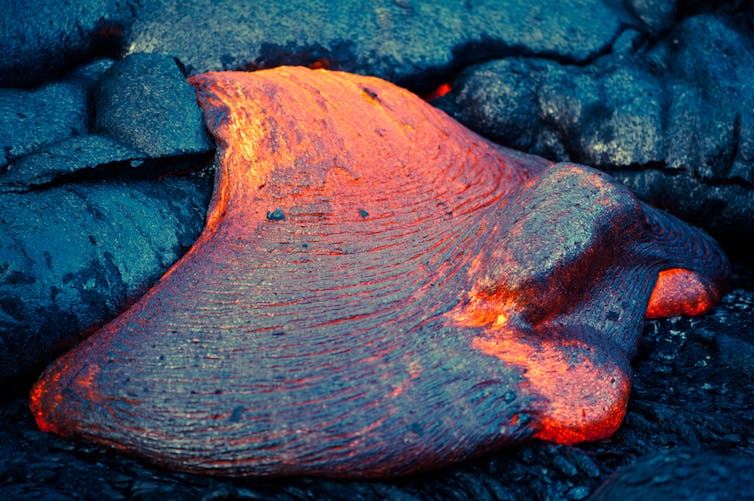 Buoyant magma comes to the surface easily.
from www.shutterstock.com
Buoyant magma comes to the surface easily.
from www.shutterstock.com
On Mars, the buoyancy of magma is relatively low, and the gravity is also relatively low. Also, the magma chambers that feed the eruptions are deeper than their counterparts on Earth. All up, this means more “oomph” is required to overcome the lower magma buoyancy and bring it to the surface of the planet. We think this leads to bigger but less frequent eruptions on Mars.
These bigger eruptions might explain how Olympus Mons got so big. Bigger eruptions mean more magma delivered to the surface, which is more material to build a monster mountain.
Heat energy also matters
While Mars’ gravity probably leads to bigger and less frequent eruptions, this doesn’t necessarily explain why we don’t see anything active today. Many believe this could be because this smaller planet has simply lost most of its heat energy.
A terrestrial planet has two main ways of generating heat: radioactive decay and primordial heating.
The radioactive decay comes from elements like potassium and uranium, which although present in small amounts, can release a lot of energy throughout the planet. Primordial heating is from the first formation of a planet – in the case of Mars as a mixture of metal and rock, where energy has come from the denser metal sinking towards the core.
While on Earth these two heat sources are going strong, this may not be the case for Mars. As a smaller planet it would have had less radiogenic and primordial heat sources to start with, so the planet may have already cooled down too much to drive volcanic activity.
However, we now know of other much smaller bodies – such as Jupiter’s moon Io and Saturn’s moon Enceladus – that are volcanically active. This (at least in Io’s case) is driven by tidal forces generated by their close orbit to a gas giant.
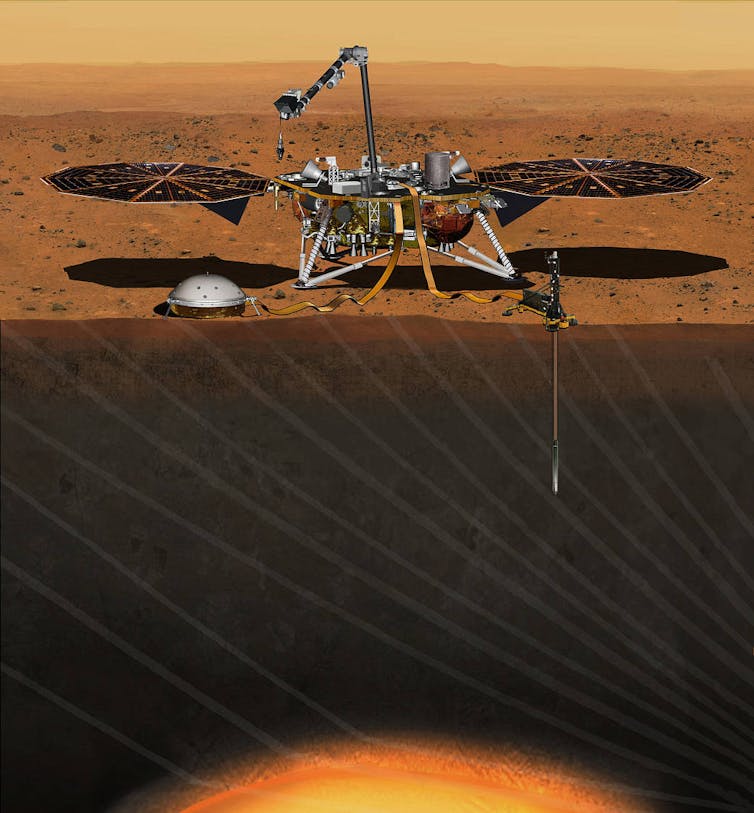 NASA’s InSight mission will measure seismic activity on Mars – which could come from magma moving under the surface.
NASA/JPL-Caltech, CC BY
NASA’s InSight mission will measure seismic activity on Mars – which could come from magma moving under the surface.
NASA/JPL-Caltech, CC BY
Evidence incoming
But new sources of evidence do arise.
The European Space Agency’s Mars Express mission has spotted what was interpreted to be a more recent larva flow (only a mere two million years old) on Mars.
And with NASA’s InSight mission, currently on its way to the red planet, we could potentially catch volcanic activity in the act.
Read more: Launching in May, the InSight mission will measure marsquakes to explore the interior of Mars
If all goes well, the InSight probe will sit on the Martian surface and listen for seismic activity (sound waves travelling through the rock). Seismic activity on Mars could be due to meteorite impacts or marsquakes, but it could also result from magma moving through the crust.
Authors: Helen Maynard-Casely, Instrument Scientist, Australian Nuclear Science and Technology Organisation


 Daily Bulletin


