

Who writes science and technology stories? More men than women
- Written by: Sarah Keenihan, Section Editor: Science + Technology, The Conversation
The Conversation’s Science and Technology stories are hugely popular – but who writes them? Academics, yes – and more men than women.
At the end of 2017 we assessed a year’s worth of stories: 584 articles. Some were written by a single academic, others featured two, three and occasionally more. Overall, 681 authors were involved – 489 men, and 192 women. That’s 72% men and 28% women.
We want to narrow that gender gap.
Changes we’ve made to date are having an impact – but we’d like to be better. Maybe you can help.
Read more: What you loved in Science and Technology 2017
TIMELINE – The most highly read The Conversation Science and Technology stories in 2017. Use the arrows or swipe to scroll through the months.
News is news
It’s important to clarify here that we aren’t trying to reduce opportunities for men. Novel research matters, news is news, and strong ideas will get up regardless of gender. We value the contributions of all our past and current authors – the popularity of their stories speaks for itself.
However there is room for more women to contribute to the news landscape.
At The Conversation, we encourage more female academics to pitch. Data collected since 2013 shows that less than 30% of author pitches to our Science and Technology section come from women (with 60-67% from men, and 5-15% of unknown gender).
Not all pitches are successful, but as with most forms of writing, the more academics pitch the better they get at it.
Ever wondered how stories appear on The Conversation?Working towards gender balance
As part of our weekly process, our team now reviews author gender across the past five days.
We deliberately seek out new female academics who may be keen to share their expertise and their experience. Unique perspectives are interesting. Evidence-based stories from fresh voices create diversity in our understanding of important issues.
We know that when new authors are supported editorially, over time they become repeat authors.
When we need to commission fast breaking news stories, we talk with both men and women who we know can write great copy at short notice.
Read more: Pitch to publication: how The Conversation works
Has it had an impact?
To date, stats collected over 2018 show that of 342 Science and Technology stories written by 322 authors, 68% of authors were male and 32% female (compared to 72% men and 28% women at end of 2017).
We’ve broken these stats down by subject. Among authors of stories classed as “science”, 38% of authors were female – with female authors particularly underrepresented in astronomy, biology, chemistry, geology, human evolution and science methods.
In other science subjects, the author ratio was around 50:50 (archaeology, communication, innovation, physics, space, sport and veterinary science) or tipped in favour of women (genetics, politics/society).
In stories classed as “technology”, women comprised 29% of authors overall. This figure included authors writing on technology innovation (13% female), technology security/legal topics (26% female) and games/gaming (30% female).
Other topics within technology were covered by around 50:50 male:female authors (engineering, forensics, politics/society and social media).
Now we can see where we’ve got real subject gaps in female representation in our body of current authors.
Read more: New study says the gender gap in science could take generations to fix
The broader picture
There are many barriers that impede women’s progress in science and technology careers. Just 16% of top-level science and technology researchers and professionals are women – it’s a leaky pipeline.
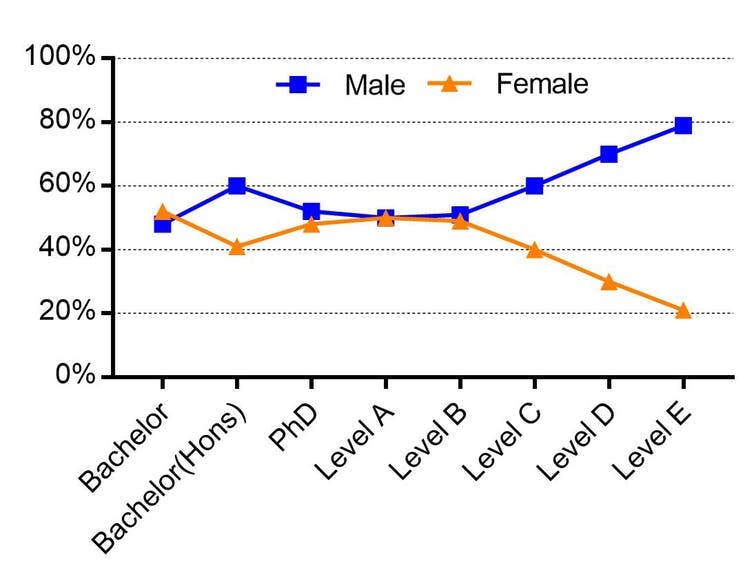 The ‘leaky pipeline’ in academia sees women lost from the system at the middle-management level. Data adapted from the Department of Education and Training, Higher Education Research Data, 2014.
Heffernan, Umbers, Mustafa 2018
The ‘leaky pipeline’ in academia sees women lost from the system at the middle-management level. Data adapted from the Department of Education and Training, Higher Education Research Data, 2014.
Heffernan, Umbers, Mustafa 2018
Do these statistics contribute to the relatively low proportion of women in our author body? Probably.
But more factors are likely at play. Demands on professional women’s time can be overwhelming, as they feel pressure to constantly provide evidence of their competence, and still somehow work less hours if they’ve had children.
Read more: Take it from us: here's what we need in an ambassador for women in science
It’s also worth noting that being a woman in the public arena can be brutal. Our community standards aim to address this problem.
How you can help
If you’re an academic already writing for The Conversation, thank you! Let us know if your university department, research conference or professional support network would benefit from an editor visit so that more women in your field can see how we work.
If you’re an academic with a strong story idea, please pitch it here or reach out to one of our team to have an informal chat.
For us as editors, we will continue to take actions to bring the gender balance in our academic authorship as close to parity as we can.
For us, this is really important. We appreciate your support.
Authors: Sarah Keenihan, Section Editor: Science + Technology, The Conversation
Read more http://theconversation.com/who-writes-science-and-technology-stories-more-men-than-women-101181


 Daily Bulletin


