

We can all help to improve communication for people with disabilities
- Written by: Bronwyn Hemsley, Professor of Speech Pathology, University of Technology Sydney
Around 5% of the population, or 1.2 million Australians have a communication disability. Communication disability can arise if a person has a health condition affecting their speech, language, listening, understanding, reading, writing, or social skills.
Communication disability can be lifelong (as for people with cerebral palsy or intellectual disability) or acquired (as for people with stroke and aphasia, motor neurone disease, or traumatic brain injury).
All people need to be able to communicate in order to work, build relationships, and seek the support they need. But they will encounter many barriers to taking part and being included.
About 30% of stroke survivors have aphasia, a condition that affects their use of language. Over time, being excluded from conversation erodes social contacts and opportunities for conversation, resulting in loneliness and isolation, depression, anxiety and fear.
People with aphasia report feeling alienated, inferior and shamed. They might have difficulty speaking, but are still aware of the world and conversations that happen around them and want to contribute.
Supportive communication partners can do a lot to help improve communication access for people with communication disability.
1. Remove communication barriers
People with communication disability often report others treat them as though they’re stupid. This negative attitude or expectation is a barrier to communication.
Regardless of their speech abilities or cognitive skills, everyone has the right to communicate. So treat them the same as you would any other person, talk directly to them, and ask them questions.
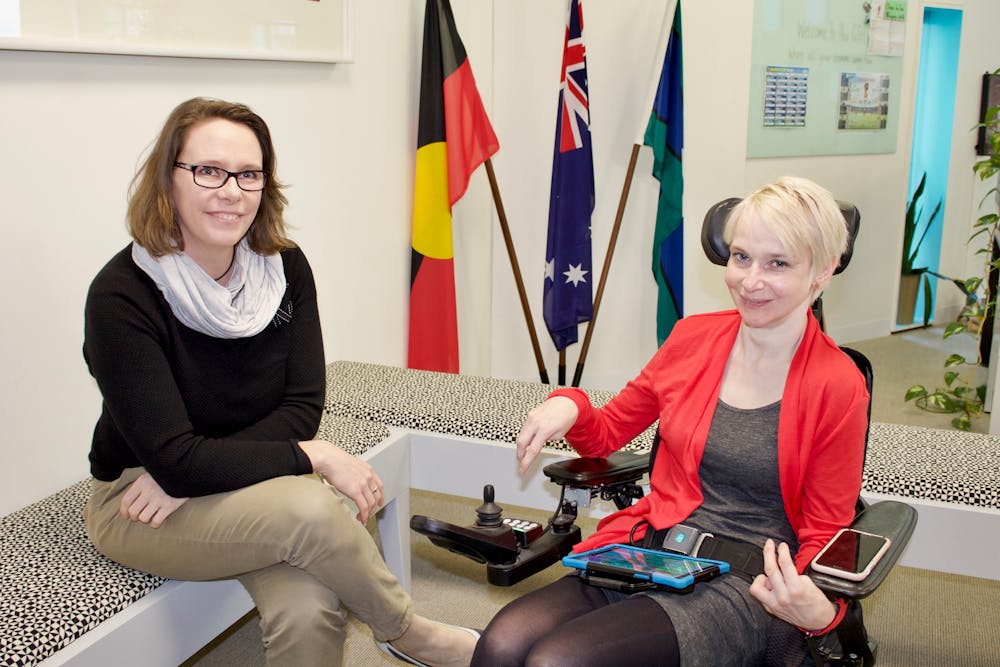 Co-author Harmony Turnbull with Fiona Bridger, who has cerebral palsy and uses a speech generating device.
Bronwyn Hemsley
Co-author Harmony Turnbull with Fiona Bridger, who has cerebral palsy and uses a speech generating device.
Bronwyn Hemsley
2. Prepare for communication success
Communication disability is “invisible”, so ask the person or their close ones about how they communicate and what helps them to get their message across
keep background noise and distractions down, and give the person your full attention
use facial expressions and gestures to help to convey information, particularly if the person has difficulty understanding speech
give the person more time to respond, and get comfortable with silence while you wait – the perfect pause takes a little longer than you might be used to, so try counting to ten in your head and leaving that space
stay attentive and off your phone, unless you’re using the photos or video feature to help. Try using some little words such as “yes” and “mhm” to indicate acknowledgement and show active listening. This can help reduce the frustration and anxiety that comes from struggling to find the right words to say
if the person uses communication technologies, watch what they’re doing and respond as you would usually. It’s just another way to talk.
Read more: The technology that gave Stephen Hawking a voice should be accessible to all who need it
3. Build a conversation together
It takes at least two people to have a conversation, and supportive communication partners to make it a successful one. Give and take turns in a conversation to show respect and interest in what they have to say. If they’re struggling, give a cue or a prompt to help the person think of a word. If you haven’t understood the person, don’t pretend. Let them know you’d like to keep trying.
A person’s cognitive-communication skills can grow when they experience more opportunities for inclusion in social situations, employment, and education.
People with traumatic brain injuries can also learn strategies to improve their chance of success in conversation. Learning to plan the topics that need to be covered in a conversation, speaking slowly to encourage others to slow down, and finding a quiet place for that important conversation can all help.
4. Use communication aids and alternative strategies when you talk
Communication involves more than spoken words. We can also communicate with gesture, facial expression, body language, and tone of voice. Learn how you use your own non-verbal communication, and try to pick up on other people’s cues.
The use of sign language, writing, and drawing can all assist someone with communication disability to understand, and express themselves. Key Word Sign, a system for using hand signs and gestures as you speak, uses signs from Auslan. The idea is to encourage language use and growth, and help people understand the meaning in a sentence. You can use the online Auslan Signbank dictionary to learn some of these signs.
Speech devices are technologies designed to help everyone communicate. But having a speech device and knowing how to use it is only the start.
It takes persistence and a keen sense of humour to navigate a world in which people can respond inappropriately when you use the technology. People with communication disability ultimately need a willing and responsible community to access their communication rights.
Communication access in any environment paves the way for people with communication disability to engage, interact, and take part – to be involved in whatever is going on. It’s just as important as physical access for people who have a physical disability.
So next time you meet someone with a communication disability, find out how they get their message across, and try having a conversation.
Authors: Bronwyn Hemsley, Professor of Speech Pathology, University of Technology Sydney


 Daily Bulletin


