

160 years of Māori monarchy
- Written by: Michael Belgrave, Professor History, Massey University
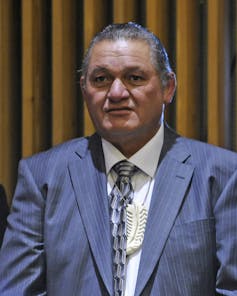 The current Māori king, Te Arikinui Kiingi Tūheitia, in 2012.
Wikimedia Commons, CC BY-ND
The current Māori king, Te Arikinui Kiingi Tūheitia, in 2012.
Wikimedia Commons, CC BY-ND
New Zealand’s Māori king, Te Arikinui Kiingi Tūheitia, recently celebrated 160 years since the installation of the first Māori monarch, Pōtatau Te Wherowhero, at Ngāruawāhia on the Waikato River in 1858.
The movement to establish a Māori monarch, known as kīngitanga, emerged following colonisation to protect Māori land ownership and Māori constitutional autonomy. Since then, it has helped bring otherwise independent tribal communities together to protect their tribal identities and resources.
Read more: Strong sense of cultural identity drives boom in Māori business
Māori resistance
The fact that the movement survived to the present is remarkable in itself. George Grey, one of Queen Victoria’s most able consuls, famously declared in 1861:
I shall not fight against him with the sword, but I shall dig round him till he falls of his own accord.
When his digging failed, he dispatched an imperial army in 1863 to destroy King Pōtatau Tāwhiao, who had succeeded his father in 1860. Māori resistance was far more effective than the Europeans anticipated, but the king and his forces were pushed up the Waikato and Waipā rivers and around 900,000 acres of Māori land was confiscated.
Through war, confiscation, post-war poverty and continued land loss, the kīngitanga movement remained a focus for Māori resistance. In the 20th century, it provided the leadership to reach a number of settlements with the Crown, most significantly over confiscated Maori lands and the management of the Waikato River.
Origins of kīngitanga
The movement has its origins in the dramatic decades that followed the 1840 Treaty of Waitangi, which led to New Zealand becoming a British colony.
Determined to understand the European world, many Māori leaders rapidly adopted Christianity and literacy. From their appreciation of the Bible and European nationalism, leaders like Wiremu Tamihana promoted the election of a king as a way to protect Māori land ownership, retain constitutional authority over the Māori world and unite the country’s disparate, and often warring, tribal groups.
Europeans initially treated it as some form of childish imitation, but they underestimated the sophistication of the extended debates preceding Te Wherowhero’s election. The tribes that supported him agreed to give up authority over their land to prevent individual rangatira (chiefs) from selling plots and compromising the interests of others. This was unprecedented in Māori tradition. And it worked.
Supported largely by tribes descended from those arriving on the Tainui canoe (one of many which had initially colonised New Zealand), the movement effectively halted land sales by its supporters. It also began to be taken far more seriously in 1860, when some of its members joined Taranaki iwi (tribes) in resisting the military force used to complete a highly disputed land purchase. By July 1863, invasion was the colonial government’s preferred method to contain it.
Despite its losses, the kīngitanga was not defeated and certainly not destroyed. For 20 years following the final battle in April 1864 at Orakau, the king ruled an independent sovereign state in the centre of the North Island. There were no colonial police or military and no courts, roads, surveyors or schools. Europeans ventured into the King Country (Rohe Pōtae) at their own risk.
Main trunk line diplomacy
During the late 1870s, the colonial government needed access to the area to build the main trunk railway. This forced it into diplomatic negotiations with King Tāwhiao, as if he was an independent monarch.
He appealed to European public opinion, with a series of triumphal royal tours across the Waikato and Auckland. In 1884, he went to London to push the British government to recognise Māori grievances. He was the hit of the season there, entertained by the rich and the powerful, and a frequent visitor to the royal boxes of the London theatre.
However, in the end, despite his protests, he had to accept the opening up of the King Country, without achieving the return of the confiscated land.
Through these decades, colonial officials confidently predicted the kīngitanga’s collapse. But it proved surprisingly resilient. Tāwhiao transformed it into a peaceful resistance movement and made it a focus for supporting the material and spiritual needs of its followers.
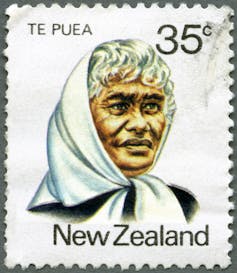 A stamp printed around 1980 shows Princess Te Puea Herangi.
from www.shutterstock.com, CC BY-ND
A stamp printed around 1980 shows Princess Te Puea Herangi.
from www.shutterstock.com, CC BY-ND
The movement faced hard times at the beginning of the 20th century, but was revitalised by Te Puea Herangi, who led the movement from behind the throne. She reached an accommodation with the government, and gave the movement new stability and confidence heading in the future.
During the first world war, the movement boycotted the war effort and resisted the conscription of its young men. After the war, a Royal Commission blamed Grey and his government for the land confiscations, and eventually parliament provided an annual compensation payment, but one that fell far short of even the limited recommendations of the commission.
After the second world war, the Tainui Māori Trust Board, set up to administer the settlement funds, gave the movement some degree of financial stability until the annual payments were made largely worthless by galloping inflation during the 1970s. By then, urbanisation and a Māori renaissance provided greater opportunities to promote Māori cultural revival, and once again negotiate a settlement with the government.
Success brings challenges
Waikato, the iwi (tribe) most affected by land confiscations, negotiated a Treaty of Waitangi settlement in 1995. Queen Elizabeth II also personally apologised for the way the iwi had been treated during the 1860s.
In the mid-19th century, Waikato had exported a substantial agricultural surplus to Australia and beyond through the port of Auckland. The NZ$170m settlement aimed to reinstate the tribe as an economic force south of Auckland, and it has been largely successful.
But Waikato were only one of the constituent iwi (tribes) of the kīngitanga. Separate settlements have been reached with other tribes, and will continue.
Success has brought its own challenges. After some initial hiccups, Waikato have dramatically increased their assets to over NZ$1.2 billion. But the kīngitanga has to reconcile its new corporate identity with the relative poverty and disadvantage of a substantial proportion of its members.
A corporate leadership, centred on the king, has created fears at the community level that local hapū (sub-tribal groups) interests may be sacrificed for larger business objectives.
Some of the salaries paid to leading administrators heighten such fears. Settlement resources can be used to reinvigorate the cultural life of a tribal group, but the funding cannot dramatically change the economic status of its members. There’s just not enough money. Nonetheless, having real resources creates novel problems for a movement that has been impoverished for most of its history.
Other tensions are not new. Despite uniting under a king, the constituent tribes remain fiercely independent. As these iwi develop their own strategies and build up their own capital, the role of the kīngitanga will change.
That it is here at all is a testament to its ability in the past to work through these tensions and to remake itself.
Authors: Michael Belgrave, Professor History, Massey University
Read more http://theconversation.com/the-kingitanga-movement-160-years-of-maori-monarchy-102029


 Daily Bulletin


