

Quotas are not pretty but they work – Liberal women should insist on them
- Written by: Chris Wallace, ARC DECRA Fellow, Australian National University
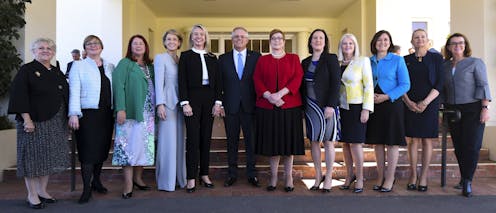
It is an historic moment for Liberal Party women. Individual complaints of sexist bullying invariably end with the lone complainant being isolated and getting crunched.
But since the Liberal leadership spill, several women have spoken out and two MPs, Julia Banks and Ann Sudmalis, have foreshadowed their exit from parliamentary politics over it. This post-#LibSpill moment holds immense promise – but only if the collective momentum is seized and built upon.
From Prime Minister Scott Morrison down, Liberal Party men are pushing back against women pressing for cultural change within the party. They don’t want to share power for ideological reasons: conservative men like women to know their place, and that place is not in the House of Representatives or the Senate. This ethos is intensifying as fringe and evangelical Christians make ever deeper inroads into Liberal Party branches and preselection processes.
Respected Liberal women like former Liberal Party vice-president Tricia Worth and former Liberal senator Sue Boyce have poured scorn on the internal party mechanisms proposed so far to deal with the problem. They point out the implausibility, for example, of making a bullying complaint to Victorian Liberal Party president Michael Kroger who denies such bullying exists.
Read more: A 'woman problem'? No, the Liberals have a 'man problem', and they need to fix it
Liberal Party women face an immediate choice. They can be cowed by the “quota girl” sledge of hostile male colleagues, and other unsupportive comments by these men’s female enablers such as NSW Liberal Senator Concetta Fierravanti-Wells.
Alternatively, Liberal women can organise to achieve structural change – the only kind that ever sticks – arguing that if it’s good enough for “quota boys” like Senator Abetz and Michael McCormack, quotas are all right by them too.
Practical politics runs on quotas. They are the tool of last resort when dominant powers refuse to share power fairly or could refuse to in the future. They work.
The most striking example of a quota in Australian politics is that underpinning Federation. The Australian colonies would not agree to federate without agreement to an upper house in which each state, even the smallest, was represented by the same number of senators as the biggest.
That’s why NSW, with a population of 7.9 million, and Tasmania, with a population of 524,000, both send 12 senators to Canberra every election. This makes the ranking Tasmanian Liberal Senator Eric Abetz arguably the biggest beneficiary of quotas currently in the federal parliament.
There are 76 senators. Would anyone seriously suggest that on merit Eric Abetz would make the list of the top 76 Australians elected as senators in Australia’s upper house if they were elected in a single nationwide ballot? The state-based quota system established at Federation ensures he gets there.
The next most striking example is the quota agreement that enables Australia’s two main conservative parties to form government in coalition, since each usually returns too few MPs at federal elections to govern in its own right.
The National Party’s price for supporting the Liberals in forming government is a quota of ministerial positions reserved for National Party MPs, along with the deputy prime ministership. This quota arrangement today underpins the cabinet position and deputy prime ministership of National Party leader Michael McCormack. Does anyone really believe that without this quota McCormack would have naturally risen to become Australia’s second most senior politician? Of course not.
The third most striking example of quotas in Australian politics is their use by the Australian Labor Party to normalise the presence of women in progressive parliamentary politics. Attempts to establish quotas in the early 1980s, backed by then Labor opposition leader Bill Hayden, foundered when ALP conference delegates, including many women, voted them down on factional lines. It was not until 1994 that an enforceable formula guaranteeing women preselection in one-third of winnable seats was established.
In her memoir Catching the Waves, Hawke Government cabinet minister Susan Ryan wrote:
These rules are bitterly resented by many men in the Party, and when they favour a woman from the wrong faction they upset some women as well.
Quotas are “a blunt tool”, Ryan readily conceded, but she supported them after experience showed nothing else could “change the gender balance among Labor members of parliament”. It worked. Labor now has a critical mass of women in caucus making a big contribution, their presence normalised and unremarked on except by misogynistic conservatives across the aisle.
People don’t have to like quotas. But no reasonable person can fail to accept that they are a regular part of political life, not the intrusive tool of progressive pinot noir drinkers pushing their own political barrows. Hundreds of examples beyond Australia’s shores could be cited, but here are just a few.
The United States has a quota of two senators from every state in its upper house, the inspiration for Australia’s state senate quotas. Conservative German chancellor Angela Merkel legislated board quotas for women when German business proved intractable in voluntarily improving board diversity. Singapore set racial quotas in public housing, reflecting the ethnic makeup of the country’s population, in the interests of racial harmony.
Quotas, in short, are management tools to ensure power-sharing where it would not otherwise occur in the interests of a greater good – and they’re used by progressives and conservatives alike. No-one could accuse Angela Merkel or the Singaporean government of being subversive left-wing entities. It has been estimated that half the countries in the world use some kind of gender quota in their electoral system and there is extensive evidence that they work.
Read more: View from The Hill: Morrison's challenge with women goes beyond simple numbers
There is high level support from Labor for Liberal women to tackle the problem and succeed in the interests of improving Australia’s political culture overall. Labor Senate leader, Penny Wong, told parliament this week that the under-representation of women in the Liberal party room is “not only bad for women, and bad for the Liberal Party, it is bad for democracy”. She urged Liberals to walk the same difficult road to establishing quotas that so successfully fixed what had also been a chronic problem for Labor.
Failure to push on to embrace and establish quotas will see the current burst of bravery by Liberal women dissipate, and the male oligopoly in the Coalition party room become even more entrenched.
Advocates could impress on internal opponents that the only winner from the current extreme and worsening masculinist culture in the Liberal Party will be Labor, whose caucus since quotas for women in winnable seats were adopted has increasingly reflected the communities it represents – something voters very much like and ultimately reward.
Authors: Chris Wallace, ARC DECRA Fellow, Australian National University


 Daily Bulletin


