

Art and science come together to examine the power and perversions of perfection
- Written by: Julie Shiels, Lecturer - School of Art, RMIT University
Review: Perfection, Science Gallery Melbourne.
It would be easy to assume that art and science occupy separate worlds. Art invites us to encounter “things as they are perceived and not as they are known” and relies on subjective experience to confirm value. Science strives to establish knowledge as fact through testing and peer review. Yet sitting at the core of both disciplines is the desire to employ curiosity, creativity, innovation and discovery to examine the world we live in. These intellectual frameworks create bridges between the two disciplines.
The intersection between art and science is the focus of Perfection, the latest pop-up show for the Science Gallery Melbourne. Part exhibition, part experiment it asks: “What does it mean to be perfect?”
Curated by a panel that includes a particle physicist, a computer scientist, a plastic surgeon and a musicologist, Perfection offers a set of reflections, calculations and speculations that engage with ideas about the perfect body, mathematical precision, quantum physics and a post-human world. We are invited to consider the current state of things and to contemplate what might constitute an ideal future.
Read more: Spilling blood in art, a tale of tampons, Trump and taboos
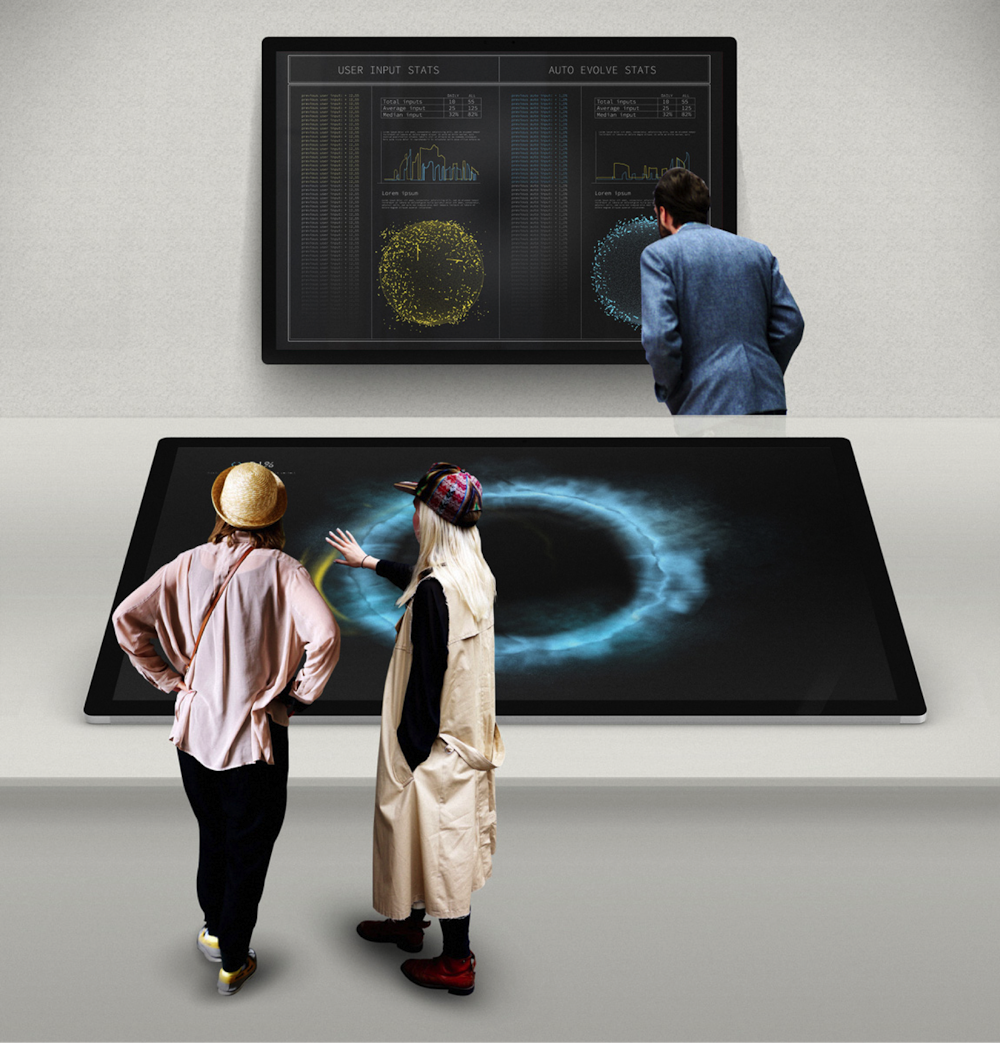 XORXOR, Perfect O, installation view.
Image courtesy of the artists
XORXOR, Perfect O, installation view.
Image courtesy of the artists
The slippages between art and science, and experiment and exhibition, are an active component of Perfection. Questions that straddle technology and art history are explored by XORXOR’s question: “Is it possible to draw a perfect circle?”
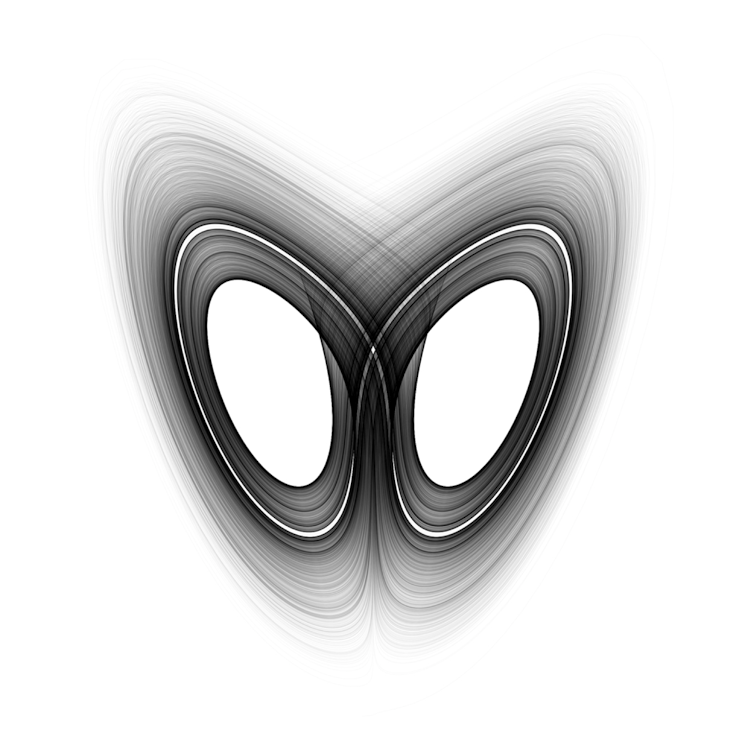 Marcus Volz, Lorenz Attractor 201, Digital animation.
Image courtesy the artist
Marcus Volz, Lorenz Attractor 201, Digital animation.
Image courtesy the artist
Marcus Volz’s digital animations, Lorenz Attractor and Natalina Cafra, employ complex 3D sculptural forms to visualise mathematical equations relating to atmospheric weather patterns and fractal diversity in molluscs. Reminiscent of late modernism and the idea of a perfect closed self-referencing system, these drawings ask whether art can be maths and maths can be art.
The lab-like conditions of Andy Gracie’s Fish, Plant, Rack v.2 speculate on a future post-human condition where the world goes on without us. In this experiment three systems interact: a blind fish emitting electrical impulses, a robot powered by the fish, and plants living in a hydroponic system. Other works that deal with non-human concerns explore ideas about a “perfect sound” and question whether light has consciousness.
The most prominent experiments in the exhibition, though, relate to the human body, identity and the self.
Throughout history, the body has been an abiding interest for artists — from the earliest forms of bodily adornment through Da Vinci’s concern with anatomy, to contemporary explorations of race, gender and sexuality. Technology takes things to a new level, enabling us to hack, modify and transform our bodies, and to use social media as a platform to manage our identity and present it to the world. As a potential extension of the body, the digital realm provides fertile ground for creative critique and exploration.
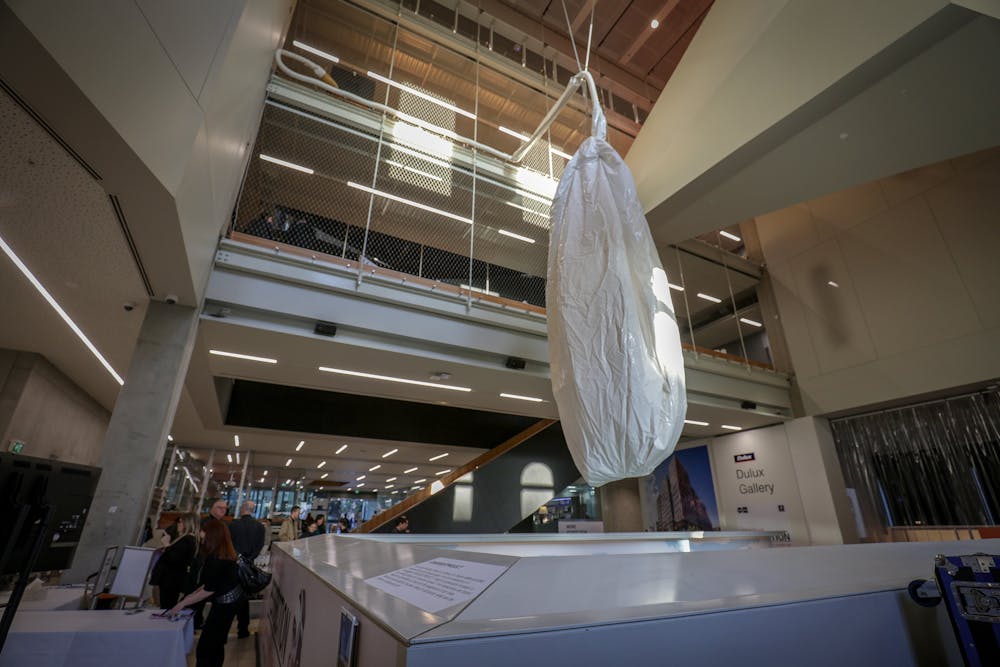 Ant Hamlyn, The Boost Project, 2015.
Nicole Cleary
Ant Hamlyn, The Boost Project, 2015.
Nicole Cleary
Ant Hamlyn’s The Boost Project and Tyler Payne’s Womanhours both address the pressures of social media.
Hamlyn’s six-metre-tall inflatable is a proxy for the body and the ego. Suspended from the ceiling, this giant orb gives form to the flux and fragility of an online presence. Each time it is liked via its hashtag, The Boost Project gets a 30-second burst of air. On a good day it has a substantial presence at the entrance of the gallery, but when it is ignored the orb slowly deflates, its firmness diminishes, and the suspended form takes on a droopy and dejected demeanour.
Payne’s Womanhours demonstrates the oppression of Instagram. In a series of videos, the artist employs her own body to reveal the level of self-correction needed to achieve the perfect self-portrait. She appears to endure an extreme physical and psychological makeover through female cosmetic rituals such as waxing, tanning, bleaching, plucking and shaving. The perfected self is captured for a fleeting moment in the virtual realm and the ritual is repeated all over again.
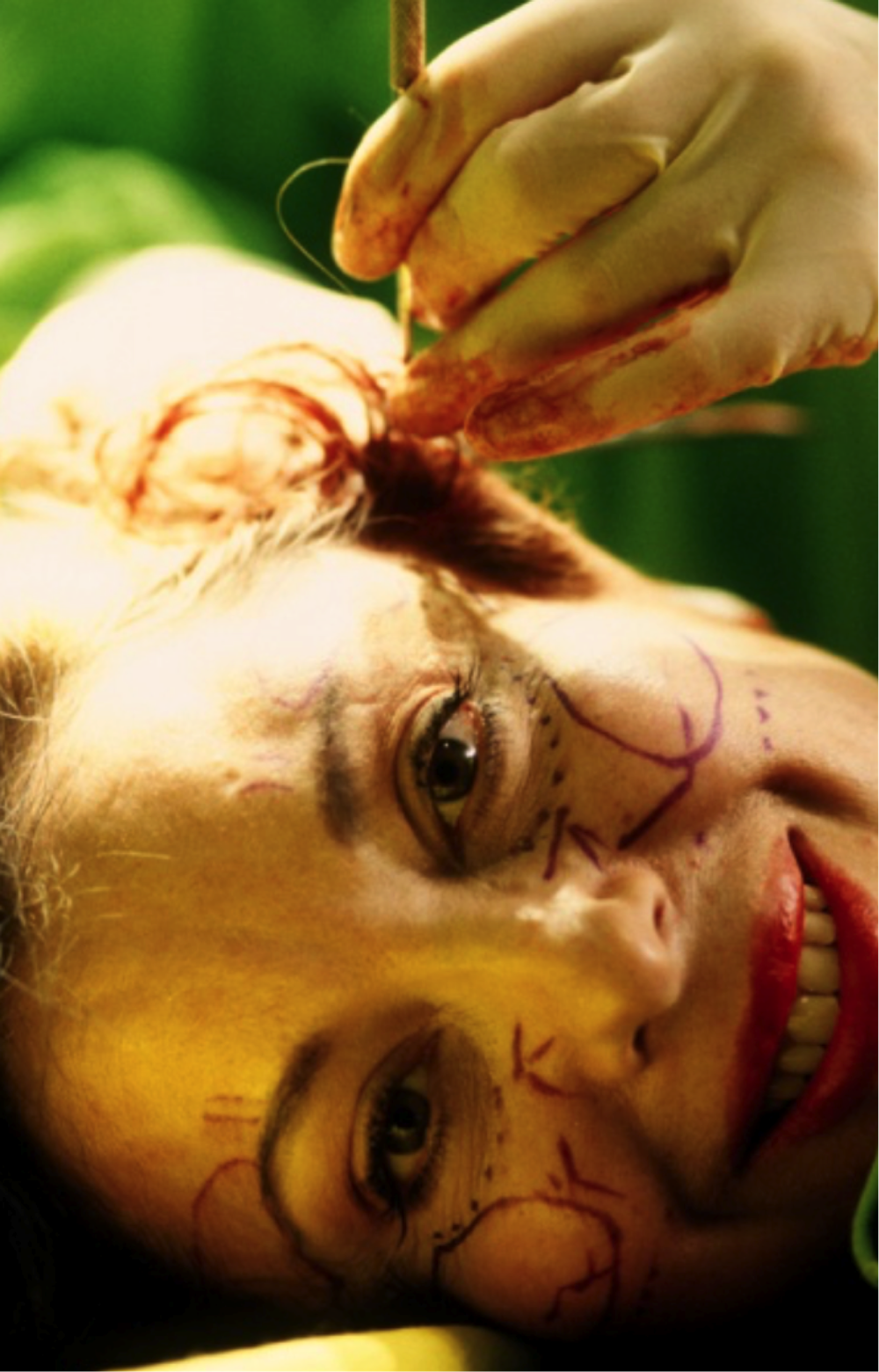 Orlan, Omniprésence, 1993.
Image courtesy of the artist
Orlan, Omniprésence, 1993.
Image courtesy of the artist
Self-correction is also the subject of ORLAN’s performance practice and her body is the canvas for experimentation. No need to repeat these rituals; the interventions are permanent. For decades, ORLAN has undergone plastic surgery in order to shape her face to reflect a version of beauty expressed in the Renaissance paintings. Her new brow resembles the Mona Lisa and her chin belongs to Botticelli’s Venus.
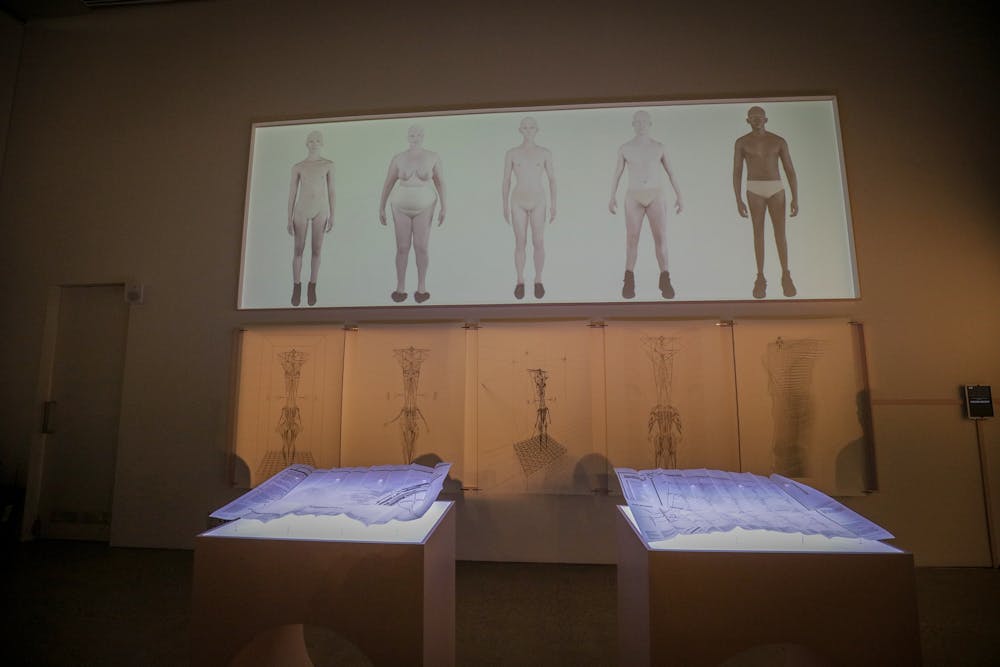 Adam Peacock, Genetics Gym, 2017, video still.
Nicole Cleary
Adam Peacock, Genetics Gym, 2017, video still.
Nicole Cleary
In Genetics Gym, Adam Peacock speculates on how genetic technologies could allow us to design our bodies and cognitive dispositions, ramping up the prospects of self-improvement beyond internal and external modification.
Similarly, in Demiurge, Jaden Hastings has accessed her entire gene sequence and used artificial intelligence to analyse potential risks and provide information about what needs to be fixed to achieve a perfect state. In doing so, the artist inserts the machine into the process of human evolution.
Most artists in this exhibition speculate on self-improvement with respect to health, function and beauty, but we might also be driven to modify ourselves through fear. What if the desire to survive a cataclysmic event was the catalyst for reshaping the human form?
Patricia Piccini’s Graham has the perfect body to walk away unscathed from a car crash. Created in collaboration with trauma surgeon Christian Kenfield and the Monash University Accident Research Centre, Graham’s honed and sculpted anatomy will withstand the impact of a 30kph collision. Paradoxically, the unintended consequences of Graham’s modified feet and ankles would appear to make walking very difficult.
Few of us would choose to look like Graham, but he is a metaphor for the lengths we will go to be safe. How far might we go to protect ourselves or our children from threats like terrorism or global warming?
The prospect of hacking, modifying and transforming our bodies presents an unexpected conundrum. Scientific and technological advances inevitably open up an unfettered realm of personal choice when innovations hit the marketplace. But in The Paradox of Choice, economist Barry Schwartz shows that having too many options generates anxiety. It’s hard enough to choose a toothbrush today, let alone make an informed decision about the potential range of future body modifications.
Perfection raises questions about what constitutes a utopian or dystopian future, ethical or unethical practices, a perfect or an imperfect human. The exhibition provides no easy answers but invites us to shift our perception and engage with the world as it is now, and as it might one day become. Be careful what you wish for.
Perfection is showing at Science Gallery Melbourne until November 11 2018.
Authors: Julie Shiels, Lecturer - School of Art, RMIT University


 Daily Bulletin


