

Five ways to reduce waste (and save money) on your home renovation
- Written by: Deepika Mathur, Researcher in sustainable architecture, Charles Darwin University
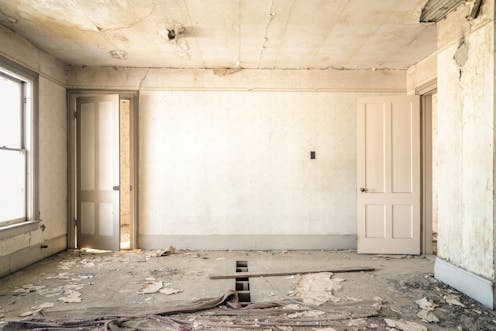
On average, renovating a home generates far more waste then building a new one from scratch.
This waste goes straight to landfill, damaging the environment. It also hurts your budget: first you have to pay for demolition, then the new materials, and then disposal of leftover building products.
By keeping waste in mind from the start and following some simple guidelines, you can reduce the waste created by your home renovation.
Read more: Thinking about a sustainable retrofit? Here are three things to consider
1. It starts with the design
Waste is often treated as inevitable, factored into a building budget with no serious attempt to reduce it.
By raising the issue early with your architect, designer or builder, they can make decisions at the design stage that reduce waste later. Often the designers and architects don’t see their decisions contributing to waste – or rather, they don’t really think about it.
During my research on reducing construction waste, I asked one architect what he thought happens to the waste generated. He laughed with a glint in his eyes and said, “I think it disappears into pixie dust!”
One simple early decision that dramatically reduces waste is designing with material sizes in mind. If you have a ceiling height that does not match the plasterboard sheet, you end up with a tiny little strip that has to be cut out of a full sheet. In the case of bricks, not matching the ceiling height is even more wasteful.
Obviously not all materials will work together at their standard sizes (and you need to fit your renovation to the existing house). But sensitive design can make intelligent trade-offs, reducing overall waste.
When I asked architects why they don’t design zero-waste buildings more often, they said clients don’t ask for it. Make it part of your brief, and ask the architect how they can save money by using the materials efficiently.
2. Get your builder involved early
If you’re using an architect for your renovation, it’s common to have very little collaboration between them and the builder. Any errors or issues are usually spotted after construction has begun, requiring expensive and wasteful rework.
Instead, ask your architect and building to collaborate on a waste management plan. Such integrated approaches have worked well in Australia and the United States.
This means clients, engineers and builders are collaborating, rather than taking adversarial roles. For such contracts to work, it’s important to involve all parties early in the project, and to encourage cooperation.
The briefing stage is an opportunity for architects, quantity surveyors Brisbane and builders to work together to identify a waste minimisation target.
3. Whatever you do, don’t change your mind
One the biggest contributions to waste on sites is late design changes. Client-led design changes are identified in all literature as having far-reaching implications on waste.
These are mostly due to owners changing their mind once something is built. Reworking any part of a building due to design changes can account for as much as 50% of the cost overrun, as well as causing delays and generating waste.
The early work with your design and construction team outlined in the first steps gives you the chance to make sure you’re committed to your original design. Skimping in the planning stage can end up costing you far more in the long run.
4. Deconstruction, not demolition
Ask your builder not to demolish the building, but to deconstruct it. Deconstruction means taking a building apart and recovering materials for recycling and reuse. This provides opportunities for sorting materials on site.
Salvaged materials can be resold to the community or reused in the renovations. It greatly reduces the tip fees which are usually higher for mixed waste (typical from demolition process) and lower for sorted waste.
Of course this takes more time and has an additional cost. Therefore you do have to balance the cost of deconstruction against the savings.
Denmark, which recycles 86% of its construction waste, has made it mandatory for all government buildings to undergo selective demolition and sorting of construction waste. A good place to start in Australia is your state environment department, which may have guidelines on what is involved.
5. Choose materials carefully
Good-quality materials last longer, reducing maintenance later. Choosing manufacturers that use minimal packaging also reduces waste (be careful here to check the difference between “minimal” and “inadequate” packaging, as the latter can mean your material breaks).
Reusing materials from your renovation may also be an option (you will need to discuss this with architect and builder at the beginning of the project). Finally, using materials with recycled content is a great option, and boosts our recycling industry.
Read more: The return of the breeze block
In March 2017 the Housing Industry Association released data suggesting the Australian residential building industry will increasingly become more dependent on renovation work rather than new construction,
If you’re renovating your home, making efficiency and low waste a priority helps cut costs and reduce landfill.
Authors: Deepika Mathur, Researcher in sustainable architecture, Charles Darwin University
Read more http://theconversation.com/five-ways-to-reduce-waste-and-save-money-on-your-home-renovation-103942
%20on%20your%20home%20renovation "Pin It")

 Daily Bulletin


