

Being in nature is good for learning, here's how to get kids off screens and outside
- Written by: Tonia Gray, Associate Professor, Centre for Educational Research, Western Sydney University
Contrary to the belief we Aussies are a nature-loving outdoor nation, research suggests we’re spending less and less time outdoors. This worrying trend is also becoming increasingly apparent in our educational settings.
I have devoted the majority of my teaching and academic career to examining the relationship of people and nature. In the last few decades, society has become estranged from the natural world, primarily due to urban densification and our love affair with technological devices (usually located in indoor built environments).
Contact with nature can enhance creativity, bolster mood, lower stress, improve mental acuity, well-being and productivity, cultivate social connectedness, and promote physical activity. It also has myriad educational benefits for teaching and learning.
Read more: Why a walk in the woods really does help your body and your soul
Outdoors and learning
The word “kindergarten” originated in the 1840s from the ideologies of German educator Friedrich Froebel and literally translates to “children garden”. Propelled by innate curiosity and wonder, a Froebelian approach to education is premised on the understanding students learn best when they undertake imaginative play and curious exploration.
Not only is outdoor play central to children’s enjoyment of childhood, it teaches critical life skills and enhances growth and development.
Contemporary research shows outdoor play-based learning can also help improve educational outcomes. A recent study found being outside stimulated learning and improved concentration and test scores.
Nature contact also plays a crucial role in brain development with one recent study finding cognitive development was promoted in association with outdoor green space, particularly with greenness at schools.
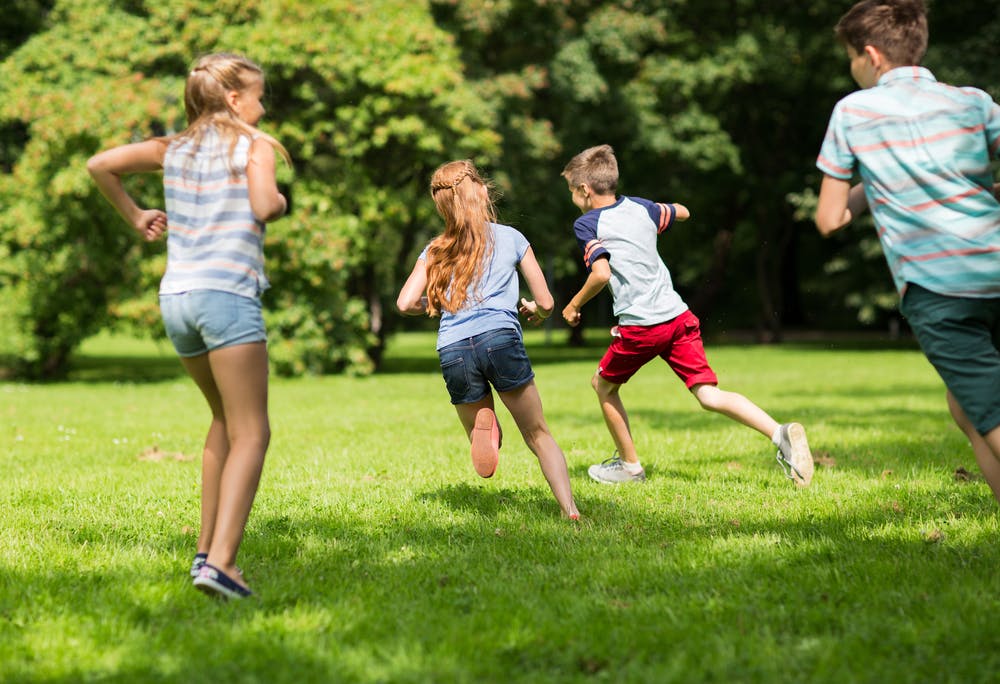 Contact with nature boosts brain development.
from www.shutterstock.edu.au
Contact with nature boosts brain development.
from www.shutterstock.edu.au
Autonomy and freedom in the outdoors is both liberating and empowering for kids. Burning off excess energy outdoors makes children calmer and fosters pro-social behaviours.
Teaching and learning in natural environments encourages self-mastery through risk taking, physical fitness, resilience, self-regulation, and student-centred discovery. Imagination is also enhanced by free, unstructured play.
Read more: Play-based learning can set your child up for success at school and beyond
How to get kids outdoors more
Children need outdoor play, but we’re not giving them enough opportunity. Countries such as Denmark, Sweden, Finland and Norway spend up to half the school day outdoors (rain, hail or shine) exploring the real-world application of their classroom learning. Here’s what parents and teachers can do to get kids outside more.
Taking the classroom outside
Children learn better when they can experience learning, rather than hearing it read from a text book. A study in Chicago used brain scans to show students who took a hands-on approach to learning had experienced an activation in their sensory and motor-related parts of the brain. Later, their recall of concepts and information was shown to have greater clarity and accuracy.
Practical lessons outside will stick better in young brains than learning theory from a book. This may be why in 2017, the Australian Curriculum and Assessment Authority (ACARA) included outdoor learning in the national curriculum.
Options for teachers include taking the class outside to write poetry about nature, measuring the height of trees for maths classes, or de-stressing using mindfulness and breathing techniques while sitting quietly in the shade of a tree.
An upcoming initiative Outdoor Classroom Day is happening in schools across Australia on November 1. This is a day where teachers are encouraged to take their classes outside. Alternatively, parents can make a special effort to take their child to the local park, river or beach.
Less time on screens
Conversations with parents and teachers show they’re increasingly concerned about technology’s broader impact on their children, in both dramatic and subtle ways.
In many ways our hunger for technology has overridden our desire for direct human interaction. Screens compete directly with authentic channels of communication such as face-to-face interaction. To combat this, parents can assign one hour on and one hour off screens.
Parents are role models and so we also need to monitor our own time on screens and spend quality time with children detached from our digital devices.
The sad reality is technology can become a pseudo-parenting device, a form of pacifier to keep the kids busy. Instead, we can encourage our kids to engage in simple, unstructured play experiences.
These could include creating an outdoor scavenger hunt where they collect items from nature, building forts or dens incorporating inexpensive materials such as branches and old sheets or blankets, climbing trees, or laying on the grass and looking upwards into the sky to watch the cloud formations.
Other methods include making mud pies or sandcastles at the beach or in a sandbox; encouraging the collection of feathers, petals, leaves, stones, driftwood, twigs or sticks to make creative artworks on large sheets of paper; planting a garden with vegetable seedlings or flowers with your child (let them decide what will be planted); putting on a jacket and gumboots when it rains and jump in puddles together; or making an outdoor swing or billycart.
Nature offers a never-ending playground of possibilities with all the resources and facilities needed. If stuck, search on the web for wild play or nature play groups nearby as they are growing in popularity and number. But most importantly, reinforce the message that getting wet, having dirt stains on their clothes and getting their hair messy is good and adds to the fun.
Authors: Tonia Gray, Associate Professor, Centre for Educational Research, Western Sydney University


 Daily Bulletin


