

Heart attacks more frequent in colder weather
- Written by: Garry Jennings, Chief Medical Advisor at National Heart Foundation of Australia; Senior Director, Baker Heart and Diabetes Institute
Heart attacks happen more frequently in winter, a major Swedish study has confirmed.
Published today in JAMA Cardiology the research found the incidence of heart attacks in a sample of more than one-quarter of a million people increased with lower air temperature, lower atmospheric air pressure, higher wind velocity and shorter sunshine duration.
They saw the most pronounced association with air temperature. An increase in 7.4℃ was associated with a 2.8% reduction of heart attack risk.
Doctors have long acknowledged heart attacks are more likely to occur in cold weather. Every medical student over the past five decades has seen medical artist Frank H Netter’s classical illustration of a middle-aged man clutching his chest as he steps out of a warm building into a cold winter’s night.
Not all heart attacks are typical but in the mind of Netter and his medical advisers of the time, there is nothing more typical than that.
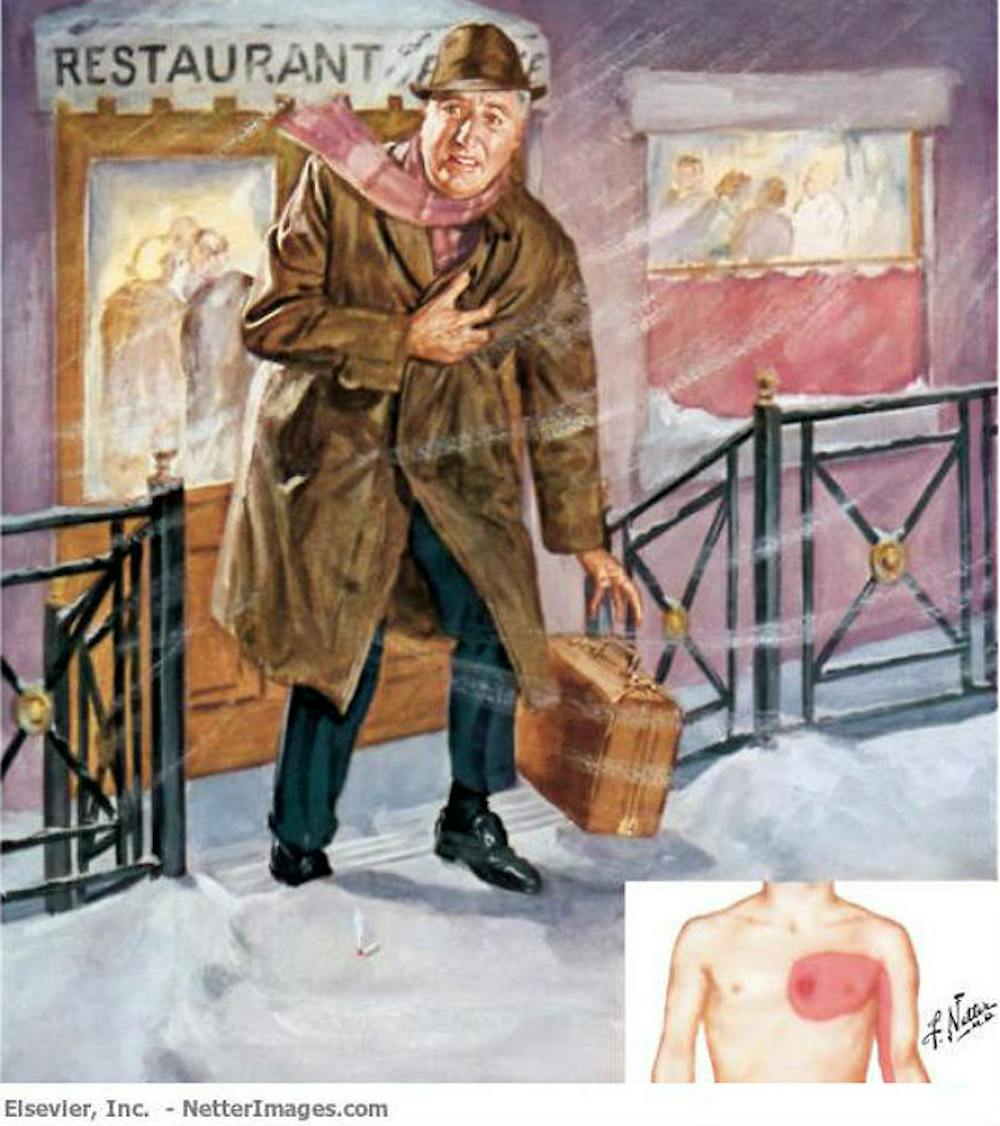 Frank Netter’s famous painting of a man clutching his heart shows how typically medical literature associates heart attacks with cold weather.
Elsevier
Frank Netter’s famous painting of a man clutching his heart shows how typically medical literature associates heart attacks with cold weather.
Elsevier
It is well documented that heart attack rates rise soon after a major natural disasters such as an earthquake, volcanic eruption or tsunami. These probably bring forward the timing a heart attack that was going to happen anyway as there are slightly fewer heart attacks a few weeks later.
But natural disasters are of course unpredictable, so we can’t prepare for them in the same way as some natural rhythms: night and day, summer or winter, wet or dry seasons. This is why research that confirms something we can plan for is a risk factor is important.
Predicting heart attacks
Reasons for why someone is prone to a heart attack are clear. These are obvious risk factors such as high blood pressure, abnormal cholesterol, smoking or diabetes as well as unseen underlying genetic and environmental factors. But the the reasons for the timing of heart attack are more difficult to understand.
Atherosclerosis, the underlying disease process leading to blockage of a coronary artery and heart attack, develops over many decades. There appears to be randomness to when thrombosis, the blood clot that forms in a vein or artery and causes the final and sudden event, occurs. It can occur during sleep, emotional stress and extreme physical activity – but more commonly, it occurs when not much is happening at all.
Read more: How Australians Die: cause #1 – heart diseases and stroke
Then there are other people with advanced coronary artery disease who have never had a heart attack. If we knew more about the short-term triggers, we could help people with coronary disease avoid some of them. And if we knew some of the longer-term influences on rates, we could tailor scarce resources in the emergency and health systems to be ready for peak periods.
Why is winter riskier?
There is a clear association between cold and artery function (the vessels that deliver oxygenated blood from the heart to other parts of the body). This can be illustrated by a common physiology lab manoeuvre known as the cold pressor test. People are asked to put their forearm into iced water. Blood pressure rises immediately because arteries constrict, presumably to maintain core body temperature at normal levels.
Read more: Health Check: what do my blood pressure numbers mean?
Simple hydrodynamics tells us constriction is more profound and impacts more on the flow through a tube – in this case a coronary artery – at points of obstruction. In a few people with coronary disease the cold pressor test is enough to cause the artery to spasm and for flow to cease until the artery relaxes again.
But there are other factors that make heart attack more likely in winter than in summer. In many places, air pollution is more common, and evidence is accumulating that certain particles in the air are related to heart disease. Winter is also flu season, which makes people already at risk of heart disease more vulnerable.
 Emotions run high when people are confined to small groups.
from shutterstock.com
Emotions run high when people are confined to small groups.
from shutterstock.com
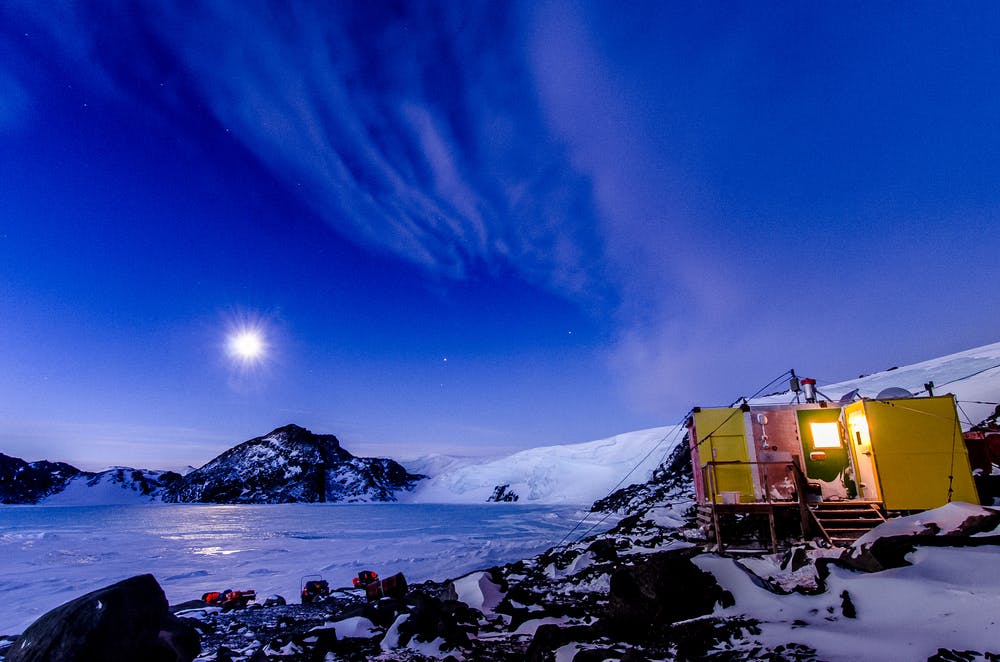
And our life is very different in winter than in summer. Studies performed by myself and my colleague Dr Gillian Deakin while she spent a year on a polar station in Antarctica demonstrated this. In winter it is always dark, and the weather prevents expeditioners doing much outside activity; they tend to put on weight and drink more alcohol.
Inevitably emotions are high when a disparate group is confined to a small area for a long time and away from their families and other everyday supports. Not surprisingly, their heart health was not the same as when they arrived. Blood pressure was higher and the metabolic pattern of their blood less healthy. This was remedied with a regular supervised exercise program.
Read more: Interactive body map: physical inactivity and the risks to your health
In summer there was a general feeling of “joie de vivre” as expeditioners conducted most of their work activities for the year. These often involved long hikes, moving large items of equipment and other physically demanding tasks. More light and milder weather allowed more time for outside leisure activities too as they explored the extraordinary Antarctic landscape and fauna.
Their blood pressure and metabolic profile improved markedly. The same exercise program they had undertaken in winter did little to improve these further as they were already at peak or near peak fitness.
What about heat?
This is an extreme example of what happens to many of us in temperate climates across the seasons and most smaller studies have reported a similar pattern to Sweden. Sudden variations in temperature also seem to be associated with heart attacks.
In Sweden and Antarctica there are very cold winters and much warmer summers. What about in the tropics where extreme heat is a defining climatic feature. A study in Pakistan also found a winter peak in admissions to coronary care units in winter. However, there was another peak in mid-summer when temperatures were highest.
So, by all means keep warm and comfortable in winter but get out and do something too. Look after your risk factors and see your doctor regularly for a heart check.
Authors: Garry Jennings, Chief Medical Advisor at National Heart Foundation of Australia; Senior Director, Baker Heart and Diabetes Institute
Read more http://theconversation.com/heart-attacks-more-frequent-in-colder-weather-105654


 Daily Bulletin


