

what any country can and can't do in Antarctica, in the name of science
- Written by: Julia Jabour, Leader, Ocean and Antarctic Governance Research Program, University of Tasmania
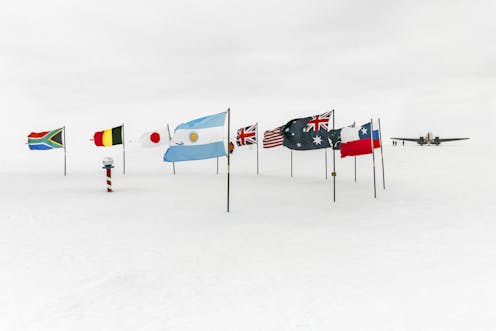
Antarctica is owned by no one, but there are plenty of countries interested in this frozen island continent at the bottom of the Earth.
While there are some regulations on who can do what there, scientific research has no definition in Antarctic law. So any research by a country conducted in or about Antarctica can be interpreted as legitimate Antarctic science.
Read more: How a near-perfect rectangular iceberg formed
There are 30 countries – including Australia – operating bases and ships, and flying aircraft to and from runways across the continent.
Russia and China have increased their presence in Antarctica over the past decade, with China now reportedly interested in building its first permanent airfield.
It is not surprising there is significant interest in who is doing what, where – especially if countries ramp up their investment in Antarctic infrastructure with new stations, ships or runways.
Their actions might raise eyebrows and fuel speculation. But the freedom of countries to behave autonomously is guided by the laws that apply to this sovereign-neutral continent.
Treaties and signatories
There are 12 original signatories to the 1959 Antarctic Treaty, including Australia, and they do not have to prove their commitment to the treaty since they wrote the rules.
Another 41 countries have signed on since 1959, and they do need to prove commitment.
Non-signatory countries, such as Iran or Indonesia, are freed from many of these legal obligations.
Until such time as the Antarctic Treaty has been designated customary international law applicable to all states by a high authority (such as the International Court of Justice), non-signatories can essentially do what they like in Antarctica.
The appliance of science
Autonomous freedom of activity by signatory countries is legitimised through the fact that science is the currency of credibility in Antarctica. This is important for two reasons:
- scientific research has legal priority
- new signatories can become decision-makers when they do science.
The “freedom of scientific investigation” is preserved in Article II of the Antarctic Treaty. It directs that signatories to the treaty can conduct scientific research of any kind anywhere in the Antarctic, without anybody else’s permission.
The Scientific Committee on Antarctic Research (SCAR) coordinates Antarctic research, but being a member is not a prerequisite for doing Antarctic science.
Further, the treaty outlines the process for new signatories (that is, other than the original 12) to achieve Consultative Party (decision-making) status.
Decisions are made by consensus (that is, everyone agrees or there is no formal objection). So every country’s “vote” counts and new countries aspire to gain a seat at the table to further their national agendas.
They become Consultative Parties by conducting “substantial scientific research activity” (Article IX.2) and when this has been accomplished to the satisfaction of the other decision-makers, they will be accepted.
Piggy backing
Demonstrating interest in Antarctic science was initially interpreted as building a base or dispatching an expedition (Article IX.2). But after the adoption of the environmental protocol to the treaty in 1991, this was re-interpreted.
Parties were encouraged (but not legally bound) to consider piggy-backing on existing national scientific expeditions of other countries, and to share stations and other resources such as ships and aircraft where possible.
Currently there is only one jointly operated scientific base - Concordia, occupied by both France and Italy. The Novolazarevskaya airfield is a joint operation coordinated by Russia.
This encouragement was designed to reduce the potential for expansion of the footprint of human activities.
In 2017 the Consultative Parties adopted revised guidelines for how to become a decision maker. These outline new rules on a concept that has never been articulated publicly in an Antarctic forum before – evaluating the quality of scientific research.
This could put the brakes on the rapid addition of new signatories to the table.
There are limits
Although there is freedom to conduct science anywhere in Antarctica, what any country cannot do is lay claim to territory on the basis of its research efforts.
The treaty expressly excludes new claims or the extension of existing claims. Signatories that conduct research, and support those endeavours by building a base and infrastructure such as an airstrip, cannot use those actions as a basis of a claim while the treaty is in force.
Seven countries claim Antarctic territory: Argentina, Australia, Chile, France, New Zealand, Norway and the United Kingdom. Two others – the United States and the Russian Federation – have reserved their rights to claim any or all of Antarctica in the future.
These paper claims are acknowledged by Article IV of the treaty. But its artful craftsmanship prevents conflict over the claims and reservations during the life of the Treaty – which incidentally has neither an expiry nor a future review date.
Because the Article II freedoms permit research to be undertaken anywhere on the continent, the borders delineating claims become irrelevant to all but the claimant.
A party has an option of recognising a claim, or not, and does not need anyone’s permission to build a station or send an expedition. This means that the claimants have very limited capacity to exercise sovereignty in their territory. This effectively reduces their power to that of jurisdiction only over their own nationals.
Read more: How a trip to Antarctica became a real-life experiment in decision-making
The sting in the tail is that conducting substantial scientific research activity in Antarctica – including the building of support infrastructure – is the pathway new states must take to achieve decision-making status.
This is only constrained by the legal requirement to undertake an environmental impact assessment of any activity prior to its commencement.
Irrespective of whether the activity’s proponent complies with best practice environmental evaluation, under the rules, no other party can veto that activity.
Essentially, any country – whether a party to the treaty or not – can do whatever they like in Antarctica.
Authors: Julia Jabour, Leader, Ocean and Antarctic Governance Research Program, University of Tasmania


 Daily Bulletin


