

Death doulas can fill care gaps at the end of life
- Written by: Deb Rawlings, Lecturer in Palliative Care, Flinders University
With continual advances in modern medicine, we’re enjoying longer lives. As the population ages, and particularly as many people are living longer with cancers and chronic diseases, end-of-life care is adapting and changing.
People who are approaching the end of their lives will usually spend some or most of their time at home, requiring care and support to do so. Family members might not always be available to provide this care. When they are, the process can be rewarding, but it can also be challenging and complex, often leading to a severe emotional burden for the carer.
Gaps in our health and social care systems are starting to be filled by death doulas. But beyond providing practical support, families are increasingly seeking the services of death doulas to help navigate the experience of dying. Those nearing the end of their lives, too, may bring in a death doula to ensure they can die the way they want to.
We urgently need a conversation about death doulas and new models of care at the end of life. We are continuing to build an evidence base through research with the death doula community and via consultation with the health services that interface with death doulas.
Read more: Planning for death must happen long before the last few days of life
Defining the death doula
We’ve seen a similar concept in midwifery, where birth doulas have long been providing social, emotional and practical support to help women through the process of childbirth. This has been shown to have positive outcomes for mothers and their babies.
Like birth doulas, death doulas’ roles and functions are non-medical; these can include advocating, supporting (spiritually and sometimes physically), guiding, and providing emotional support to the person and their family, mainly in the home.
We undertook a systematic review of the literature to find available evidence about the death doula role. We found little formal academic literature describing the role, their training, or contribution to individuals, families and the health system.
But what we do know is that each death doula enacts the role differently. They might spend time with the dying person, offering emotional and spiritual support, and sometimes providing physical care. They might support the family carers in the work they are doing. Some death doulas are only present in the last days of life, offering “vigiling” – sitting with the dying person so they are not alone.
Some doulas offer after-death rituals such as helping families prepare the body or keeping the deceased at home.
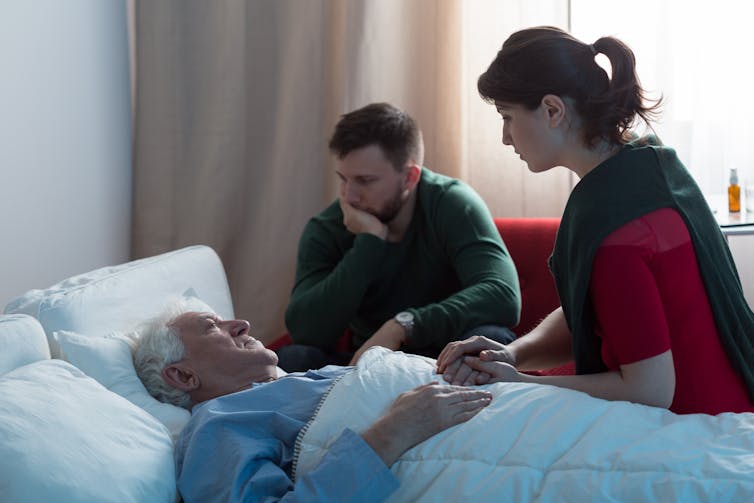 A death doula can provide additional support to family members acting as caregivers at the end of life.
From shutterstock.com
A death doula can provide additional support to family members acting as caregivers at the end of life.
From shutterstock.com
Some death doulas are paid by families who engage their services. Families have often found their chosen doula online or through word-of-mouth. Other death doulas work voluntarily, in a similar way to a hospice volunteer. But, because there are no formal structures or registers, we don’t know how many death doulas there are.
In Australia and elsewhere, palliative care nurses, social workers and those from the funeral industry work as death doulas. This seems to be a natural progression, but it’s a grey area: they are providing care, but are not registered or supervised.
There is little formal assessment to guide patient and family choice or to inform end-of-life care provided by professionals.
How can doula care be formalised?
Providing care in homes can be informal. It may be provided by families, friends, or community groups. Care can also be formally negotiated and provided by health services, aged care providers or private agencies.
It’s necessary to understand the implications of the death doula role. For example, they could become part of formal care arrangements such as home care packages or via private health insurance funding.
We also need to look at how these new roles are authorised to represent the dying person, as they are neither a family member nor a qualified health professional. It’s also important that they are appropriately trained and insured (if providing paid services).
Sign up for the newsletter
 Sign up to Thrive, a weekly dose of evidence to help you live well.
There are personal, social and cost advantages in enabling care in the home for a dying person. For families, being able to support the person in a familiar environment can be a powerful motivator to engage a death doula to fill the gaps in care provision.
For the health system, care in the home is seen as positive. It can avoid unnecessary hospital use and help spread the costs of caring.
For the dying person who may prefer to die at home, it is a way of achieving this. Importantly, death doulas can improve the dying person’s ability to control their own care.
Read more:
What is palliative care? A patient's journey through the system
The death doula role may well incorporate some of the direct care provided by families and help them to navigate the complex needs and planning required at the end of life. If so, death doulas could represent an important opportunity to improve dying outcomes.
We need to ensure our community is informed, health service provision crosses both hospitals and homes, and that those providing care – regardless of setting – have skills and knowledge appropriate to their role.
Sign up to Thrive, a weekly dose of evidence to help you live well.
There are personal, social and cost advantages in enabling care in the home for a dying person. For families, being able to support the person in a familiar environment can be a powerful motivator to engage a death doula to fill the gaps in care provision.
For the health system, care in the home is seen as positive. It can avoid unnecessary hospital use and help spread the costs of caring.
For the dying person who may prefer to die at home, it is a way of achieving this. Importantly, death doulas can improve the dying person’s ability to control their own care.
Read more:
What is palliative care? A patient's journey through the system
The death doula role may well incorporate some of the direct care provided by families and help them to navigate the complex needs and planning required at the end of life. If so, death doulas could represent an important opportunity to improve dying outcomes.
We need to ensure our community is informed, health service provision crosses both hospitals and homes, and that those providing care – regardless of setting – have skills and knowledge appropriate to their role.
Authors: Deb Rawlings, Lecturer in Palliative Care, Flinders University
Read more http://theconversation.com/death-doulas-can-fill-care-gaps-at-the-end-of-life-105743


 Daily Bulletin


