

Man who burnt his wife alive gets at least 27 years' jail, but not life
- Written by: Lisa Featherstone, Associate Professor in Australian History and the History of Sexuality, The University of Queensland
Last week in the New South Wales Supreme Court, Justice David Davies sentenced a 45-year-old man found guilty of murdering his wife to a maximum of 36 years with a minimum non-parole period of 27 years. He had burned her alive in the family home in front of their two children, and had blocked her escape. The crime involved “gratuitous cruelty”, said Justice Davies, adding it was “difficult to imagine the horror” of the victim’s last minutes alive. Her remains were found between a bed and a window blocked by bars.
During sentencing submissions, the Crown argued the case was an example of the worst possible category of murder, and called for a life sentence. The man and his victim cannot be identified for legal reasons.
Yet, Justice Davies did not hand down the maximum penalty for murder, claiming the prisoner did not require a life sentence as his victim was not “unknown” to him:
This was a murder committed, not at large against a person unknown to the offender, by a person with no prior criminal record. I do not mean to suggest thereby that the murder of a spouse or a partner is any less serious than the murder of a stranger. However, it is a matter which is relevant to the issue of community protection.
Community protection is one of a number of issues judges weigh up when sentencing.
Read more: After a deadly month for domestic violence, the message doesn't appear to be getting through
Justice Davies also said the offender would be “a relatively old man by the time of his release”, and would thus pose a lower risk to the community. He noted the sentence is in line with other sentences in New South Wales, where, since 1991, a life sentence had been given only in cases of murder of a child alongside the female partner. A spokesperson for the NSW director of public prosecutions told us a possible appeal is still being considered.
The outcome of this case was a conviction for murder, and judicial acknowledgement of the serious violence and cruelty associated the perpetrator’s murder of his wife. But the intimate relationship between the perpetrator and victim was used to characterise the crime as falling short of the worst examples of murder. These approaches are common in the criminal law’s long-standing response to family violence.
A hierarchy of violence
Examining social and legal attitudes towards family violence shows there is a hierarchy of violence, where gendered assaults on family members are routinely viewed as considerably less serious than assaults on strangers. This hierarchy has pragmatic social and legal implications influencing reporting, policing and prosecution of family violence, with those crimes often remaining hidden in the private sphere of the home.
In sentencing decisions, domestic violence offenders are seen as posing a lower threat to the community at large. This framing of such crimes erases the threats to family members from these offenders as being regarded as “community” risk. As a result, families are seen as not deserving the same level of protection as other citizens. Further, criminological research shows serious family violence perpetrators do have versatile offending histories.
The relative public invisibility of family violence has a long history in law and culture, with domestic violence and intimate partner violence regularly being treated as less serious than offences against strangers.
1950s: familial sexual offences
In Australia in the 1950s, the nuclear family was the core of social organisation. Little public comment was made on intra-familial sexual abuse: it was largely a crime hidden from public discourse outside the criminal law and social welfare settings. Yet, higher courts dealt quite frequently with sexual abuse within the family, particularly criminal assaults on children by fathers and stepfathers.
Defendants, lawyers, judges and witnesses regularly explained familial sexual assaults as different to other forms of sexual crime. Often, familial sexual offences were often not understood as violence at all, but constructed as a problem of household morals (a husband’s alcoholism, a wife’s neglect, a child’s behaviour).
Read more: Infographic: A snapshot of domestic violence in Australia
Courts were told that children would soon forget about the assault, or that the victim had not been “harmed” by the abuse, especially in cases of non-penetrative sex. An assault might have been criminal, but this did not mean that it was necessarily understood as abusive.
Judges’ statements from the period show that familial sexual abuse was seen as less serious than if a man had offended outside his family. In one sentencing hearing in 1954, an offender (who had pleaded guilty to the indecent assault of his 14-year-old daughter) was given a more lenient sentence, as the judge explained he had not assaulted children other “than his own”. The familial tie in this case was seen to lessen the severity of the crime.
Similarly, violence on intimate partners could also be understood as less serious than that against strangers.
1970s: rape in marriage
Until the 1970s and 1980s in Australia, rape in marriage was not a crime: following British common law, a husband had specific immunity from being charged with raping his wife. Under legal interpretations established in the eighteenth century, it was assumed that a wife gave her consent to sex for the life of the marriage, whether or not she agreed to an individual act of intercourse.
Read more: Money plays a role in family violence across cultures
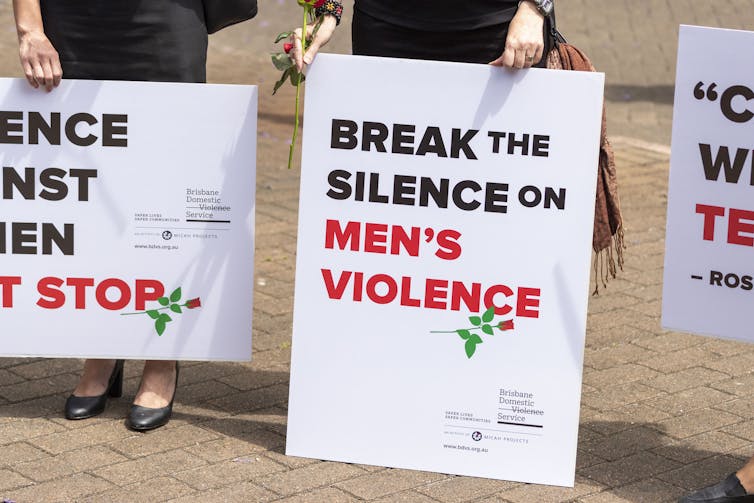 Public anger is growing over entrenched attitudes to domestic violence.
Glenn Hunt/AAP
Public anger is growing over entrenched attitudes to domestic violence.
Glenn Hunt/AAP
By the 1970s, a husband’s immunity had come into question. In part, this was due to rising rates of separation and divorce, around the key question: in the case of a family separation, when exactly did his right to sex end? It was questioned too by feminist agitation, as women’s liberationists argued that a married woman should not have fewer rights to bodily autonomy than a single woman.
We might now see criminalising rape in marriage as a popular, sensible reform. Yet there was surprising opposition to it across Australia. Over and over, public debate about rape in marriage showed that in both the law and in Australian culture, the rape of a man’s own wife was seen as less serious than “real rape” by a stranger.
Family violence
In Australian law and culture, it remains difficult to imagine the family as a site of violence, harm and trauma. As these case studies show, the minimisation of family violence has a long history.
Sentencing in intimate partner homicides is part of an enduring legacy of treating family violence as less serious than other forms of violence. It’s time we broke with the past and reframed our hierarchies of violence.
Authors: Lisa Featherstone, Associate Professor in Australian History and the History of Sexuality, The University of Queensland


 Daily Bulletin


