

One year on from Royal Commission findings on Northern Territory child detention: what has changed?
- Written by: Kate Fitz-Gibbon, Senior Lecturer in Criminology, Monash University
A change of government in the Northern Territory has done little or nothing to address the underlying issues relating to abusive practices inflicted on young offenders in detention - captured in images that sent shockwaves around Australia, and the wider world, more than two years ago.
On July 25, 2016, the ABC Four Corners investigative programme aired Australia’s Shame, a documentary featuring disturbing imagery and footage of children being abused while held in the Don Dale Juvenile Detention Centre in Darwin.
‘Hooded, shackled, strapped to a chair and left alone’
The evidence of abuse included accounts of detained boys who had been exposed to tear gas and the use of spit hoods while being held in isolation. This shone a national spotlight onto the violence perpetrated within juvenile justice institutions against some of society’s most vulnerable.
Read more: Evidence of NT detention centre abuse was there for all to see
After the documentary aired, then prime minister Malcolm Turnbull announced plans for a Royal Commission into the Northern Territory’s juvenile detention system Royal Commission into the Protection and Detention of Children in the Northern Territory. The then NT chief minister, Adam Giles, of the Country Liberal Party whose federal representatives vote with the Nationals, responded to the Don Dale allegations, stating: “I was shocked and disgusted…A community is judged by the way it treats its children.”
Since the Don Dale allegations emerged, there has been a change of NT government, with Michael Gunner now chief minister of a Labor government. A question emerges though: what changes have occurred for children in detention?
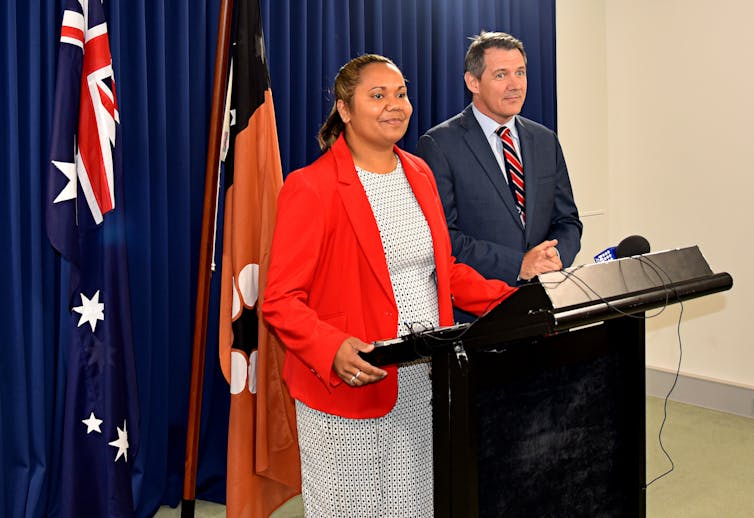 Michael Gunner, chief minister of the Northern Territory, with Nunggubuyu woman Selena Uibo, minister for education and workforce training, photographed in June.
Gregory Roberts/AAP
Michael Gunner, chief minister of the Northern Territory, with Nunggubuyu woman Selena Uibo, minister for education and workforce training, photographed in June.
Gregory Roberts/AAP
One Year on
We have just marked the one-year anniversary of the findings and recommendations of the Royal Commission into the Protection and Detention of Children in the Northern Territory.
The royal commission confirmed that over the past decade, children detained in the NT had been mistreated, verbally abused, humiliated, isolated or left alone for long periods, among other human rights breaches. At the sharp end of of rights breaches, the commission stated that many children held in detention had been assaulted by staff, who either wilfully ignored rules or were unaware of the rules. Either way, they clearly acted in breach of Australia’s international human rights obligations and some domestic laws.
Read more: Why are so many Indigenous kids in detention in the NT in the first place?
The royal commission found that senior government members were aware of but chose to ignore these abusive practices. The report made substantial recommendations for reform.
One year on, Don Dale continues to be in operation despite the royal commission recommending it be closed as soon as possible. The ongoing use of the facility continues to arouse significant concerns among legal practitioners, human rights advocates and youth justice stakeholders. It raises a critical question of what has been achieved in the 12 months since the commission reported - and in over two years since the ABC exposed “Australia’s shame”.
What has been achieved?
The NT government asserts that “Territory Families (an NT government department) is undertaking extensive reform of youth detention”, with the development of “an operating model that better considers the needs of young people”. It states that in 2017-2018 enhanced and specialised training has been completed, along with the hiring of 23 new recruits, the introduction of the ‘Australian Childhood Foundation’s Trauma Informed and Strength Based approach’ and Restorative Practice training. These developments represent important progress but recent high-profile incidents at the Don Dale detention centre pose further serious questions about the extent to which the problems at the heart of the Royal Commission remain unaddressed.
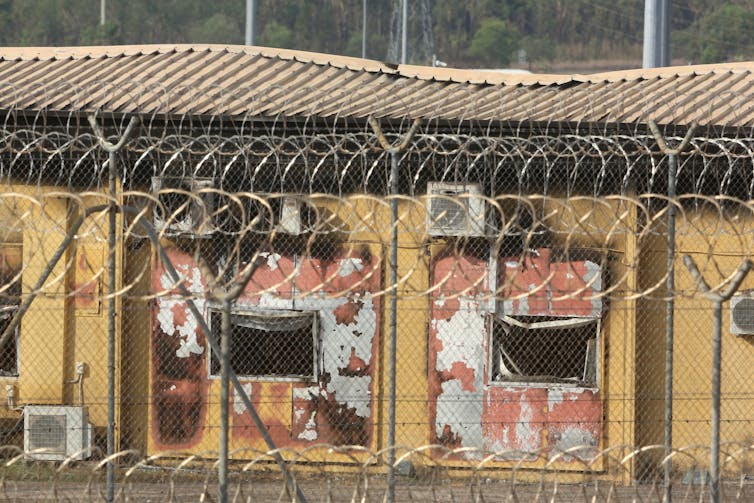 The notorious Don Dale youth detention centre near Darwin pictured last week after a distubance.
Glenn Campbell/AAP
The notorious Don Dale youth detention centre near Darwin pictured last week after a distubance.
Glenn Campbell/AAP
Earlier this month, Don Dale dominated the media headlines again following reports of riots, fires within the detention centre and staff assaults. Reports stated that tear gas had been deployed. Other allegations reported include young women “showering and using the toilet under the watchful eye of security cameras which are recording and monitoring on site”.
These reports act as an unwelcome reminder of the continued broken state of NT’s juvenile justice system and the ongoing and urgent need for change to ensure better protections for young people held in detention.
The continued failure to protect children’s rights
It is nearly 30 years since Australia ratified the 1989 Convention on the Rights of the Child. Yet we still do not have a national strategy or measures to ensure the implementation of appropriate protection of children’s rights in Australia.
Serious concerns about the state of children’s rights in Australia were highlighted in the latest national coalition NGO report to the United Nations Committee on the Rights of the Child. The Children’s Report, published by UNICEF on November 1, draws on 58 consultations with 527 children and young people in 30 locations around Australia. Its findings draw significant attention to Australia’s gross violations of the rights of children held in detention.
Read more: Abuse in youth detention is not restricted to the Northern Territory
The report makes a substantial number of recommendations that build and give national standing to those previously made by the royal commission. They include: that the government immediately review and amend youth justice legislation, policies and practices to ensure that all children are treated consistent with the UNCRC and the Beijing Rules. It also recommended that governments prioritise detention centres where children are placed as requiring immediate action as part of the implementation of the Optional Protocol to the Convention against Torture and Other Cruel, Inhuman or Degrading Treatment or Punishment.
Another recommendation was that all governments prohibit the use of solitary confinement other than as a last resort; prohibit the use of restraints against children and routine strip searches, unless all other options have been exhausted. Importantly, the report also recommends that governments ensure the existence of child specific, independent inspectorates and complaint mechanisms.
The Children’s Report explicitly calls for governments to be held accountable to the children and young people affected by state failings in the provision of juvenile justice, and calls out the failure to implement the recommendations of the royal commission.
Mechanisms for accountability
The lack of substantive progress in the year since the commission reported highlights the need for accountability and independent implementation monitoring. Scepticism over the degree to which the commission will represent a moment of change is understandable. It is now more than 25 years after the Royal Commission into Aboriginal Deaths in Custody. For many, the lack of progress since that 1998 Royal Commission casts doubt over the potential for this royal commission to achieve meaningful change to the lives of young indigenous Australians in the NT.
The Northern Territory government has allocated $70 million for the construction of two new detention centres in Darwin and Alice springs. It is expected that these will be completed in mid-2020.
The royal commission established that the present situation is unacceptable. UNICEF’s report reaffirmed this on the international human rights stage. Change in this area cannot be slow and cannot be incremental. We have the evidence, the commission has laid out the road map and now action is needed.
We call on the NT government to act to better protect the rights of the children within its care.
Authors: Kate Fitz-Gibbon, Senior Lecturer in Criminology, Monash University


 Daily Bulletin


