

Your riding position can give you an advantage in a road cycling sprint
- Written by: Paul Franciscus Johannes Merkes, PhD candidate, Edith Cowan University
Many professional road cycling events are hundreds of kilometres long, but the final placings are often decided by what happens in the last few seconds of any race stage.
New research shows that a rider can gain up to an extra 5kph advantage in those final sprint seconds, and it all depends on how they position themselves on their bicycle.
That can be enough to make the difference between winning or losing a race.
Race to the finish
If you’ve ever watched a professional road cycling event, either live or on television, you know they can go on for several days or even weeks.
Read more: 3D concrete printing could free the world from boring buildings
But more than half of the stages during the Santos Tour Down Under and the Tour de France, as well as some of the recent World Championships, were won in either a head-to-head, small group, or mass sprint finish.
The average speed during professional road cycling sprints is 63.9kph (53.7-69.1kph) sustained for between 9 and 17 seconds for men, and 53.8kph (41.6-64kph) for 10-30 seconds for women.
During the sprint, men produce peak power outputs between 13.9 and 20.0 Watts per kilogram (989-1,443 Watts), and women 10.8-16.2 Watts per kilogram (716-1,088 Watts).
But peak power output is not the only important factor to win the sprint, with tactics playing a significant role.
Our new research, published this month in the International Journal of Sports Physiology and Performance, shows that adopting a forward standing position during a sprint could give riders a speed boost of up to 5kph.
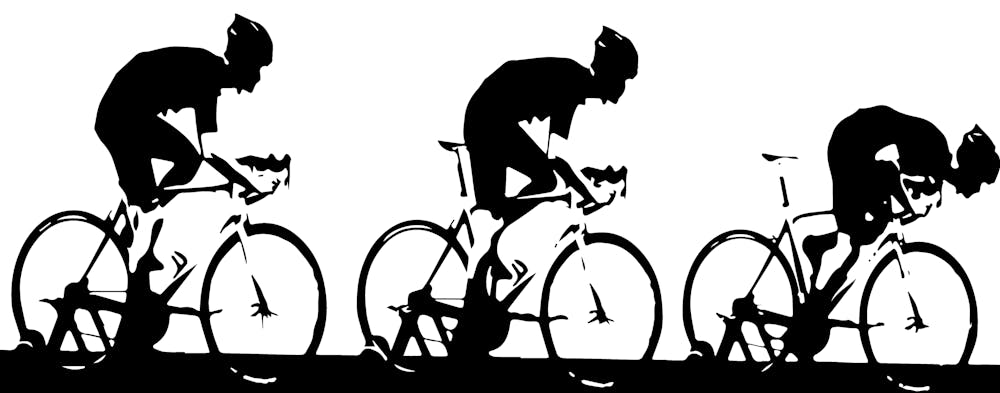 The three tested sprinting positions from left to right: seated, standing, and forward standing.
International Journal of Sports Physiology and Performance, Author provided
The three tested sprinting positions from left to right: seated, standing, and forward standing.
International Journal of Sports Physiology and Performance, Author provided
The drag on a cyclist
Cycling speed is affected by several factors, including power output, aerodynamic drag (CdA), road characteristics, and environmental variables.
During the sprint, roughly 95% of the total resistive forces working against the rider is caused by aerodynamic resistance. Therefore, it is important to reduce aerodynamic drag in road cycling, particularly during the sprint which is the fastest activity on the bicycle (with the exclusion of some downhill riding during a race).
Given that the outcomes of road cycling sprints are often decided by very small margins – in one race stage down to just 0.0003 seconds – the aerodynamics are meaningful to overall sprint performances.
Studies on flow dynamics in cycling have shown that lowering the head and torso significantly reduces wind resistance.
That is why several cyclists have, over the past few years, begun to adopt a forward standing cycling sprint position.
This novel sprint position has already shown to be successful at the highest level of professional cycling, in events such as the Giro d’Italia and Vuelta a España and in Australia’s biggest road cycling race, the Santos Tour Down Under (see video, below).
Santos Tour Down Under 2016 stage 6 victory in the forward standing position.Body position to the test
To better understand why this forward standing position may give riders an advantage, we compared it with the more traditional seated and standing sprint positions.
During the study, participants rode 250 metres in two directions at 25kph, 32kph and 40kph and in each of the three positions, resulting in a total of 18 efforts per participant.
During these efforts we measured cycling velocity, power output, road gradient, wind velocity and direction, temperature, humidity, and barometric pressure.
We then used these variables, together with the weight of the cyclist and bicycle, and constants for rolling resistance and the efficiency of the drive system, in a mathematical model to calculate the aerodynamic drag.
This model has previously been shown to give valid measurements compared with a wind tunnel.
The results are in
We found the forward standing cycling sprint position resulted in a 23-26% reduction in aerodynamic drag compared with a seated and standing position, respectively.
This decrease in drag could potentially result in an important increase in cycling sprint velocity of 3.9-4.9kph.
Read more: Skill vs luck: who really deserves the rewards from success?
Throughout the average duration of a typical road cycling sprint (about 14 seconds) this would result in a gain of 15-19 metres, which is why it could mean the difference between winning and losing a race.
How ECU is helping the world’s best cyclists improving their sprint performance.While this novel position was more aerodynamic, it is plausible that changes in body position may influence a rider’s movement kinetics, and therefore increasing or decreasing power output. This is currently under investigation in this PhD project.
But cyclists who want to improve their sprint performance might want to start practising the forward standing position. It takes time to learn how to sprint in that position but you could gain those aerodynamic benefits, and potentially win more races.
Authors: Paul Franciscus Johannes Merkes, PhD candidate, Edith Cowan University


 Daily Bulletin


