

public housing tenants fight for their place in the city
- Written by: Pratichi Chatterjee, PhD Student, Urban Geography, University of Sydney
After years of strong housing market growth, Sydney’s property market is slowing. Despite this, housing stress remains a reality for many Sydneysiders, with rents remaining largely untouched.
Public housing is a lifeline for those who can’t afford to rent in the private market, but the numbers of households in this position means many must wait years for a place.
Median rents for apartments in Sydney fell only 0.9% in the September quarter, to $545 a week. This means a household needs to earn about $94,000 a year to avoid housing stress. About half of the households in Sydney earn less than this.
Adding to these cost pressures, tenancy laws are strongly weighted in favour of landlords. This gives tenants little security of tenure and exposes them to frequent upheaval, inadequate conditions and rental hikes.
Read more: An open letter on rental housing reform
But public housing tenants are also facing upheaval and uncertainty in inner-city areas such as Waterloo and Redfern, as a result of redevelopments that they feel are aimed at pushing their communities out of the city.
What is happening to public housing?
The lack of public housing investment in New South Wales and the costs of private rental mean over 50,000 people are on the state waiting list. In inner-city areas, they face a wait of five to ten years for public housing.
Through the Communities Plus program and the Social and Affordable Housing Fund, the NSW government plans to build 27,000 more social and affordable homes. But this figure is somewhat misleading. In the last three years, the government has sold off half as much public housing as it has built. And the figure of 27,000 looks more like 9,900 when you consider that this includes around 17,000 dwellings that will be demolished and rebuilt.
Several of the housing estates that remain will undergo massive redevelopment. One of these projects involves Sydney’s largest inner-city public housing estates, in Waterloo. The redevelopment will transform it into a mixed estate of 70% private housing and 30% social housing, going from just over 2,000 dwellings to potentially more than 7,000.
Residents fear being pushed out
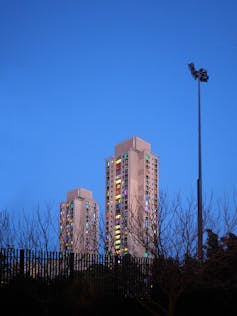 The Waterloo redevelopment will produce a mixed estate of 30% social housing and 70% private.
Carol Tang, Author provided
The Waterloo redevelopment will produce a mixed estate of 30% social housing and 70% private.
Carol Tang, Author provided
Since the redevelopment was announced in 2015, we have been working with the residents of Waterloo to understand their experience of the redevelopment. Many residents feel the project is a ploy to “move the poor people out of the city”, as one of them put it.
While the government has promised everyone the right to return, there is still a huge amount of uncertainty. And this is justified given that, like many large infrastructure projects conceived during Sydney’s boom time, the Waterloo project will be subject to many changes and delays.
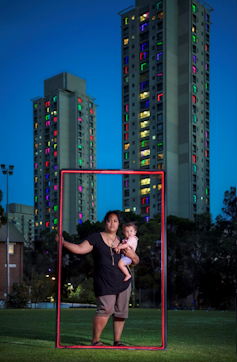 Residents of the Matavai and Turanga towers installed coloured lights in their windows to make a statement: ‘We live here’.
Nic Walker, Author provided
Residents of the Matavai and Turanga towers installed coloured lights in their windows to make a statement: ‘We live here’.
Nic Walker, Author provided
The residents of Waterloo, however, will not go quietly. “People are trying to speak up,” says Maryanne Laumua, a Waterloo tenant and key team member of the WeLiveHere2017 project.
One of the ways that residents are speaking up is by making their presence known on Sydney’s skyline. In September 2017, residents in the tallest of Waterloo’s towers, Matavai and Turanga, installed coloured lights in their apartment windows to make a statement: “We live here”. The residents’ efforts are chronicled in a new ABC documentary, There Goes Our Neighbourhood.
Read more: We Live Here: how do residents feel about public housing redevelopment?
A long history of displacement
A history of displacement through colonialism, redevelopment and evictions has shaped Waterloo and neighbouring Redfern. The Gadigal people were violently dispossessed of their country after European invasion. Throughout the last century, “slum clearance” displaced many working-class households.
The demolition of The Block in Redfern removed many Aboriginal families from their homes. The redevelopment in neighbouring Waterloo comes at a time when approval has been given to redevelop The Block. The Redfern development includes construction of student housing that seems to have priority over affordable Indigenous housing.
These areas also have a long history of organising against displacement. Waterloo residents joined with the unions as part of the 1970s Green Bans campaigns to limit the destruction of working-class housing in the suburb. Jenny Munro and other Aboriginal leaders have campaigned tirelessly for the rights of their community, which includes a years-long tent embassy protest on the site of The Block.
The redevelopment of Waterloo’s public housing estate will hardly make a dent in easing housing pressure in Sydney. And as Waterloo resident Karyn Brown puts it:
To solve the city’s housing crisis, they are picking on public housing tenants, those on the second rung of the housing ladder.
Waterloo tenants resisting the redevelopment are concerned that it’s a form of state-led gentrification. They see the notion of “social mix” — the idea that introducing private owners and tenants can “fix” disadvantaged communities — as a smokescreen for the class upgrading of their neighbourhood. Indeed, there is little empirical evidence to support the notion that social mix can solve a community’s problems.
Read more: Social mix in housing? One size doesn't fit all, as new projects show
Rather than a project intended to alleviate their disadvantage, many tenants feel that “social mix” is both classist and racist. As Lorna Munro and Joel Sherwood-Spring put it, the dilution of the existing community including the Aboriginal population is simply a continuation of the colonial project.
The residents of Waterloo’s public housing might be far from the city’s wealthiest residents, but they’ve got fighting spirit and community pride in spades. As There Goes Our Neighbourhood shows, this community is diverse, creative and determined to fight for their right to remain in the city.
There Goes Our Neighbourhood airs on ABC on Tuesday, November 20, at 9.20pm.
Read more: Class divide defies social mixing and keeps public housing stigma alive
Authors: Pratichi Chatterjee, PhD Student, Urban Geography, University of Sydney


 Daily Bulletin


