Cover girl: the difficulty of illustrating Lolita persists, 60 years on
- Written by: The Conversation
 Many covers of Nabokov's novel convey the false impression of Lolita as a young seductress.Ivana Vasilj
When it was published in 1955 by Olympia Press, Vladimir Nabokov’s seminal and controversial novel Lolita had a very simple, green cover design. Nabokov himself had wanted his own particular cover:
I want pure colours, melting clouds, accurately drawn details, a sunburst above a receding road with the light reflected in furrows and ruts, after rain. And no girls.
Some 60 years later – and still frequently topping best-book lists – Lolita has inspired hundreds of front cover designs, many of which feature similar visual tropes: endless lollipops, lips, lipstick, scrunchies, underwear, bathers, heart-shaped sunglasses from Stanley Kubrick’s 1962 adaptation, sly references to the female anatomy (strawberries, etc.), and a lot of pink.
In her work The Lolita Phenomenon (2003), academic Barbra Churchill, from the University of Alberta, wrote:
the Lolita image has so pervaded popular consciousness that even those who have never read the book usually know what it means to call a girl “Lolita". The moniker “Lolita,” translated into the language of popular culture, means a sexy little number, a sassy ingénue, a bewitching adolescent siren.
 GB Transworld/Corgi’s cover, London 1969.Image courtesy of Dieter E. Zimma
While many of the double-entendre images of the female anatomy partly suit Nabokov’s mischievous writing style and his playful treatment of the subject matter, many of these covers take this liberty a bit too far.
They convey the (false) impression of Lolita as a young seductress, when in fact the character was sexually abused by her step-father, the infamous Humbert Humbert, and robbed of her youth.
The discrepancy between the cover designs and the themes of the novel are stark. In 2013, The New Yorker’s Rachel Arons explained that “the sexualised vision of Lolita perpetuated by popular culture has very little to do with the text of Nabokov’s novel, in which Lolita is not a teen-aged seductress but a sexually abused twelve-year-old girl.”
 Penguin Australia’s cover, Melbourne 2011.Image courtesy of Dieter E. Zimma
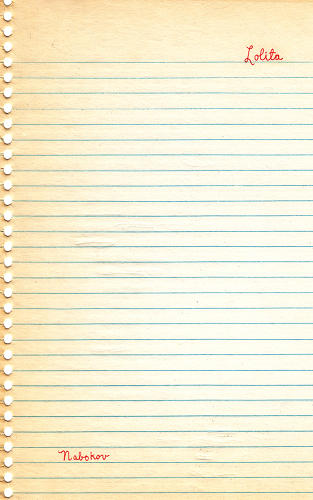
Other designs attempt to creatively capture and interpret, in a single image, the overall theme of the novel. There is Rachel Berger’s cover design of an old hand with a withered flower, Jason Polan’s design featuring just a simple loose-leaf writing sheet, and Andy Pressman’s design, which captures Lolita’s elusiveness with a barely distinguishable image of the word “Lolita” on the cover.
These sorts of covers relate more to Lolita’s lost youth and her dehumanisation than the sexual elements of the novel.
Many of those covers are featured in John Bertram and Yuri Leving’s book Lolita: The Story of a Cover Girl, Vladimir Nabokov’s Novel in Art and Design (2013), in which they argue:
If there ever were a book whose covers have so reliably gotten it wrong, it is Lolita.
Bertram and Leving’s book was inspired by a competition that Bertram held in 2009 for readers to redesign the cover of Nabokov’s novel. It shows how the novel’s cover has become something of an experimental terrain, and the number of covers just keeps growing.
Although we have been taught to disregard a book’s cover, media studies academic Nicole Matthews argues just the opposite in her work Judging a Book by its Cover (2007):
If jackets and covers had a role to play in the marketing of books during the nineteenth century, they came to have new forms of significance in the twentieth. Undoubtedly one of the critical shifts in the marketing of books in the twentieth century was the development of the paperback.
 Omega Boek’s cover, Amsterdam 1978.Image courtesy of Dieter E. Zimma
Arguably, the more sexually explicit the cover of a copy of Lolita is, the more likely it is to sell. This is true even if it deviates considerably from the specific themes of the book. M Gigi Durham, professor of gender, women’s and sexuality studies at the University of Iowa College of Liberal Arts and Sciences, discusses what she calls the “Lolita Effect”, in her 2008 book of the same name. Analysing the images of young girls in the media, Durham argues that the Lolita Effect “operates in a corporate, commercial sphere […] the Lolita Effect is driven by profit motives”. The link between media sexualisation and profit may operate just as fiercely in the publishing world.
As the nature of these covers attest, the “Lolita-as-sexpot” rhetoric is far more enticing for those who have not even read Lolita, suggesting that the existence and circulation of Lolita in the popular imagination is more profitable than a cover more befitting to the story’s ethos.
Interestingly, in his 2013 work Marketing Literature and Posthumous Legacies, Yuri Leving notes that the paperback in the early 20th century was more concerned with crime novels and romance dramas. This is an interesting point insofar as Lolita arguably contains elements of both (though the romance factor might be debatable).
Leving also notes how the Russian publication of Lolita was marketed as “a semi-erotic thriller”. What this may suggest is that the over-hyped sexual imagery we see today is not necessarily born out of misinterpretations.
Instead, early publications were seen to be taking advantage of the sexual themes present within the novel itself, and using them as a selling point that has since been taken dramatically out of context.
The execution of those Russian cover designs, Leving states, were poor. But it was also a technological issue:
Many of the creative solutions for cover design inevitably resulted from the limitations in polygraph printing technologies of struggling post-socialist publishing manufacturing.
 Gyldendal’s cover, Copenhagen 2011.Image courtesy of Dieter E. Zimma
But ironically, he adds, this “came closest to the late author’s original vision as expressed to his American publishers.”
Nabokov himself was no stranger to book promotion or marketing. Leving states that in publishing Lolita, Nabokov balanced his understanding of marketing with his demand for highbrow aesthetics in literature. But ultimately, no ideal cover was or has ever been created, and many contemporary cover designs certainly would have baffled Nabokov.
The original green hardback design is hardly alluring or meaningful in any way, and perhaps that is apt for a novel whose protagonist is the unreliable narrator par excellence, and whose subject matter is told with an eclectic mix of black humour and melancholy reflections. Since the novel itself resists any sound interpretation, a blank cover – even now, 60 years on – might be the way to go.
As Nabokov wrote in a letter to publisher Walter J Minton in 1958 from Ithaca, New York:
If we cannot find that kind of artistic and virile painting, let us settle for an immaculate white jacket (rough texture paper instead of the usual glossy kind), with LOLITA in bold black lettering.
Siobhan Lyons does not work for, consult to, own shares in or receive funding from any company or organisation that would benefit from this article, and has no relevant affiliations.
Authors: The Conversation


 Daily Bulletin