

What younger people can learn from older people about using technology
- Written by: Bernardo Figueiredo, Senior Lecturer in Marketing, RMIT University
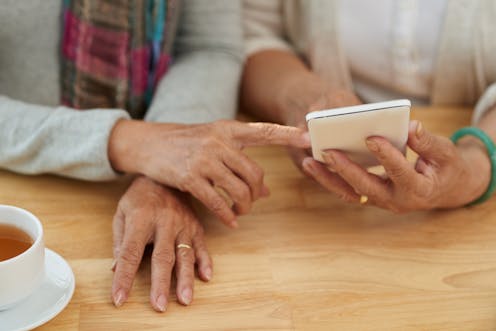
Older people are often portrayed in the media as being technically challenged. Jokes are often shared on social media about older people taking photos on their phones with their thumb covering the lens, or accidentally installing viruses on computers.
Some of these damaging stereotypes impact upon how ordinary Australians interact with older age cohorts. A study published by the Australian Human Rights commission found 20% of Australians avoid conversations about technology with older people as they feel explanations will take a long time and a lot of effort.
But older people can and do use technology – and younger generations could learn a thing or two from them about how to have a healthier relationship with digital technologies like social media.
Read more: Online dating could have been made for older adults – they love it
How older Australians use social media
The 2018 YellowSocial Media Report confirms that around two thirds of Australians over 65 (67%) use social media, and almost a quarter (24%) use it at least once a day. While this is much less than the overall population (where 88% use social media, and 62% are daily users), it shows that seniors are engaged.
Older Australians also use social media differently compared to others. Australians aged over 65 are much less likely to check their accounts when commuting, during lunch time, at breaks and before going to bed, compared to younger users who tend to take advantage of any opportunity to engage with social media.
So, older people are social, but on their own terms rather than those dictated by the capabilities of the technology or the device.
Older Australians also prefer to access social media at home more than younger generations, and access it less outside the home. They have the highest preference for desktop access (51%) and the lowest preference for smartphone access to social media.
In the home, they prefer to use a study more than any other generation, and they never access social media in the bathroom or on the toilet (which almost 40% of 18-29 year olds do).
Multitasking isn’t popular among older Australians. Compared with the rest of the population, only 25% of Australians over 65 years of age use social media while watching TV. They are also much less likely to use social media on their commute, when working, during breaks, at lunchtime, in the evening or before bed.
Read more: Connecting online can help prevent social isolation in older people
Developing healthier habits
These behaviours may have health benefits. For example, research has shown that the blue light on our mobile phone screens suppresses production of brain chemicals that make us sleepy, so reducing phone use before bed could lead to a better sleep.
The way older Australians use social media may have other positive attributes. They upload less content, consume less news and video content, and follow fewer brands and celebrities than the rest of the population.
This may explain why they are less anxious about being unable to check social media, and less worried their activities on social media will come back to haunt them. In younger cohorts, “fear of missing out” drives social media addiction.
Australians over 65 feel their social media usage is “about right”, and they are the least likely age group to feel they spend too much time on social media.
Technology as a means to an end
Older people apply workarounds that fit tech into their lives, rather than adapting their lives to suit the latest tech trends. These are patterns found in digital immigrants – those who had to adjust to technology at some point later in their lives. This is markedly different from younger digital natives, who grew up with social media and smartphones.
Seniors tend to use technology for a narrower range of purposes than others. Only 36% of older Australians use phones to access social media. This is a sharp contrast to the national average of 74%. They also prefer traditional ways of listening to music and watching videos over online entertainment.
Digital natives have created their social networks through technology and therefore have more “friends” on social media than digital immigrants. Studies show the average Australian has 239 friends on Facebook, compared with 68 for those above 65 years.
For digital natives, online contacts are as real to them as their face-to-face ones. But for the goal-oriented digital immigrants, technology may merely be a means to reach their existing networks, rather than a place to hang out. Seniors normally report higher levels of satisfaction with their social relationships than younger adults. Their relationships are intimate, supportive, rewarding, even if facilitated by technology.
Read more: The digital divide: small, social programs can help get seniors online
Ensuring learning goes both ways
Older people have something to teach younger generations about the healthy and safe use of social technologies.
Retroactive socialisation, which happens when younger generations transfer knowledge acquired in the marketplace to older generations, may be how older people learn, but we should recognise that older consumers are solving their problems in innovative and unexpected ways.
In an environment where primary socialisation about technology is being driven by the tech industry, there may be space for learning from older people about social participation that is driven by deep and meaningful personal relationships facilitated by technology and devices.
Authors: Bernardo Figueiredo, Senior Lecturer in Marketing, RMIT University


 Daily Bulletin


