

Why do so few Aussies speak an Australian language?
- Written by: Laura Rademaker, Postdoctoral Research Associate, Australian National University
Linguistically speaking, Australia is special. With around 250 languages spoken when Australia was first colonised, Australia was one of the most linguistically diverse places in the world.
But few people speak our Indigenous languages. As of 2016, only 10% of Australia’s Indigenous population spoke an Indigenous language at home. Most Indigenous languages are now “asleep”, waiting to be woken up by language revivalists.
Australian languages did not simply fade away; they were actively silenced by governments, schools and missions.
Read more: Some Australian Indigenous languages you should know
At most missions through the mid-20th century, Aboriginal languages were to be replaced with English. The Commonwealth Office of Education explained its intention in 1953:
The policy of assimilation demands a lingua franca as soon as possible – not only for communication between aboriginal and European but between aboriginal and aboriginal. That lingua franca must be English… There is a need everywhere for a planned, vigorous and maintained drive for English. Substitution of a new language for the old is not likely to disrupt the traditional social structure of the people any more than the substitution of Christian religion for their old religion and superstitions. In fact the former might assist the latter process.
As linguist Arthur Capell wrote in 1964:
Government policy looks forward to the loss of Aboriginal languages so that the Aborigines may be “assimilated.”
In pursuit of this policy, the Commonwealth Government banned Aboriginal languages in schools. It required teachers in mission schools to report on whether and for what reason they used any Aboriginal words. Aboriginal languages were to be forbidden even in the playground. The use of mission dormitories, separating children from families, compounded the attack on language.
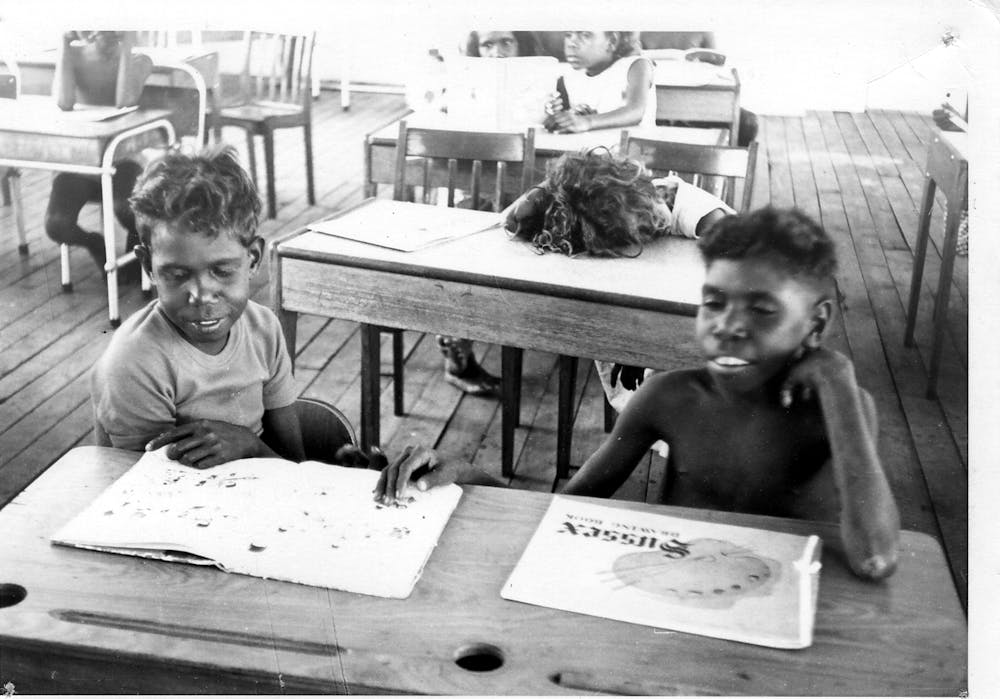 Mission school children on Groote Eylandt in the 1960s.
Groote Eylandt Linguistics
Mission school children on Groote Eylandt in the 1960s.
Groote Eylandt Linguistics
This attack was partly based on the idea that Aboriginal languages were deficient and impaired critical thinking. Missionary linguist Beulah Lowe was told in the 1950s that Aboriginal people have “no real language.” Linguist Robert Dixon remembered being told in 1963 that Aboriginal languages were “just a few grunts and groans.”
As recently as 1969, the Commonwealth government presumed the need for “remedial work” in Aboriginal schools due to the supposed “inhibitory influences” of “bilingualism in education”.
Nowadays educators are aware of the cognitive benefits of being multilingual.
Translating the Bible
The few Europeans who did learn Australian languages were mostly missionaries. But their approaches were contradictory. On the one hand they directly contributed to the loss of Aboriginal languages by putting children in dormitories, English-only schools and separating families. On the other, missionaries showed a greater concern for languages than other colonisers, due to their drive to translate the Bible.
These efforts to translate the Bible were slow compared to those overseas. The first Aboriginal Bible was completed in 2007 (in Kriol, spoken in northern Australia). The Maori Bible was complete in 1868 and by 1946 the Bible was in 30 Pacific languages.
Read more: Meet the remote Indigenous community where a few thousand people use 15 different languages
Translation efforts began in 1824 when Lancelot Threlkeld began learning Awabakal of the Lake Macquarie region and, with his Aboriginal co-translator Biraban, completed an Awabakal Gospel. But disease and violence devastated the community. By 1840 only 16 people were left at the mission.
Other small-scale translation projects followed. German missionaries, perhaps due to their Lutheran tradition of Bible translation or their unfamiliarity with English, made significant efforts. Teichelmann and Schurmann, for example, wrote a grammar of the Kaurna language of the Adelaide region in 1840.
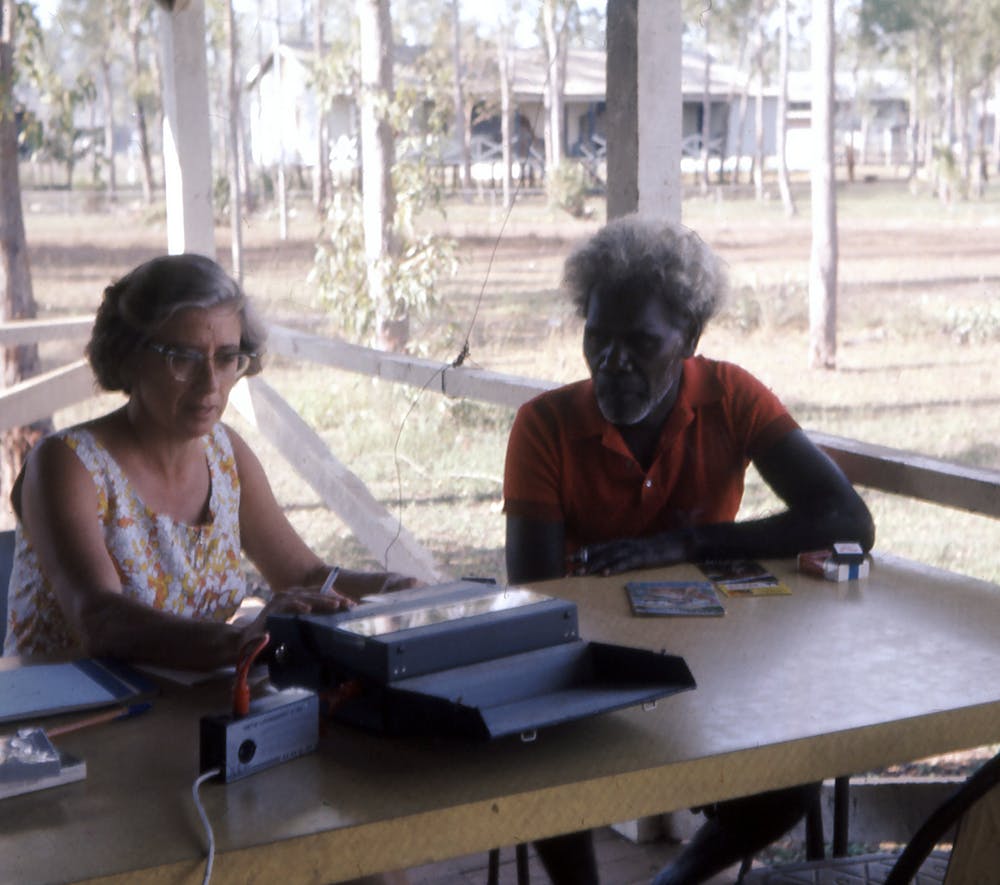 Missionary Judith Stokes and Gula Lalara work on the Anindilyakwa language in the 1970s.
Groote Eylandt Linguistics
Missionary Judith Stokes and Gula Lalara work on the Anindilyakwa language in the 1970s.
Groote Eylandt Linguistics
Missionary linguists always depended on Aboriginal co-translators to teach and translate their language. Carl Strehlow at Hermannsburg worked in with Moses Tjalkabota. Strehlow was one of the few who acknowledged his Aboriginal partner; we don’t know the names of others.
In many places, Aboriginal people used missionaries to have their language and knowledge recorded for future generations. Their foresight is being rewarded. Now, over a century later, their work is being used in language revival projects.
Learning English
Meanwhile, many Aboriginal people quickly learned English, finding it brought them opportunities to defend their interests. They were often gifted linguists. Usually already multilingual when the colonisers came, adding English was relatively easy.
Dispossession of land often meant distinct Aboriginal language communities were thrust together, so Aboriginal people used English, or an English pidgin, as a lingua franca. Some thought it best to keep their language secret from colonisers, perhaps to hide their Aboriginality and the associated discrimination, perhaps to uphold their authority over their cultural knowledge. So they spoke English.
Changing attitudes
By the 1940s, white Australia was realising Aboriginal people were not doomed to extinction. Instead, they assumed Aboriginal cultures and languages would die out once Aboriginal people assimilated.
Read more: Friday essay: dreaming of a 'white Christmas' on the Aboriginal missions
Aboriginal linguists and missionaries at Hermannsburg, Ernabella and Milingimbi in central and northern Australia advanced translation in Arrente, Pitjantjatjara and Yolngu Matha and used language in the classroom. Yet as late as 1964, Capell wrote of recording languages so that they “may be handed down to generations who will see them only as darker members of a European culture”. Linguistic research was still considered a matter of archiving languages on their deathbeds.
Attitudes began changing in the 1960s. In 1963, Yolngu people presented their Bark Petition to the Commonwealth government. The petition was written first in Gupapyngu with an English translation. Aboriginal languages could no longer be dismissed as “grunts and groans” of little cultural value.
In 1973, the Commonwealth government introduced mother tongue education at select Aboriginal schools. Aboriginal educators increasingly called for and implemented “two-ways” education.
Today it is possible to study Indigenous Languages Education or Yolngu Studies. Or you could learn a word a day through RN’s Word Up. Communities are “waking up” languages such as Kaurna and Awabakal. But there is a long way to go. Communities wishing to keep language strong still face barriers of policy, prejudice, funding and resourcing.
Authors: Laura Rademaker, Postdoctoral Research Associate, Australian National University
Read more http://theconversation.com/why-do-so-few-aussies-speak-an-australian-language-109570


 Daily Bulletin


