

Alban Berg's Wozzeck, an apocalyptic descent into madness
- Written by: Michael Ewans, Conjoint Professor, School of Humanities and Social Science, University of Newcastle
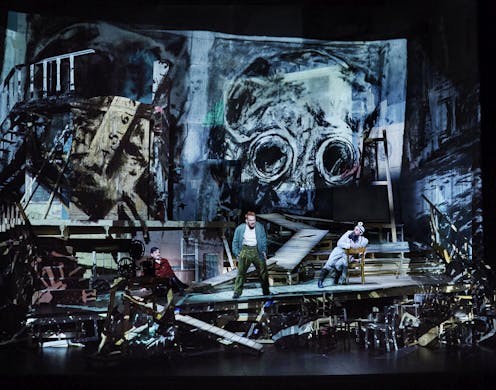
Alban Berg’s Wozzeck is arguably the most important opera composed in the first half of the 20th century. It is certainly one of the most powerful, and its emotional impact remains as strong today as when it was first performed in 1925.
The text for the opera is drawn from Woyzeck, a play by German playwright Georg Büchner that is one of the most extraordinary dramas ever written.
Read more: Decoding the music masterpieces: Rossini's opera, Otello
Büchner died at the age of 23 in 1837. He left several works behind, including fragmentary drafts of his masterpiece – Woyzeck. The play was not published in the posthumous 1850 edition of Büchner’s works, whether because of its occasional obscenity, its incompleteness, or the difficulty involved in deciphering the author’s cramped handwriting.
It eventually appeared in print in 1876. The drama had an enormous influence on the development of modern playwriting (Brecht was one of its warmest admirers), but it was not staged until 1913. The composer Alban Berg attended the first Vienna performances in 1914, and at once decided to make it into an opera, which became Wozzeck. (It was only discovered that the correct name of the hero was Woyzeck after Berg had composed most of the opera from an edition which printed it as Wozzeck).
The torment of the humble fusilier
Woyzeck is the first significant tragedy of “low” life, written in prose and with a common man as the hero. The titular Woyzeck is a fusilier in the army of his city-state (unnamed in the opera).
Nature plays a dominant role in Büchner’s drama. For Büchner, there is only a fragile boundary between the underlying animal aspects of human nature and morality and reasoning. These are only a veneer, easily broken down by passion into a reversion to nature. In Woyzeck, this happens when Marie, Woyzeck’s common-law wife and the mother of his child, allows the army’s Drum Major to take her to bed.
Wozzeck and the Captain (Act I scene 1). Franz Grundheber and Graham Clark in Patrice Chéreau’s production, conducted by Daniel Barenboim. From EuroArts.A doctor’s research, which involves placing Woyzeck on a diet of only peas, and Marie’s infidelity, push Woyzeck over the thin line between moral reasoning and instinctive, natural action; between sanity and insanity. Woyzeck goes mad. But Woyzeck’s “madness” gives him an insight into the workings of nature which is superior to that of the paranoid Captain whose Batman he is and the megalomaniac Doctor. Woyzeck can see into the abyss.
Having studied medicine and philosophy and lectured in natural history, Büchner possessed a unique combination of a compassionate human vision and scientific detachment. He viewed life as consisting of a sequence of separate pictures, apparently disconnected fragments. So each one of the play’s 27 short scenes presents one episode relevant to the drama of Woyzeck’s relationship with Marie.
This technique, which was revolutionary in the theatre – and indeed rendered Woyzeck unstageable before the 20th century – is reminiscent of German expressionist films created immediately after the first world war, particularly The Cabinet of Dr Caligari.
Büchner depicts Woyzeck’s descent into madness as the inevitable consequence of his existential terror. He imbues Woyzeck, his tormented, humble Fusilier and the victim of sexual betrayal and the Doctor’s medical experiment, with an extraordinary nobility. The text deploys language of vivid intensity, as Woyzeck struggles to express the visions which drive him to murder and madness.
Visions of terror
These visions are almost beyond expression in words – but not in music. In Act I, scene 2 of Berg’s opera, where Wozzeck is tormented by the apocalyptic power of Nature, the orchestra illuminates and makes real for the audience the terrors which in Büchner’s scene the audience can only imagine.
In the opera, the audience is forced to experience the visions from inside, from the point of view of Wozzeck. Creating that music required a creative leap by the composer, one which is still astonishing even today.
Wozzeck murders Marie (Act III scene 2). Franz Grundheber as Wozzeck, Waltraud Meyer as Marie. Directed by Patrice Chéreau, conducted by Daniel Barenboim. From EuroArts.The Viennese composer Alban Berg (1885-1935) saw Wozzeck at exactly the right moment in his own compositional development. Berg’s composition teacher Arnold Schoenberg had begun around 1905 to write short pieces within an idiom which abandons the system of keys and key-relations, known as tonality, which is the fundamental basis of 19th-century classical music. Instead, he favoured atonality, a style in which all sounds, even piercing dissonances, are permitted.
In his Three Pieces for Orchestra (1914) Berg was the first composer working in this style to incorporate structural devices that enabled him to compose atonal pieces on a larger scale.
The final March of the Three Pieces, which Berg wrote (prophetically) just before and after the assassination of the Archduke at Sarajevo, begins quietly enough, but rapidly becomes grotesque, terrifying and brutal.
The March from Alban Berg’s Three Pieces for Orchestra. Live recording from the Munich Philharmonie.This apocalyptic intensity and musical structure paved the way for Wozzeck. This opera required both extreme emotional intensity, as Berg responded with all his eloquence to the compassion and social protest of Büchner’s text – and a firm musical structure, to create unity among the diverse characters and episodes of the play.
Berg selected 15 of Büchner’s 27 scenes, and divided them into three Acts, each of five scenes. He then chose a musical form for each Act – Five Character Studies (Act 1), a Symphony in five movements (Act 2), and a set of six Inventions (Act 3). Within this overall design, each scene also has its own musical form.
Read more: Decoding the music masterpieces: Rossini's opera, Otello
Whether individual audience members consciously apprehend them or not, Berg’s chosen forms bring familiar resonances from classical music, and each one has been chosen to illuminate the dramatic and psychological essence of its scene.
The creative tension between overt emotional power and concealed but rigorous control is clear not only in the opera’s formal design, but also in the range of modes of vocal delivery, which extend far beyond those of classical opera. Once again, the pressure towards incoherence is counterbalanced by a minute attendance to volume and phrasing, together with precise notation of every grade of sound, from ordinary speech via pitched but half declaimed words, to full song and on to florid ornamentation.
Nearly a century after Wozzeck was first performed, it maintains a central place in the international repertory today, despite the challenges it presents to designers, directors and performers. Berg’s ability to use his extraordinary music to chart Wozzeck’s descent into madness, and the compassion with which he views his character’s suffering, have ensured its continuing acclaim.
Wozzeck is being staged by Opera Australia in Sydney from January 25 - February 15 2019.
Authors: Michael Ewans, Conjoint Professor, School of Humanities and Social Science, University of Newcastle


 Daily Bulletin


