

the significance of the Treaty of Waitangi
- Written by: Sandra Morrison, Associate Professor, Faculty of Māori and Indigenous Studies, University of Waikato
The Treaty of Waitangi is New Zealand’s foundation document. On February 6, 1840, the treaty was signed by representatives of the British Crown and Māori chiefs who acted on behalf of their hapū (sub-tribes).
Māori are indigenous to New Zealand, with historical ties and common narratives extending to Polynesia. The signing of the treaty confirmed formal European settlement in New Zealand. But debate and confusion have continued ever since regarding the exact meaning of the treaty text.
Read more: New Zealand's indigenous reconciliation efforts show having a treaty isn't enough
Nuance in translation
The debate stems from the fact that the parties involved in its signing, namely the rangatira (chiefs) and New Zealand’s first governor William Hobson on behalf of the British Crown, had different understandings and expectations as to what they had signed and what authority they would exercise.
There are two accepted versions of the Treaty of Waitangi: a Māori text known as Te Tiriti o Waitangi and the English version hereon called the Treaty of Waitangi. Under law both are accepted as the Treaty of Waitangi, but they are significantly different in meaning.
Te Tiriti speaks of the chiefs maintaining their tino rangatiratanga (authority) over their taonga (all that they hold precious, including the Māori language). The chiefs allow the Queen to have kāwanatanga, a nominal and delegated authority so that she can control her people. On the other hand, the treaty in English tells us that the chiefs ceded their sovereignty to the crown while retaining full, exclusive and undisturbed possession over their lands, estates, forests and fisheries.
A matter of interpretation
Given that at the time of the signing, the dominant language was Te Reo Māori and the majority of the discussions would have been conducted orally, the Māori text of Te Tiriti reflects the intentions of the chiefs. It is a critical reference point in informing our understandings, reinforced by the international convention of contra proferentem in relation to treaty making. This rule in contract law states that any clause considered to be ambiguous should be interpreted against the interests of the party that requested the clause to be included.
Claudia Orange, generally considered the most authoritative Pākehā (non-Māori) historian on the treaty, states:
The treaty was presented in a manner calculated to secure Māori agreement. The transfer of power to the Crown was thus played down.
Bear in mind also that the Declaration of Independence, the forerunner to Te Tiriti/Treaty, signed in 1835, had affirmed the authority chiefs already had. This meant they held mana and rangatiratanga (all power and sovereign authority). This system of political authority had been in place for many centuries.
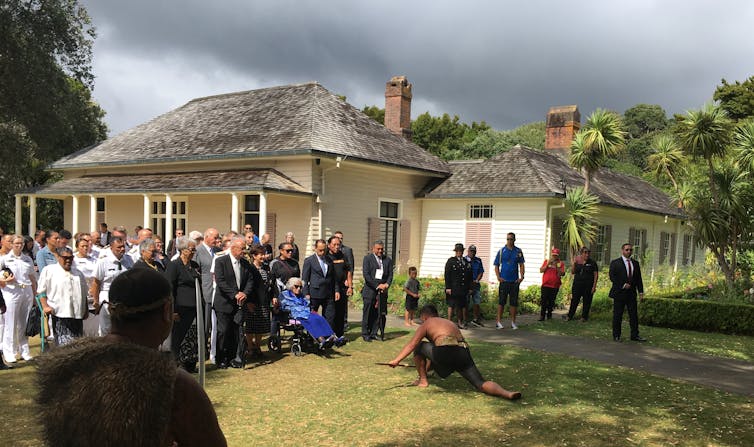 The Governor General of New Zealand, Dame Patsy Reddy, during a welcome ceremony to the treaty grounds at Waitangi.
Eileen Cameron, CC BY-ND
The Governor General of New Zealand, Dame Patsy Reddy, during a welcome ceremony to the treaty grounds at Waitangi.
Eileen Cameron, CC BY-ND
Legal status of the treaty
Fast forward to 2019 and what has been happening in the landscape of treaty jurisdiction. During and after the cumulative impact of introduced legislation and policies which led to systemic colonisation, consistent and unwavering Māori protests at violations of both treaties eventually led to the introduction of the 1975 Treaty of Waitangi Act and its 1985 amendment.
This gave us the Waitangi Tribunal, which allows for a process to hear claims about breaches of the treaty, typically the taking of land and resources from Māori. The tribunal found in 2014 that Maori did not cede their sovereignty in Te Tiriti o Waitangi. It also introduced a set of principles which embodied the intention of both treaties in an attempt to mediate the differences in the two versions.
A series of judgements and mandates by the courts and the Waitangi Tribunal also ruled that the Crown has the right to govern (kāwanatanga), subject to the protection of Māori interests (rangatiratanga). This position is not accepted by many Māori who will continue to advocate for the supremacy of rangatiratanga over kāwanatanga.
In his book about the treaty’s place in New Zealand law and constitution, Mathew Palmer notes:
The Waitangi Tribunal developed the core of an interpretation of the meaning of the treaty that could and should be applied in contemporary New Zealand. This was a forward-looking constructive approach to enhancing relationships between the Crown and Māori.
A long-standing education campaign about the Treaty of Waitangi has also helped non-indigenous New Zealanders to appreciate the significance of the treaty relationship.
Treaty settlements
Most discussions on the principles of the Treaty of Waitangi generally include the following:
- duty to act in good faith, reasonably and/or honourably
- principle of partnership
- principle of protection or active protection.
New Zealand’s constitution demands that robust public policy gives expression to the principles of the Treaty of Waitangi. This has led to the redesign of Crown agencies which must now be culturally responsive to the aspirations of Māori and actively innovate solutions to reduce the glaring social disparities where Māori are disproportionately represented.
The Waitangi Tribunal has heard and settled 54 treaty claims since 1989, including financial redress of more than NZ$1.5 billion. The first settlement, in respect of the Waitomo Caves, involved the transfer of land and a loan. Settlements since then have included several elements of redress: a formal apology by the crown, financial and cultural redress, the transfer of or the option to purchase significant properties, and restoration of traditional geographical names.
Since the identity of hapū is rooted in their physical and spiritual relationship with the environment over hundreds of years, these forms of cultural redress acknowledge the tribe as the rightful guardians and their deep association with place. The process seeks to restore the sacred relationships compromised by colonisation.
The treaty settlement process has been the catalyst for significant economic growth for iwi (tribe) controlled assets and Māori enterprise. This naturally brings positive development to the New Zealand economy, encouraging iwi and Māori to continue to progress their advancement not only economically but socially, culturally and environmentally.
Authors: Sandra Morrison, Associate Professor, Faculty of Māori and Indigenous Studies, University of Waikato
Read more http://theconversation.com/explainer-the-significance-of-the-treaty-of-waitangi-110982


 Daily Bulletin


