

Don't overlook residents' role in apartment building safety
- Written by: Matthew Bell, Senior Lecturer and Co-Director of Studies for Construction Law, University of Melbourne
For many of us, the reality of Australian homes now sits many storeys up in the sky. High-rise apartment buildings have sprouted across the nation’s cities. In recent weeks – on Christmas Eve at the Opal Tower building in Sydney and on February 4 at the Neo200 Building in Melbourne – that reality has turned into the nightmare for hundreds of residents of being turned out of their homes with little more than the clothes they were wearing.
Read more: The big lesson from Opal Tower is that badly built apartments aren’t only an issue for residents
Read more: Cladding fires expose gaps in building material safety checks. Here’s a solution
The Opal Tower evacuation was due to structural cracking. At Neo200, a fire raced up the building, fuelled by flammable cladding on part of its facade.
The rapid spread of the fire, and its apparent origin in a smouldering cigarette on the balcony, was eerily reminiscent of the Lacrosse building fire in Melbourne in 2014. It also brings to mind the Grenfell Tower inferno in London (probably originating in a small electrical fire). This catastrophe took the lives of 72 people and devastated the lives of many more.
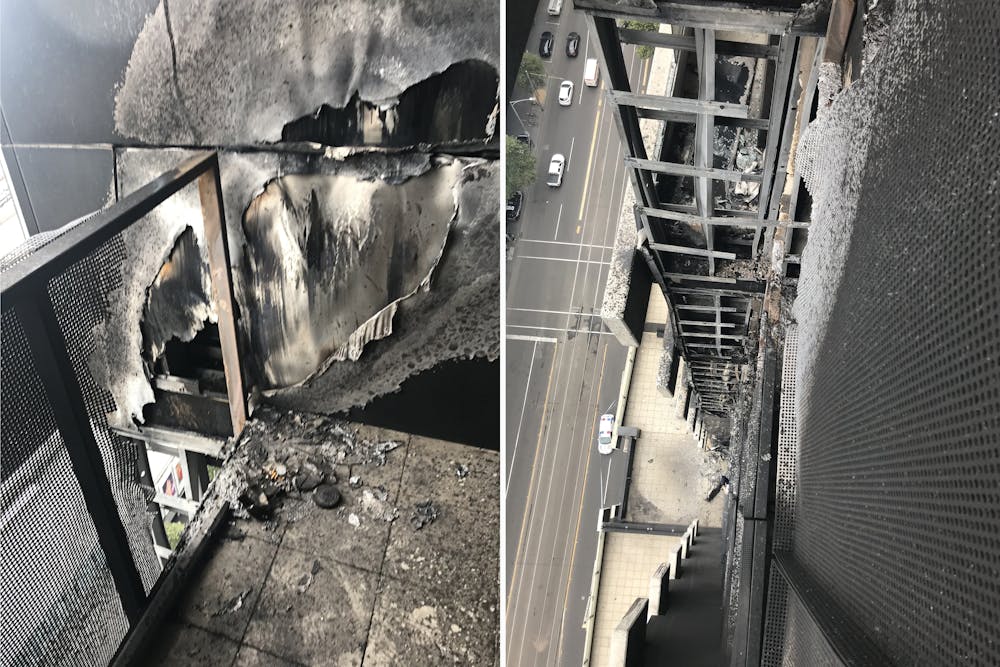 Flammable cladding on parts of the Neo200 building facade appears to have helped the fire spread rapidly.
AAP
Flammable cladding on parts of the Neo200 building facade appears to have helped the fire spread rapidly.
AAP
Read more: Grenfell: a year on, here's what we know went wrong
Media reports of the Neo200 fire included two concerning aspects:
Such behaviours and lack of knowledge compromise critical safety-related equipment. This represents both a challenge to, and reinforcement of, the critical role of residents in ensuring high-rise buildings are safe.
In the final report of the post-Grenfell “Building a Safer Future” review for the UK government, Dame Judith Hackitt observed:
Residents need to be safe, and feel safe, in their homes … they also have a responsibility towards their fellow residents to ensure that their actions do not compromise the safety of the building.
Six elements of residential building safety
The Hackitt Review joins a raft of reports that have influenced ongoing reform of residential construction regulations. In Victoria, notable recent contributions include the Auditor-General’s 2015 report on the consumer protection framework, and Shergold and Weir’s 2018 report for the Building Ministers’ Forum.
There is significant agreement between these reviews. Their vision for an effective regulatory scheme can be distilled into six elements, which need to interact holistically:
Information: all parties who have an influence on occupant safety need sufficient information about the risks in the building to make decisions consistent with protecting occupant safety.
Responsibility: while the “buck stops” with an adequately resourced regulator, all parties in the residential construction supply chain need to discharge clearly expressed, risk-based and complementary responsibilities.
Standards: people with appropriate expertise (for example, about how building materials interact) should set standards to be enforced throughout the supply chain.
Competence: where work requires particular skills and experience, only people who have these should do it.
Quality assurance: inspection regimes need to provide a robust “last line of defence” to catch defects before they threaten occupants’ safety.
Rectification: recognising that litigation is slow and expensive, dispute avoidance processes and insurance should expedite rectification.
 Multiple elements are involved in avoiding safety issues of the sort that led to Opal Tower residents being unable to stay in their apartments since Christmas Eve.
Mick Tsikas/AAP
Multiple elements are involved in avoiding safety issues of the sort that led to Opal Tower residents being unable to stay in their apartments since Christmas Eve.
Mick Tsikas/AAP
The Victorian regulatory regime for residential construction mainly comprises the Building Act 1993, its recently updated regulations, the National Construction Code which underpins those regulations, and the Domestic Building Contracts Act 1995. Justifiably, much of the recent reform focus has been on the role of the regulator under element 2 – the Victorian Ombudsman’s 2012 report led to the Victorian Building Authority replacing the Victorian Building Commission – and elements 3-6. Contributors to The Conversation have, for example, noted:
The regulatory response on each of these four elements remains a matter for ongoing debate. This is justified given that the performance-based nature of most standards-setting results in increased competence requirements.
What about the role of residents?
The Neo200 experience highlights, however, that the role of residents can be underestimated. In particular, where regulatory elements 1 and 2 refer to “parties”, this very much includes dwelling occupants and others who enter these buildings. It also includes the designers, builders and other construction professionals who are the primary concern of elements 3-6.
Given the diverse ways in which people visit, live or work in high-rise buildings, it will always be a challenge to devise ways to make sure occupants:
- have enough information to understand the risks of being in such buildings (whether or not there is combustible cladding)
- act in ways that reflect their responsibility to keep themselves and their fellow residents safe.
As recent moves in Victoria to register and inspect backyard pools and spas arguably demonstrate, there seems to be robust community support for intruding into people’s homes where the safety risk is seen as high. Is it time, therefore, to mandate airline-style safety briefings in apartments, regular inspections of apartments to make sure smoke detectors are working, and other similar interventions? Certainly, a recognition of occupants as active stakeholders would suggest such measures are appropriate in pursuit of a deeply held community goal of dwelling safety.
As a society, though, are we ready for such state-based assaults on our homes – upon what the Kerrigans regarded as their “castle”? Time will tell. In the meantime, the residents of the Neo200 building – like those at the Opal building before them – are left searching for alternative accommodation, and for answers.
Authors: Matthew Bell, Senior Lecturer and Co-Director of Studies for Construction Law, University of Melbourne
Read more http://theconversation.com/dont-overlook-residents-role-in-apartment-building-safety-111255


 Daily Bulletin


