

The Crown is Māori too
- Written by: Dominic O'Sullivan, Associate Professor of Political Science, Charles Sturt University
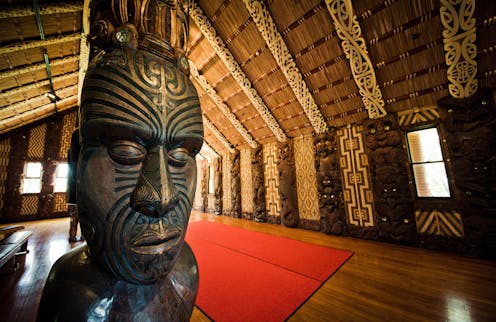
This week, New Zealand marked Waitangi Day, which commemorates the 1840 signing of the Treaty of Waitangi.
The treaty allowed Britain to establish government over its settlers (Article One), guaranteed ongoing Māori authority over their own affairs (Article Two) and gave Māori the rights and privileges of British subjecthood, which over time has become New Zealand citizenship (Article Three).
Read more: Explainer: the significance of the Treaty of Waitangi
The debate about the treaty’s precise meaning continues to this day. For some, it is a blueprint for constitutional order and justice. For others, a path to ethnic privilege – a Māori “birth right to the upper hand”. There are many interpretations in between and the treaty has important public policy significance.
Treaty debate focuses mostly on the agreement’s first two articles, and I argue that its third promise, of citizenship, is not getting enough attention. Discussions tend to place Māori and the Crown in a “them” and “us” binary, but citizenship means that Māori are also the Crown.
From subject to citizen
In 1840, British subjecthood was a limited promise. It contained few “rights and privileges”. There was certainly no right to participate in government. No expectation that one’s voice mattered.
But subjecthood evolved. In 1949, New Zealand citizenship became a legal category. Citizenship is much more than the right to vote, receive a welfare benefit or go to school. It is a body of political capacities - the capacity to have a meaningful say in how society works. Not just in the decisions that governments make, but in working out the values that inform decision making.
It means that Māori values should count in public affairs. For example, the five central concepts underlying Māori philosophy that the legal scholar Carwyn Jones describes:
- Whānaungatanga - the centrality of relationships to Māori life
- Manaakitanga - nurturing relationships, looking after people, being careful how others are treated
- Mana - the importance of spirituality, sanctioned authority and the limits on Māori leadership
- Tapu/noa - respect for the spiritual character of all things
- Utu - the principle of balance and reciprocity.
Read more: Strong sense of cultural identity drives boom in Māori business
Beyond the bicultural treaty
During the 1980s and 1990s, the concept of biculturalism that treats Māori and Pākehā (non-Māori New Zealanders) as neatly separable cohesive political communities and “as if they ran on separate parallel train tracks” dominated treaty discussions. While this approach made important contributions to Māori policy, it was also limited.
In 2019, it competes with alternative possibilities for self-determination. For example, several iwi (Māori tribes) have received financial and land settlements in compensation for confiscations that breached the treaty’s promises. Māori language and culture are continuing to grow in strength. A better educated population and the continuation of intermarriage mean that this kind of biculturalism - a “them” and “us” worldview - provides an increasingly limited way of thinking about political possibilities. It stops people thinking about what it means to be a Māori citizen - what it means to help determine the ways in which the state works.
From biculturalism to binationalism
While the English version of the treaty’s first article surrendered Māori sovereignty to the British Crown, the Māori text (which was the signed document), used the term kāwanatanga (governorship). In 2014, the Waitangi Tribunal, the body that deals with alleged breaches of the treaty, accepted Ngā Puhi’s argument (widely shared among Māori) that the treaty did not cede sovereignty.
Nevertheless, then minister of Treaty of Waitangi negotiations, Chris Finlayson, argued that:
There is no question that the Crown has sovereignty in New Zealand. This report doesn’t change that fact … The tribunal doesn’t reach any conclusion regarding the sovereignty the Crown exercises in New Zealand. Nor does it address the other events considered part of the Crown’s acquisition of sovereignty or how the treaty relationship should operate today.
But what is the Crown, what is sovereignty and how do these relate to citizenship as it has developed from the British subjecthood that the treaty promised?
Read more: The Treaty of Waitangi and its influence on identity politics in New Zealand
Sovereignty and citizenship
Sovereignty is not an absolute and indivisible power, exercised over subjects by an all-powerful Crown, as it was in 1840. It is a collective political authority in which all citizens participate. Helping to shape public sovereignty is an essential part of what it means to be a citizen.
At the same time, citizenship is not a panacea for creating just political relationships between Māori and others. Nor does it guarantee the political space for Māori to exercise rangatiratanga (authority) over their own affairs. But it does mean that sovereignty belongs to Māori as much as it belongs to anybody else. At least theoretically, it is not an oppressive force.
Bringing that theory into practical politics requires that article three receive much greater attention in treaty discourse. Guaranteed Māori representation in parliament is an example of Māori exercising the right to citizenship in a distinctive way, but sovereignty is not found in parliament alone.
Questions of where else Māori might exercise their citizenship and what it means to do so in authentically Māori ways are not thought about as widely as their importance justifies. This is because the Crown/Māori bicultural binary continues to separate Māori from the collective authority of national citizenship.
As the former Waitangi Tribunal Chairman Justice Williams suggested:
The Crown is also Māori. If the nation is to move forward, this reality must be grasped.
Authors: Dominic O'Sullivan, Associate Professor of Political Science, Charles Sturt University


 Daily Bulletin


