

how a tropical holiday led us to find the world's biggest bee
- Written by: Simon KA Robson, Honorary Professor, University of Sydney
Many people on a tropical island getaway might take a jungle hike, or learn about the local wildlife. My colleagues and I went one better: we tracked down the world’s biggest bee species, which hadn’t been spotted for decades, while on holiday in Indonesia’s North Molucca islands.
Wallace’s giant bee, Megachile pluto, is fascinating for many reasons. It’s the largest of all known living bees, with a body length about that of a human thumb and a wingspan of more than 6cm. What’s more, its last confirmed sighting in the field was in 1981. After numerous efforts to rediscover it, it was unclear whether the species still remained in the wild.
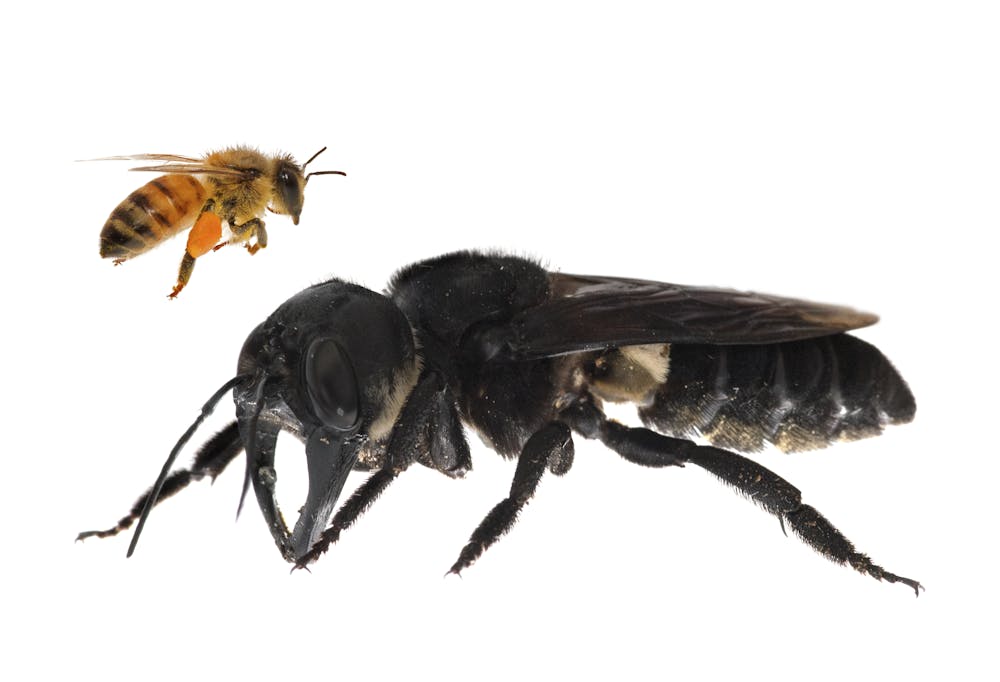 Beenormous: M. pluto is roughly four times the size of a European honeybee.
Clay Bolt, Author provided
Beenormous: M. pluto is roughly four times the size of a European honeybee.
Clay Bolt, Author provided
The bee also has a special place in scientific history. It was first collected by the British naturalist and explorer Alfred Russel Wallace in 1859, as part of his work in the Malay Archipelago. He described the female bee as “a large black wasp-like insect, with immense jaws like a stag-beetle”.
Wallace not only independently derived the theory of natural selection as an explanation for evolution alongside Charles Darwin, but his detailed studies of the distribution of animals gave rise to the famous Wallace Line, a boundary that splits Australia and Asia and helps to explain the distribution patterns of many plants and animals.
Read more: Wallacea: a living laboratory of evolution
Holiday plans
How did four biologists from across the globe, two from Australia (myself and Glen Chilton) and two from the United States (Eli Wyman and Clay Bolt), end up on this journey?
My involvement started at the prompting of Glen, who although specialising in ornithology and writing was interested in both Wallace and the rediscovery of potentially extinct species. He became aware of the existence of the world’s largest bee, and after two years of cajoling I agreed that searching for the bee would represent an excellent holiday.
During the planning for our trip, we became aware that Eli and Clay were also, independently, planning to travel to the Moluccas to search for M. pluto. After a brief Skype call we decided it made sense to join forces and collaborate. So despite our two duos never having met in person, we were a team heading out into the field.
And what a great team it was: Eli’s expertise in all things bee-related; Clay’s fantastic photographic skills; Glen’s enthusiasm and knowledge of Wallace; and my own fascination with the evolution of insect behaviour.
On the ground
We converged on the island of Ternate and began our search across the North Molucca islands for termite mounds containing bee-sized holes, helped by two excellent local guides, Ekawati Ka'aba and Iswan Maujad.
M. pluto is a solitary bee species that forms communal nests inside termite mounds, using its mandibles to collect and apply tree resin to the inner walls of its nest. So we knew what to look out for.
After five fruitless days of searching termite mounds, we were about to call it quits and head for a late lunch when we spotted another mound near the edge of a path.
Inspection with a torch and binoculars revealed a hole that looked promising. Clay scaled the tree and reported that the hole looked to be lined with resin – very exciting. Our guides constructed a platform from branches, we inspected the hole in more detail, and there she was. Cue intense excitement and cries of jubilation as we all rushed to peer inside and catch a glimpse.
Now that we had the bee, we had to be able to prove it, so we put away our iPhone cameras in favour of better-quality (but riskier: the bee might escape!) footage with more professional photographic and video equipment. We gently coaxed her out of her nest and into a small flight chamber, and then eventually Clay got the magic shot, where we released the bee back onto her nest and photographed her at the entrance to her home. Mission accomplished.
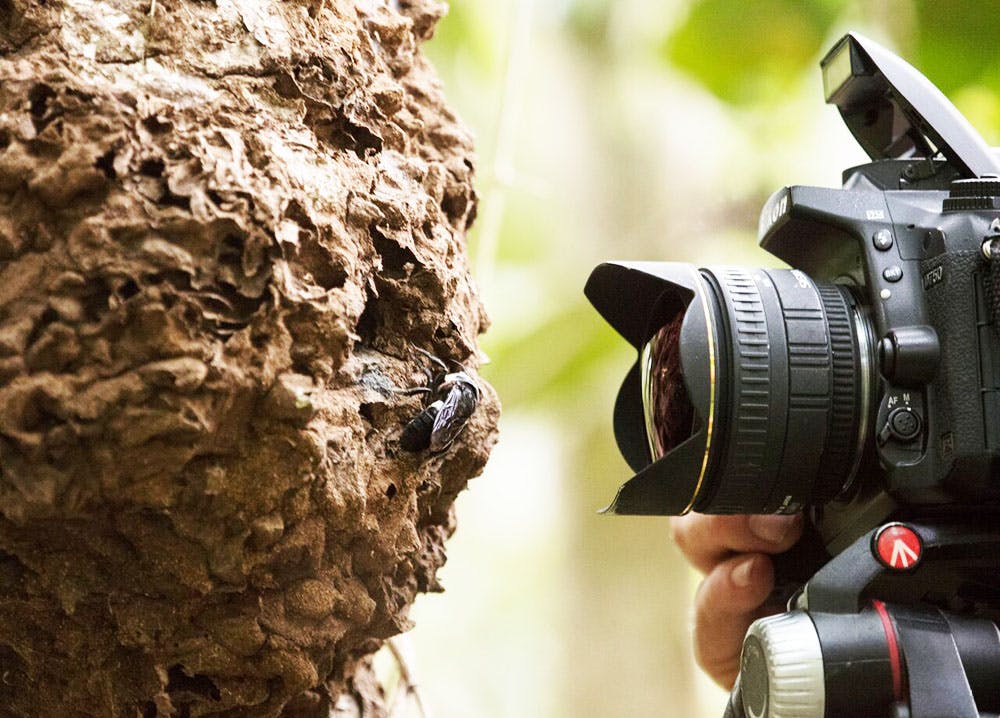 Capturing the evidence.
Simon Robson, Author provided
Capturing the evidence.
Simon Robson, Author provided
Confirming that the world’s largest bee species is still alive is an enticing development for ecologists. We can learn a lot about the ecology, behaviour and ecological significance of this giant. Amid a global decline in many insects, it’s wonderful to discover this special species is still surviving.
Read more: Ten years after the crisis, what is happening to the world's bees?
We also hope our discovery will galvanise conservation movements in Indonesia, and we were inspired by the reception our journey met with many people in the conservation and forestry fields of the North Molucca islands.
We would love more work to be done to assess the bee’s current conservation status. Plans to produce a documentary about Wallace and the rediscovery of this bee are underway, and we hope that its rediscovery provides further impetus to conservation efforts generally.
Not a bad outcome for a holiday!
Authors: Simon KA Robson, Honorary Professor, University of Sydney


 Daily Bulletin


