

Virtual reality adds to tourism through touch, smell and real people's experiences
- Written by: Erik Malcolm Champion, UNESCO Chair of Cultural Heritage and Visualisation, Curtin University
Back in 2001, an acquaintance who worked for Lonely Planet told me about a surprise discovery. The travel guide business had an audience of people who would buy their travel books, but never travel. Lonely Planet dubbed them “virtual tourists”.
Now Lonely Planet, and others, have become excited by tourism powered by virtual reality (VR) – both on this planet and, thanks to NASA, on others.
VR films are also being developed by travel companies, such as Thomas Cook. And Tourism Australia has partnered with Google to understand the marketing potential of VR (well, 360 degree panoramic videos).
But VR tourism isn’t only about recreating a virtual version of reality that renders travel to the destination unnecessary. It can enhance tourism in other ways – by allowing tourists to handle precious historical artefacts in virtual form, or by retelling contested histories from previously unexplored perspectives.
Read more: Tourist attractions are being transformed by immersive experiences – some lessons from Scotland
What is virtual tourism?
In contrast to Lonely Planet’s definition, let’s consider virtual tourism to be the application of virtual reality – including augmented reality (AR) and mixed reality (MR) – to tourism.
The term virtual reality is most commonly used to describe what happens when you are completely immersed in a virtual environment you can see through a headset. Enhanced forms of virtual reality allow you to interact with that environment using extra equipment, such as gloves fitted with sensors.
Virtual reality is also used as a catch-all term to describe the overall spectrum of digitally mediated reality, which includes virtual reality, as well as mixed reality and augmented reality.
Augmented reality and mixed reality are computer-generated visualisations that augment our sense of the real world around us or merge the real and virtual together. You still wear a headset, but rather than blocking out the world, an AR or MR headset enables you to see visualisations within your real world surroundings.
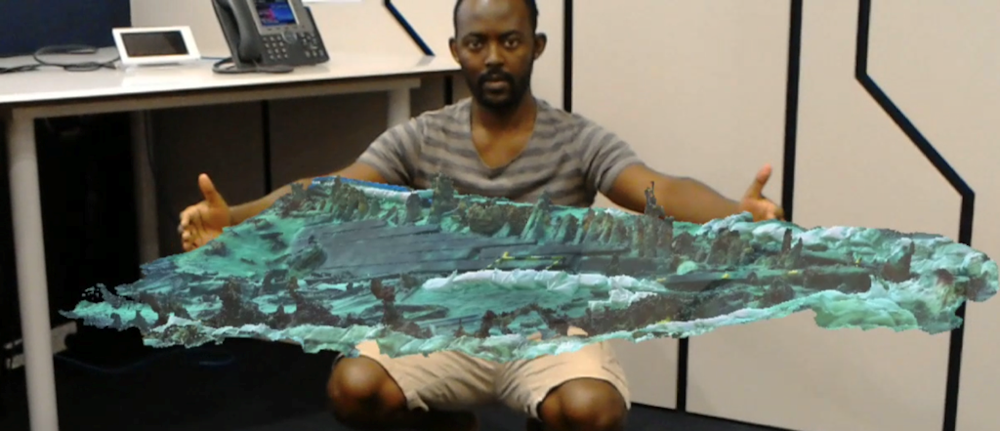 PhD student Mafkereseb Bekele demonstrates a digital underwater landscape augmented over the real world as it would appear through a Microsoft Hololens headset.
Author provided
PhD student Mafkereseb Bekele demonstrates a digital underwater landscape augmented over the real world as it would appear through a Microsoft Hololens headset.
Author provided
Augmented reality and mixed reality is usually visual, but you can now get audio augmented reality, that will play audio recordings through special glasses about sites you’re looking at. There is even olfactory-augmented reality that can enhance your experience with smell.
Read more: VR technology gives new meaning to ‘holidaying at home’. But is it really a substitute for travel?
Moving beyond realism
Virtual reality can be more than a mirror that gives you a realistic interactive simulation of the current world: it can bring the past into the present.
As Sir David Attenborough has noted:
The one thing that really frustrates you in a museum is when you see something really fascinating, you don’t want to be separated from it by glass. You want to be able to look at it and see the back of it and turn it around and so on.
The London Natural History Museum’s app Hold the World gives users a chance to move and manipulate virtual objects that are fragile, expensive or remote.
Virtual tourism is also breathing new life into mythology and folklore. In Denmark, there are plans to turn a virtual reality exhibition exploring Viking history and Norse mythology into a permanent theme park. Visitors will be able to fight giants and dragons, and explore a complete “Nordic” landscape.
Virtual tourism can allow people to hear fresh interpretations of history. For example, the augmented reality app Dilly Bag connects users with the stories of Indigenous Australian servicemen via a smartphone.
Stories can be told from the perspective of flying animals, or provide thrills and spills that appear more dangerous, immediate and visceral than the real thing (see this VR rollercoaster theme park in China).
Whether virtual tourism proves to be only a pale imitation of the real thing depends on how imaginative we are.
Read more: How Virtual Reality is giving the world's roller coasters a new twist
How common is virtual tourism?
Given the expense and complexity of virtual reality, augmented reality and mixed reality arguably have more potential for virtual tourism.
Wi-Fi, which is required for many virtual tourism experiences, is now commonplace, and many people do have their own devices. But content must be tailored to specific devices – smartphones can overheat from processing so much data, and the size of tablets can make them unwieldy.
The number of exciting technological showcases is matched by the number of failed or broken equipment and deserted VR centres. Hyped promises proliferate – apparently every year is the year that VR, AR and MR will break though.
Yet any VR software and hardware currently full of promise seems to get old very, very, quickly. If we are to move past one-hit AR wonders such as Pokémon Go, we need scalable yet engaging content, stable tools, appropriate evaluation research and robust infrastructure.
Formats such as WebVR and Web XR promise to supply content across both desktops and head mounted displays, without having to download plugins.
But before we see virtual tourism become widespread, we need to change our preconceptions about what virtual reality is. Let’s not limit VR experiences to recreations of the real world, instead let’s open our minds to history, mythology and fresh perspectives from real people.
Authors: Erik Malcolm Champion, UNESCO Chair of Cultural Heritage and Visualisation, Curtin University


 Daily Bulletin


