

To reduce fire risk and meet climate targets, over 300 scientists call for stronger land clearing laws
- Written by: Martine Maron, ARC Future Fellow and Associate Professor of Environmental Management, The University of Queensland
Australia’s high rates of forest loss and weakening land clearing laws are increasing bushfire risk, and undermining our ability to meet national targets aimed at curbing climate change.
This dire situation is why we are among the more than 300 scientists and practitioners who have signed a declaration calling for governments to restore, or better strengthen regulations to protect native vegetation.
Read more: Land clearing on the rise as legal 'thinning' proves far from clear-cut
Land clearing laws have been contentious in several states for years. New South Wales relaxed its land clearing controls in 2017, triggering concerns over irreversible environmental damage. Although it is too early to know the impact of those changes, a recent analysis found that land clearing has increased sharply in some areas since the laws changed.
The Queensland Labor government’s 2018 strengthening of land clearing laws came after years of systematic weakening of these protections. Yet the issue has remained politically divisive. While discussing a federal inquiry into the impact of these policies on farmers, federal agriculture minister David Littleproud suggested that the strenthening of regulations may have worsened Queensland’s December bushfires.
We argue such an assertion is at odds with scientific evidence. And, while the conservation issues associated with widespread land clearing are generally well understood by the public, the consequences for farmers and fire risks are much less so.
Tree loss can increase fire risk
During December’s heatwave in northern Queensland, some regions were at “catastrophic” bushfire risk for the first time since ratings began. Even normally wet rainforests, such as at Eungella National Park inland from Mackay, sustained burns in some areas during “unprecedented” fire conditions.
There is no evidence to support the suggestion that 2018’s land clearing law changes contributed to the fires. No changes were made to how vegetation can be managed to reduce fire risk. This is governed under separate laws, which remained unaltered.
In fact, shortly after the fires, Queensland’s land clearing figures were released. They showed that in the three years to June 2018, an area equivalent to roughly 570,000 Melbourne Cricket Grounds (1,138,000 hectares) of bushland was cleared, including 284,000 hectares of remnant (old-growth) ecosystems.
Tree clearing can worsen fire risk in several ways. It can affect the regional climate. In parts of eastern Australia, tree cover reductions are estimated to have increased summer surface temperatures by up to 2℃ and southwest Western Australia by 0.4–0.8℃, reduced rainfall in southeast Australia, and made droughts hotter and longer.
Removing forest vegetation depletes soil moisture. Large, intact areas of forest typically have cooler, wetter microclimates buffered from extreme temperatures. Over time, some forest types can even become fire-resistant, but smaller patches of trees are typically drier and more flammable.
Trees also form a natural windbreak that can slow the spread of bushfires. An analysis of the 2005 Wangary fire in South Australia found that fires spread most rapidly through paddocks, rather than through areas lined with native trees.
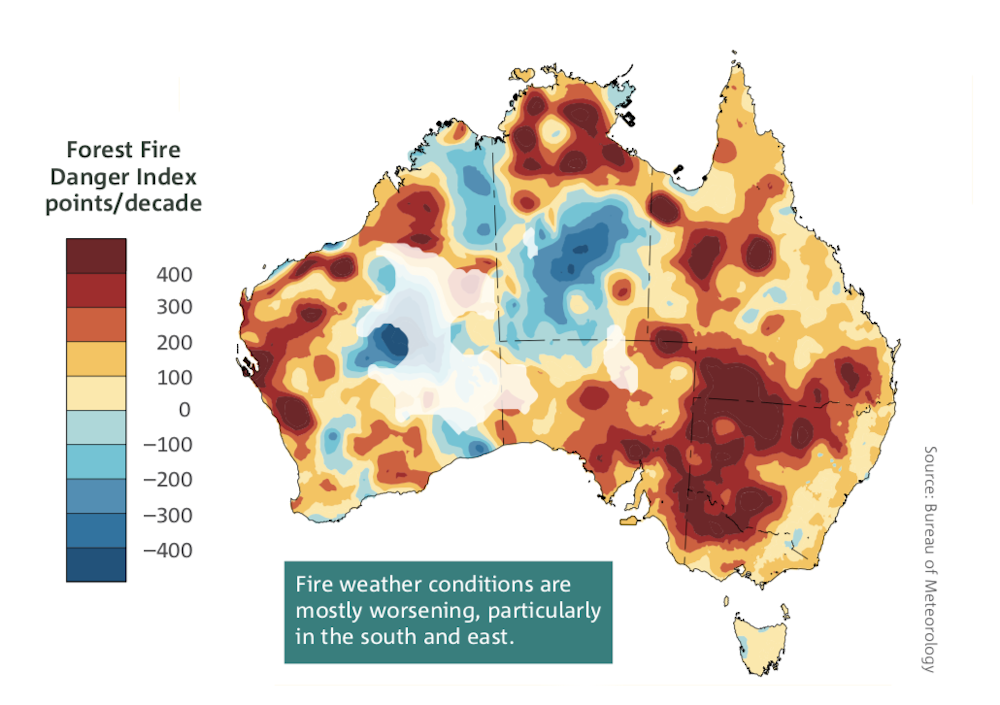 Trends from 1978 to 2017 in the annual (July to June) sum of the daily Forest Fire Danger Index, an indicator of the severity of fire weather conditions. Positive trends, shown in the yellow to red colours, indicate increasing length and intensity of the fire weather season. Areas where there are sparse data coverage, such as central parts of Western Australia, are faded.
CSIRO/Bureau of Meteorology/State of the Climate 2018
Trends from 1978 to 2017 in the annual (July to June) sum of the daily Forest Fire Danger Index, an indicator of the severity of fire weather conditions. Positive trends, shown in the yellow to red colours, indicate increasing length and intensity of the fire weather season. Areas where there are sparse data coverage, such as central parts of Western Australia, are faded.
CSIRO/Bureau of Meteorology/State of the Climate 2018
Finally, Australia’s increasing risk of bushfire and worsening drought are driven by global climate change, to which land clearing is a major contributor.
Farmers on the frontline of environmental risk
Extensive tree clearing also leads to problems for farmers, including rising salinity, reduced water quality, and soil erosion. Governments and rural communities spend significant money and labour redressing the aftermath of excessive clearing.
Sensible regulation of native vegetation removal does not restrict existing agriculture, but rather seeks to support sustainable production. Retained trees can help deal with many environmental risks that hamper agricultural productivity, including animal health, long-term pasture productivity, risks to the water cycle, pest control, and human well-being.
Rampant tree clearing is undoing climate policy too. Much of the federal government’s A$2.55 billion Emissions Reduction Fund has gone towards tree planting. But it would take almost this entire sum just to replace the trees cleared in Queensland since 2012.
Read more: Stopping land clearing and replanting trees could help keep Australia cool in a warmer future
In 2019, Australians might reasonably expect that our relatively wealthy and well-educated country has moved beyond a frontier-style reliance on continued deforestation, and we would do well to better acknowledge and learn lessons from Indigenous Australians with respect to their land management practices.
Yet the periodic weakening of land clearing laws in many parts of Australia has accelerated the problem. The negative impacts on industry, society and wildlife are numerous and well established. They should not be ignored.
Authors: Martine Maron, ARC Future Fellow and Associate Professor of Environmental Management, The University of Queensland


 Daily Bulletin


