

The summer bushfires you didn't hear about, and the invasive species fuelling them
- Written by: Christine Schlesinger, Senior Lecturer in Environmental Science and Ecology, Charles Darwin University
In January 2019, fires burned across a 100-kilometre length of the iconic Tjoritja National Park in the West MacDonnell Ranges, from Ormiston Gorge nearly to the edge of Alice Springs.
These fires affected an area comparable to the recent Tasmanian fires, but attracted relatively little national attention. This is partly because the fires in Tasmania were so unusual – but we believe the fires in central Australia were just as unexpected.
Read more: Dry lightning has set Tasmania ablaze, and climate change makes it more likely to happen again
In the past, fires of this magnitude have tended to come after heavy rain that powers the growth of native grasses, providing fuel for intense and widespread fires. But our research highlights the new danger posed by buffel grass, a highly invasive foreigner sweeping across inland Australia and able to grow fast without much water.
Far from being pristine, Tjoritja and the Western MacDonnell Ranges are now an invaded landscape under serious threat. Our changing climate and this tenacious invader have transformed fire risk in central Australia, meaning once-rare fires may occur far more often.
Buffel grass in Australia
Buffel grass is tough and fast-growing. First introduced to Australia in the 1870s by Afghan cameleers, the grass was extensively planted in central Australia in the 1960s during a prolonged drought.
Introductions of the drought-resistant plant for cattle feed and dust suppression have continued, and in recent decades buffel grass has become a ubiquitous feature of central Australian landscapes, including Tjoritja.
Buffel grass has now invaded extensive areas in the Northern Territory, Queensland, Western Australia and South Australia and is spreading into New South Wales and Victoria. It was legally recognised as a key threat in 2014, but so far only South Australia has prohibited its sale and created statewide zoning to enforce control or destruction.
Buffel grass crowds out other plants, creating effective “monocultures” – landscapes dominated by a single species. In central Australia, where Aboriginal groups retain direct, active and enduring links to Country, buffel grass makes it hard or impossible to carry out important cultural activities like hunt game species, harvest native plant materials or visit significant sites.
Buffel grass impacts on Anangu Pitjantjatjara Yankunytjatjara communities in central Australia.But buffel grass isn’t only a threat to biodiversity and Indigenous cultural practices. In January the Tjoritja fires spread along dry river beds choked with buffel, incinerating many large old-growth trees. Much like the alpine forests of Tasmania, the flora of inland river systems has not adapted to frequent and intense fires.
We believe the ability of the fires to spread through these systems, and their increased intensity and size, can be directly attributed to buffel grass.
Fire and buffel grass
Because of the low average rainfall, widespread fires in central Australia have been rare in the recorded past, only following unusual and exceptionally high rainfall.
This extreme rain promoted significant growth of native grasses, which then provided fuel for large fires. There could be decades between these flood and fire cycles. However, since the Tjoritja (previously West MacDonnell Ranges) National Park was established in the 1990s, there have been three large-scale fires in 2001, 2011 and 2019.
What has changed? The 2001-02 and 2011-12 fires both came after heavy rainfall years. In fact, 2011 saw one of the biggest La Niña events on record.
Climate change predictions suggest that central Australia will experience longer and more frequent heatwaves. And although total annual rainfall may stay the same, it’s predicted to fall in fewer days. In other words, we’ll see heavy storms and rainfall followed by long heatwaves: perfect conditions for grass to grow and then dry, creating abundant fuel for intense fires.
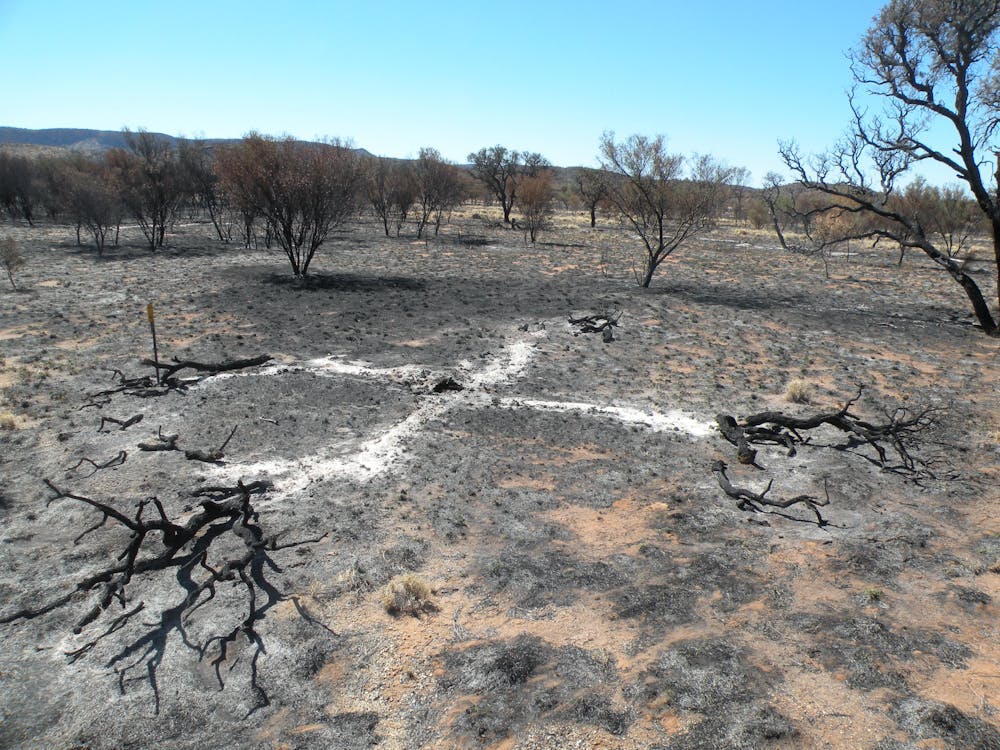 The remains of a corkwood tree after an unplanned bushfire in an area heavily invaded by buffel grass near Simpsons Gap. Very few large old corkwood trees now remain in this area.
Author provided
The remains of a corkwood tree after an unplanned bushfire in an area heavily invaded by buffel grass near Simpsons Gap. Very few large old corkwood trees now remain in this area.
Author provided
If central Australia, and Tjoritja National Park in particular, were still dominated by a wide variety of native grasses and plants, this might not be such a problem. But buffel grass was introduced because it grows quickly, even without heavy rain.
The fires this year were extraordinary because there was no unusually high rainfall in the preceding months. They are a portent of the new future of fire in these ecosystems, as native desert plant communities are being transformed into dense near-monocultures of introduced grass.
The fuel that buffel grass creates is far more than native plant communities, and after the fire buffel grass can regenerate more quickly than many native species.
So we now have a situation in which fuel loads can accumulate over much shorter times. This makes the risk of fire in invaded areas so high that bushfire might now be considered a perpetual threat.
Changing fire threat
In spinifex grasslands, traditional Aboriginal burning regimes have been used for millennia to renew the landscape and promote growth while effectively breaking up the landscape so old growth areas are protected and large fires are prevented. Current fire management within Tjoritja “combines traditional and scientific practices”.
However, these fire management regimes do not easily translate to river environments invaded by buffel grass. These environments have, to our knowledge, never been targeted for burning by Aboriginal peoples. Since the arrival of buffel grass, there is now an extremely high risk that control burns can spread and become out-of-control bushfires.
Even when control burns are successful, the rapid regrowth of buffel grass means firebreaks may only be effective for a short time before risky follow-up burning is required. And there may no longer be a good time of year to burn.
Read more: How invasive weeds can make wildfires hotter and more frequent
Our research suggests that in areas invaded by buffel grass, slow cool winter burns - typical for control burning - can be just as, or more, damaging for trees than fires in hot, windy conditions that often cause fires to spread.
Without more effective management plans and strategies to manage the changing fire threat in central Australia, we face the prospect of a future Tjoritja in which no old-growth trees will remain. This will have a devastating impact on the unique desert mountain ranges.
We need to acknowledge that invasive buffel grass and a changing climate have changed the face of fire risk in central Australia. We need a coordinated response from Australia’s federal and state governments, or it will be too late to stop the ecological catastrophe unfolding before us.
The authors acknowledge the contribution of Shane Muldoon, Sarah White, Erin Westerhuis, CDU Environmental Science and Management students, and NT Parks and Wildlife staff to the research at experimental sites and ongoing tree monitoring in central Australia.
Authors: Christine Schlesinger, Senior Lecturer in Environmental Science and Ecology, Charles Darwin University


 Daily Bulletin


