

Dowry abuse does exist, but let's focus on the wider issues of economic abuse and coercive control
- Written by: Supriya Singh, Professor, Sociology of Communications, Graduate School of Business & Law, RMIT University
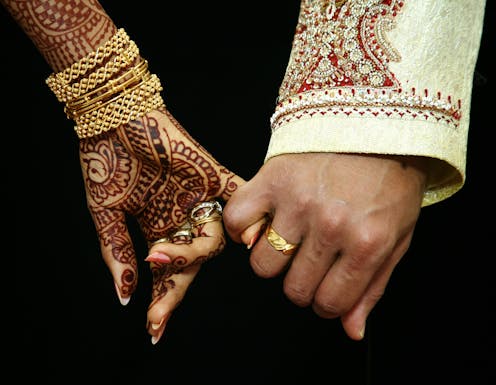
Rina’s marriage problems began two days before her wedding, when her fiance’s parents demanded gold and a car. Her parents agreed to part of the demands to ensure the planned marriage went ahead.
But the 27-year-old Indian woman’s marriage to a man in Melbourne would last just eight months, as abusive behaviour by her husband and new in-laws escalated.
Dowries – where the bride’s parents are forced to give valuable gifts to the husband’s parents – have been officially banned for decades in India. But dowry traditions continue to live on throughout South Asia and in the Middle East.
Read more: When gold prices go up, so does the cost of a dowry – and baby girl survival rates in India fall
As Rina’s story shows, it has also been imported into expatriate communities in Australia.
To what extent remains unknown. The Senate inquiry into Dowry and Dowry Abuse was asked to report on the prevalence of dowry in Australia. But its final report, published last month, says there is insufficient data to do so, with the available evidence on dowry abuse “largely anecdotal”.
The inquiry decided not to recommend a specific law against dowry. It has instead recommended that “economic abuse” be included as a form of family violence in the Family Law Act, and that dowry abuse be included in a “non-exhaustive list” of examples of economic abuse.
This seems to me the right approach, based on the stories Rina and others told me as part of my research into financial and domestic abuse. Of 17 stories from Indian migrants, only Rina’s involved dowry abuse.
Rather than focusing on specific cultural practices, with the danger of demonising specific minority communities, we need to concentrate on economic abuse in whatever form it takes.
Rina’s story
I heard Rina’s story as part of the comparative research I did with Marg Liddell and Jasvinder Sidhu on money, gender and family violence. We listened to 17 Indian migrants, 13 Anglo-Celtic women and 17 community leaders, service providers and leaders of faith communities. We found our interviewees through professional, personal and community networks.
Their stories demonstrated that economic abuse was not limited by culture. Dowry abuse was just one example of many different forms of economic abuse.
Read more: When care becomes control - financial abuse cuts across cultures
What is economic abuse? It is any type of economic control or exploitation. It might involve preventing a partner from getting work, so as to control how much money they have. It might include determining what they can spend money on. It might involve insisting on access to bank accounts or controlling other assets.
In Rina’s case, most of her jewellery was kept in a bank locker under her father-in-law’s name in India (her in-laws nonetheless remained dissatisfied with the dowry they had received). With no job or money or bank account of her own, she was completely dependent on handouts from her husband. In her first six months in Australia, she said, he gave her just $100 in spending money.
He was jealous and controlling in other ways, too. Though her only social activity was attending the Sikh temple each week, this didn’t stop him accusing her of having a relationship with every man she spoke with, she told me.
He demanded to know if she had given the man her mobile phone number, and would “snatch my phone, saying that he pays the bill so I have no right to talk to anybody”.
Three months into the marriage his jealousy escalated into physical abuse. Rina’s father sent her a ticket, and she returned to India. After two months she came back to Melbourne to give him another chance. But almost immediately, her husband’s behaviour left her fearing for her life. “I felt if I stayed there another night,” she said, “I would be found dead the next day.”
Broader economic abuse
Rina, clearly, was subjected to abuse that went way beyond dowry abuse.
We heard other stories of economic abuse involving no dowry.
In Asha’s case, her husband wanted to control the money she earned, dictating how she spent it and preventing her from sending any to help her family in India.
She had originally come to Australia to study. Her husband was a fellow Indian student. Before and after they got married, she was the principal income earner.
Once they were married, she said, he wanted to control all the money. “You should be giving all your money to me,” she says he told her. “You are now a member of my family.” While he failed to pay an equal share of their bills, she recalls him criticising her for overspending on a $2 bag of papadums.
About six months into their marriage, he kicked her in the stomach. “I could take the emotional abuse,” she said. “I could take the verbal abuse, but I could not comprehend a man beating me.”
Such controlling behaviour is by no means a feature of one culture.
One of our Anglo-Celtic stories involved Carol. A teacher in her late 60s, she put her savings of $60,000 and her salary into a joint account with her second husband. Though she was the main and only reliable earner, he questioned every item of expenditure, every gift she wanted to give.
“He took it all,” Carol said. As their relationship deteriorated she increasingly feared physical violence. She recalled one occasion where she hid in a walk-in wardrobe for three hours: “I’d nearly gone crazy.”
Such stories show it would make little sense for social policy or law makers to focus on one narrow, culturally specific manifestation of economic abuse.
Coercive control
Coercive control underlies economic abuse as with other dimensions of family violence.
It works through “malevolent” conduct over time to instil fear and isolate the women. Its tactics lead to women feeling they are poor mothers, wives, home makers and sexual partners. It has a devastating effect on women from all backgrounds and walks of life across Australia.
Changing the Family Law Act to recognise economic abuse as a form of domestic violence (and dowry abuse as a form of economic abuse) is a good start.
But we would do well to go further, and have a conversation about criminalising the coercive and controlling behaviour behind economic abuse.
Read more: Australia should be cautious about introducing laws on coercive control to stem domestic violence
This has been done in England and Wales (2015), Scotland (2018) and Ireland (2018). These new laws have drawn attention to the need to think of family violence as more than separate incidents of physical assault.
The emphasis on coercive control requires a different type of policing. It looks at a pattern of behaviour that is corrosive, involving emotional, economic, sexual and physical abuse. It’s this pattern of controlling and coercive behaviour that is criminalised.
Nothing ever happened to the abusers of Rina, Asha and Carol. Criminalising coercive control would have ensured they were properly held to account.
Authors: Supriya Singh, Professor, Sociology of Communications, Graduate School of Business & Law, RMIT University


 Daily Bulletin


