

Why we should be wary of expanding powers of the Australian Signals Directorate
- Written by: Terry Goldsworthy, Associate Professor in Criminology, Bond University
Last week, Home Affairs Minister Peter Dutton reignited the debate about new spying powers for Australian authorities during an interview on the ABC Insiders program.
His comments followed a police raid on a journalist’s home earlier this month related to the leaking of sensitive documents detailed in a story published in 2018. The documents outlined discussions and proposals for new powers for the Australian Signals Directorate (ASD) to monitor Australian citizens.
Dutton was at pains to deny this on Sunday’s ABC Insiders interview, stating:
Well if you look back to what I said at the time, we don’t support spying on Australians, that was a complete nonsense.
But he went on to say:
I think there needs to be a sensible discussion about whether or not we’ve got the ability to deal with threats that we face.
So let’s take a look at the powers the ASD currently has, and whether new powers are really needed.
ABC Insiders interview with Home Affairs Minister Peter Dutton.Read more: Why the raids on Australian media present a clear threat to democracy
What is the role of the ASD?
The ASD became a statutory agency in 2018 following the recommendations of an intelligence review in 2017.
It sits within the Defence portfolio and is responsible for:
- cyber security
- collection and communication of foreign signals intelligence
- prevention and disruption of offshore cyber-enabled crime
- support for military operations
- assisting the national security community in Australia.
Its focus is on activity that takes place outside Australia.
What new powers are we talking about?
The government hasn’t revealed any official plans to increase the powers of the ASD, but the original 2018 story written by Daily Telegraph journalist Annika Smethurst cited leaked documents suggesting the ASD would gain powers to secretly spy on Australian citizens.
The powers proposed in the documents reportedly included the ability to access emails, bank records and text messages of Australian citizens without their knowledge. (Currently, under the Federal Intelligence Services Act, the ASD is restricted to gathering intelligence and fighting cyber crime offshore.)
Under current laws, the Australian Federal Police (AFP) and the Australian Security Intelligence Organisation (ASIO) are the primary federal organisations with the power to undertake actions against individuals or organisations within Australia. The Intelligence Services Act does allow for requests of assistance to be made of the ASD, but these must be at the direction of the responsible minister.
In the case of ASIO, the Attorney-General can issue a warrant for the use of special powers, such as entering a premises to insert listening devices. A warrant to question or detain a person can only be obtained by applying to a judge appointed by the Attorney-General.
The AFP primarily obtains its search warrants and powers under the Commonwealth Crimes Act. It needs to convince a judge that there is reasonable grounds for issuing the warrant.
By contrast, Smethurst’s story alleged that the expanded powers would allow the ministers for defence and home affairs to authorise a warrant sought by the ASD to undertake onshore actions, without judicial oversight.
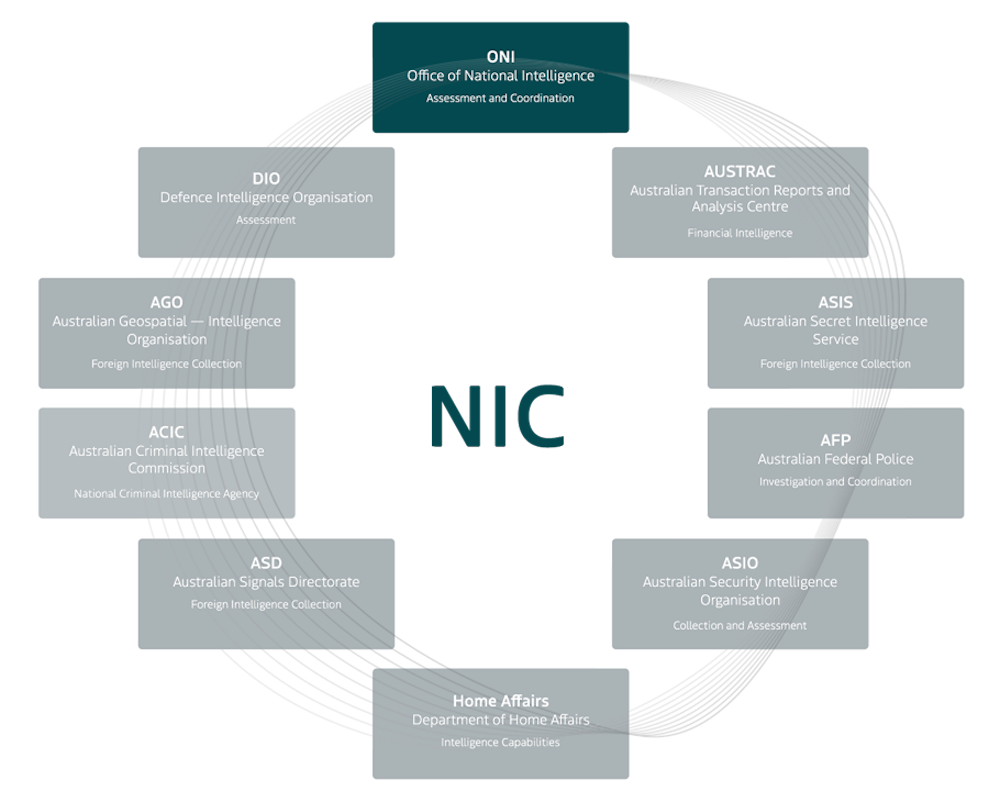 National Inteligence Community.
Screengrab, Office of National Intelligence
National Inteligence Community.
Screengrab, Office of National Intelligence
Read more: Explainer: how the Australian intelligence community works
Are the new powers needed?
On Sunday’s Insiders program, Dutton attempted to frame the argument for new powers in terms of criminal activity. He used the examples of online paedophilia and cyber attacks on institutions such as banks and universities.
For that argument to work, we would have to see cyber attacks on our institutions originating from within Australia. That is simply not a current threat, and this has certainly not been the case generally.
The Office of the Information Commissioner reported that in the 12 months to March 31, 2019, there were 964 data breach notifications under the National Data Breach scheme, 60% of these were criminal or malicious. But no specific details are provided as to where the threat originated from.
The reality is that law enforcement agencies already have powers that allow them to access emails, bank records and text messages of Australian citizens – usually after satisfying a judge there is a reasonable need to do so.
The AFP currently targets online child abuse and paedophilia with the Virtual Global Taskforce, which cooperates with INTERPOL, EUROPOL and other law enforcement agencies. The AFP Child Protection Operations (CPO) team “performs an investigative and coordination role within Australia for multijurisdictional and international online child sex exploitation matters. It deals with cases in the online, and travel and tourism environments”.
In addition, the AFP’s Cybercrime Investigation teams within the Australian Cyber Security Centre can undertake targeted intelligence to investigate cybercrimes of national significance. In any event, either ASIO or the AFP can make requests for assistance from the ASD under the Act as required.
The key difference is that under the new proposals is that some of these activities could being done in secret.
Mike Burgess, Director-General on the Australian Signals Directorate, delivers an address on offensive cyber security.Read more: A state actor has targeted Australian political parties – but that shouldn't surprise us
We should be concerned
The leaked proposal effectively suggests a blurring of the line between an externally focused defence organisation and internally focused law enforcement agencies. If the new powers are in line with those reported last year, they could potentially sideline the Attorney-General, and give the home affairs and defence ministers power in the approval process for use of the ASD’s functions.
It would take powers primarily designed to defend Australia against external threats and use them for internal investigations against Australian citizens.
Australians should rightly be concerned about any shift to an intelligence or investigative model that is based on the introduction of greater powers on the one hand, and less oversight and governance on the other.
The case needs be made that current laws and powers are ineffective and that there is a real need for any additional powers. Only then should serious consideration be given to the proposals outlined above. Issues of governance and transparency should be paramount in any realistic discussion of increasing the role and power of the ASD.
Authors: Terry Goldsworthy, Associate Professor in Criminology, Bond University


 Daily Bulletin


