

Academia can help humans and large carnivores coexist
- Written by: Euan Ritchie, Associate Professor in Wildlife Ecology and Conservation, Centre for Integrative Ecology, School of Life & Environmental Sciences, Deakin University
Bears, wolves, lions and other top predators have a long history of conflict with people – they can threaten our safety and kill livestock.
In our recent study, published in Conservation Biology, we outline how conventional conservation approaches are unlikely to lead to effective coexistence between humans and large carnivores in human-dominated landscapes.
Read more: Guardian dogs, fencing, and 'fladry' protect livestock from carnivores
This wicked problem encompasses public safety, agriculture, conservation, animal welfare, and more. Each facet is commonly managed by a different institution working in isolation – often failing to reflect the reality of our highly connected world.
Academia can help foster better institutional arrangements, especially in places like Romania, India and Brazil, where there are substantial populations of people and large carnivores in shared spaces.
In Romania, for instance, bears and wolves live in the same places used by shepherds and their livestock. Guardian dogs typically help protect livestock from being attacked.
Similarly, Australia’s own dingo occurs across agricultural and pastoral regions, with sentiments ranging from protected native species to disliked pest.
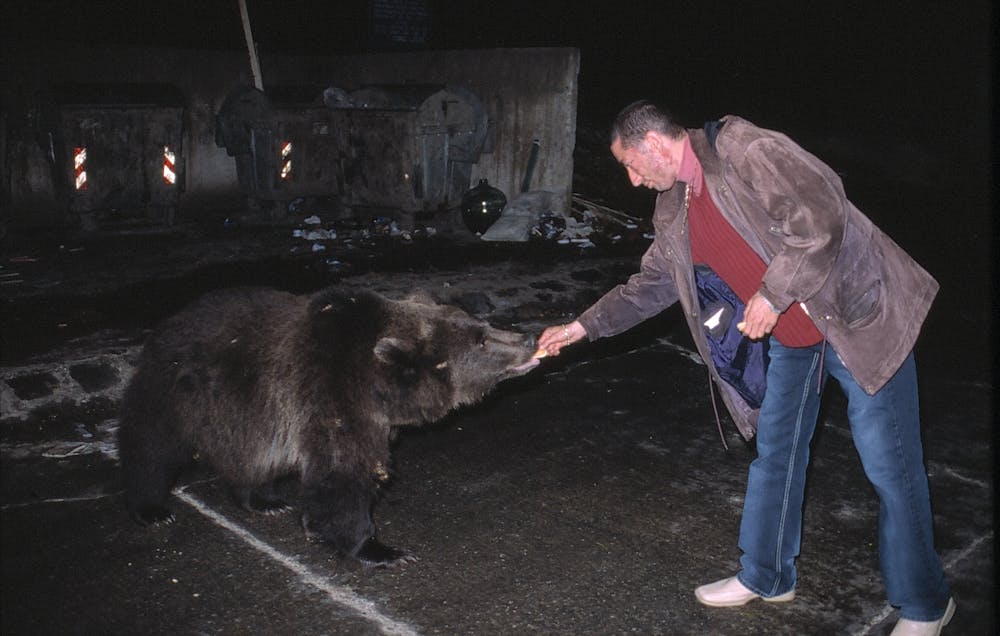 Brasov city garbage disposal officers work with wildlife management to help remove attractants that draw bears into the Romanian city.
Photo credit: John Linnell, Author provided (No reuse)
Brasov city garbage disposal officers work with wildlife management to help remove attractants that draw bears into the Romanian city.
Photo credit: John Linnell, Author provided (No reuse)
Why institutions fail carnivore-human relationships
From bears in Romania to dingoes in Australia, large carnivores are found in an array of places. This means they regularly affect the interests of a range of institutions, from agriculture to forestry.
But the current arrangements are poorly suited to facilitate a peaceful coexistence between humans and large carnivores.
Typically, institutions focus on a small subset of concerns. Forestry and agricultural sectors, for instance, may not feel responsible for large carnivore conservation because they are primarily interested in timber and agricultural production.
On the other hand, institutions for transport, energy and border security might be indifferent towards large carnivores. But they can negatively affect these animals if they put up barriers restricting predator movement and inappropriately handle roadkill.
These compartmentalised, and often conflicting, institutions are poorly suited to helping wildlife, especially when large carnivores, such as leopards, wolves and bears, live in human-dominated regions.
A role for academia
Academia has solutions to offer.
Most environment-related professionals, like foresters, wildlife managers and conservation biologists, are trained in a range of academic institutions. Unfortunately, they are often taught narrowly within their sector or discipline.
However, all these future professionals passing through the same institutions provides a great opportunity for a broad change in how we approach difficult conservation challenges and conflict with wildlife.
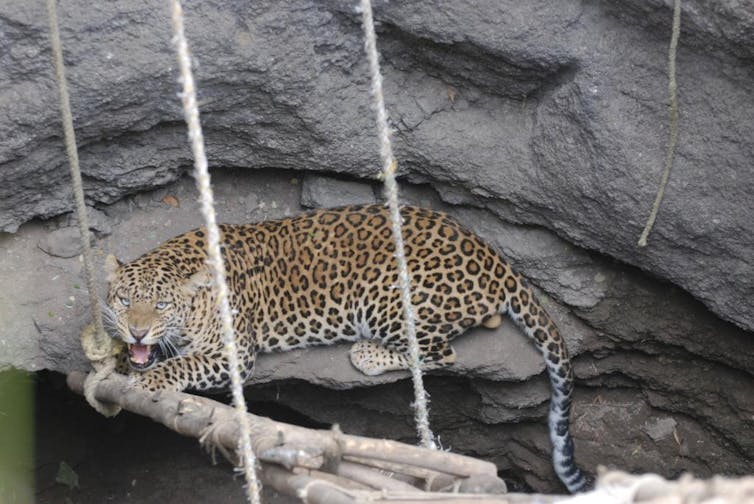 A leopard being rescued from a well in rural India, where the animals interact with locals regularly.
Photo credit: John Linnell
A leopard being rescued from a well in rural India, where the animals interact with locals regularly.
Photo credit: John Linnell
There are at least three ways in which academia could help address the challenges of human and large carnivore coexistence:
1. Break down the silos
Academic institutions need to create special centres to better support teaching and research across different disciplines.
Conservation – and, on a broader level, how humans should relate to the natural world – cannot be siloed away in wildlife management courses.
2. Broaden the view
We need to actively foster a broader perspective that does not see large carnivores as an “enemy”, while still safeguarding human life. This is a complex and multifaceted challenge.
By working across disciplines, universities have the chance to actively foster this broader perspective. This may seem like a nebulous point, but the collapse of species around the world has highlighted how ineffective our current approach to conservation is. We need to move beyond tinkering around the edges of our extinction crisis.
Conservation policy is already equipped to address individual targets such as regulating carnivore populations and legally protecting species. It is the larger aim of changing norms, challenging values and ensuring all these various institutions are pulling in the same direction that we need to tackle – a tactic called the “leverage points approach”.
3. Work outside the academy
Academia could support existing collaborations. When people with shared interests come together to pool knowledge and address a particular issue, we call it a community of practice. Academia can contribute to these communities by offering the skills and expertise of its graduates, but also broader social and industry connections (where required), knowledge sharing, collaborative research, education and technological innovation.
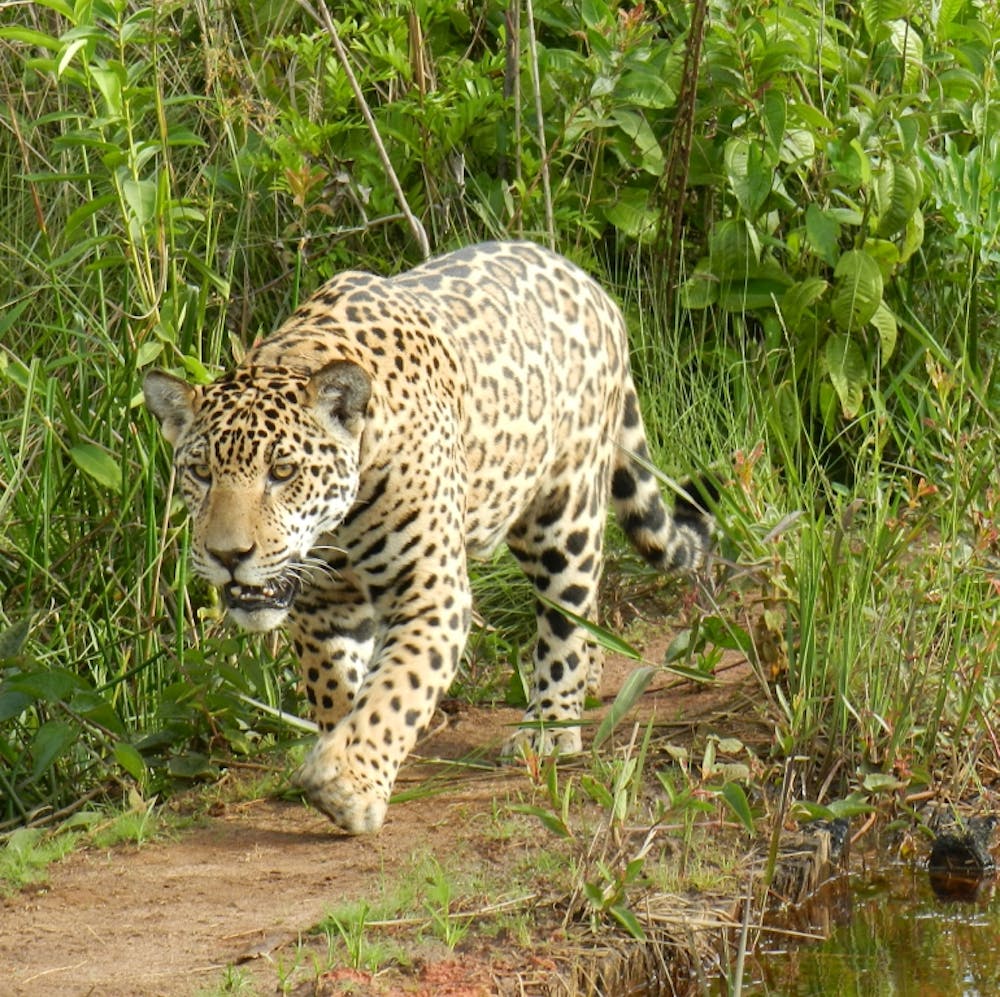 The survival of jaguars in central Brazil is in the hands of stakeholders as diverse as farmers, foresters, road planners, hydro-power and mining engineers, landless peasants, Indigenous people, conservation NGOs and global financial institutions.
Photo credit: John Linnell, Author provided (No reuse)
The survival of jaguars in central Brazil is in the hands of stakeholders as diverse as farmers, foresters, road planners, hydro-power and mining engineers, landless peasants, Indigenous people, conservation NGOs and global financial institutions.
Photo credit: John Linnell, Author provided (No reuse)
We need big carnivores and they need us
Large carnivores are critical for the health of ecosystems globally, and we need to provide them with enough space and tolerance to survive.
The ongoing controversy regarding the management of the dingo, Australia’s largest land-based predator (aside from humans), provides a perfect test case for this new approach to managing human-wildlife conflict.
If we can achieve more harmonious relations with the world’s top predators, many of the myriad other species that coexist with them are also likely to benefit from both better habitat management and conservation and the important ecological effects large carnivores can have, such as keeping herbivore and smaller predator numbers in check. This can be a positive step towards addressing Earth’s mass extinction crisis.
The authors would like to thank John Linnell, Senior Research Scientist at the Norwegian Institute for Nature Research, for his contribution to this article.
Authors: Euan Ritchie, Associate Professor in Wildlife Ecology and Conservation, Centre for Integrative Ecology, School of Life & Environmental Sciences, Deakin University
Read more http://theconversation.com/academia-can-help-humans-and-large-carnivores-coexist-115467


 Daily Bulletin


