

What other countries can teach us about ditching disposable nappies
- Written by: Kelly Dombroski, Senior Lecturer in Human Geography, University of Canterbury
This year, the small Pacific Island nation of Vanuatu announced a plan to ban disposable nappies, as well as other throwaway items such as plastic bags. While some commentators praised the move, others worried about what the alternatives might be, and how this might affect household workloads, particularly for women.
While Vanuatu is the first nation to take such a bold step, it is not the first nation to recognise the environmental problems disposable nappies pose. Although most landfill waste in Australia and New Zealand consists of building waste, disposable nappies make up a significant percentage of household waste entering landfill – Australia uses an estimated 3.75 million of them every day.
Read more: Does becoming a mother make women ‘greener’?
Many urban parents find that a week’s worth of nappies barely fits into their kerbside bin, especially for families with two children in nappies. I’ve certainly met these parents stalking the streets on the evening before bin day, searching for half-empty bins to dump their surplus dirty nappies.
But this is not the only problem: nappies are a significant source of contamination in the waste stream. Infant faeces are a source of live vaccine, bacteria such as E. coli, and many other hazardous contaminants. The correct procedure is to scrape faeces into the toilet before disposing of the nappy. But let’s be honest – the whole attractiveness of disposable nappies is not having to do this, especially while out and about.
Lessons from a bygone age
So what is the alternative? Obviously, before disposable nappies, parents had to use cloth nappies. In Australia, the standard was the fluffy terry cloth folded into a triangle; in New Zealand, the flat flannelette folded differently for boys and girls.
Traditional cloth nappies were much less absorbent, and therefore had to be changed about 15 times per day, before being washed, dried, and folded for next time. It’s no coincidence that this practice dates to an era when households typically featured a stay-at-home mother.
In recent years, modern cloth nappies have emerged, with more absorbent designs that require less frequent changing. They use modern materials such as microfibre, microfleece, polyurethane laminate, and fabrics derived from bamboo. These nappies may be snug in design, pleasing to the eye, and less prone to leaks. They also require less water for laundry, because they can be put straight into a washing machine rather than being soaked as traditional nappies were.
Yet, as Ni-Vanuatu commentators have already pointed out, these designs are not necessarily suitable for tropical climates or warmer weather due to the use of non-breathable fabrics. These fabrics might also encourage nappy rash and other related problems for babies’ delicate skin.
Lessening the load
The search for alternatives does not need to be limited to Oceania, however. My research with families with young infants in northwestern China examined a practice known as ba niao, or “holding out to urinate”. This method of infant hygiene involves very limited use of nappies, meaning laundry can feasibly be done by hand.
Briefly, it involves learning the signals and timing of a baby’s patterns of poop and pee, then holding them out over a basin, toilet or potty for them to release, nappy-free. Caregivers look for signs such as squirming, pushing, fussing, stillness, and other forms of more direct communication that precede an “elimination”. As babies get older and begin to walk, they can be taught to urinate in Chinese-style squat toilets or other appropriate places, with the help of pants with a hole cut out of the crotch.
 Items used for ba niao in northwestern China.
Kelly Dombroski, Author provided
Items used for ba niao in northwestern China.
Kelly Dombroski, Author provided
In colder parts of China, this is done by using several layers of pants, each with a hole, so babies do not have to be undressed. Caregivers tuck nappy-cloths made from old sheets or other soft rags up into the waistband of the pants, to be quickly and easily removed when a baby seems ready to “go”. If the caregiver misses the signal, the small, light cloth can be easily handwashed and dried on a balcony or radiator. If the caregiver is not near a toilet, the baby may even be held out over the ground or tiles, and urine cleaned up with a mop.
For faeces, babies are encouraged into a regular routine through a large morning feed of milk, and patient “holding out” until the morning elimination is done. If the baby’s bowel movements are less predictable, perhaps due to illness, some families use disposable nappy pads, tucked in the same way as the traditional nappies, but more as a backup for missing a signal rather than relying on it.
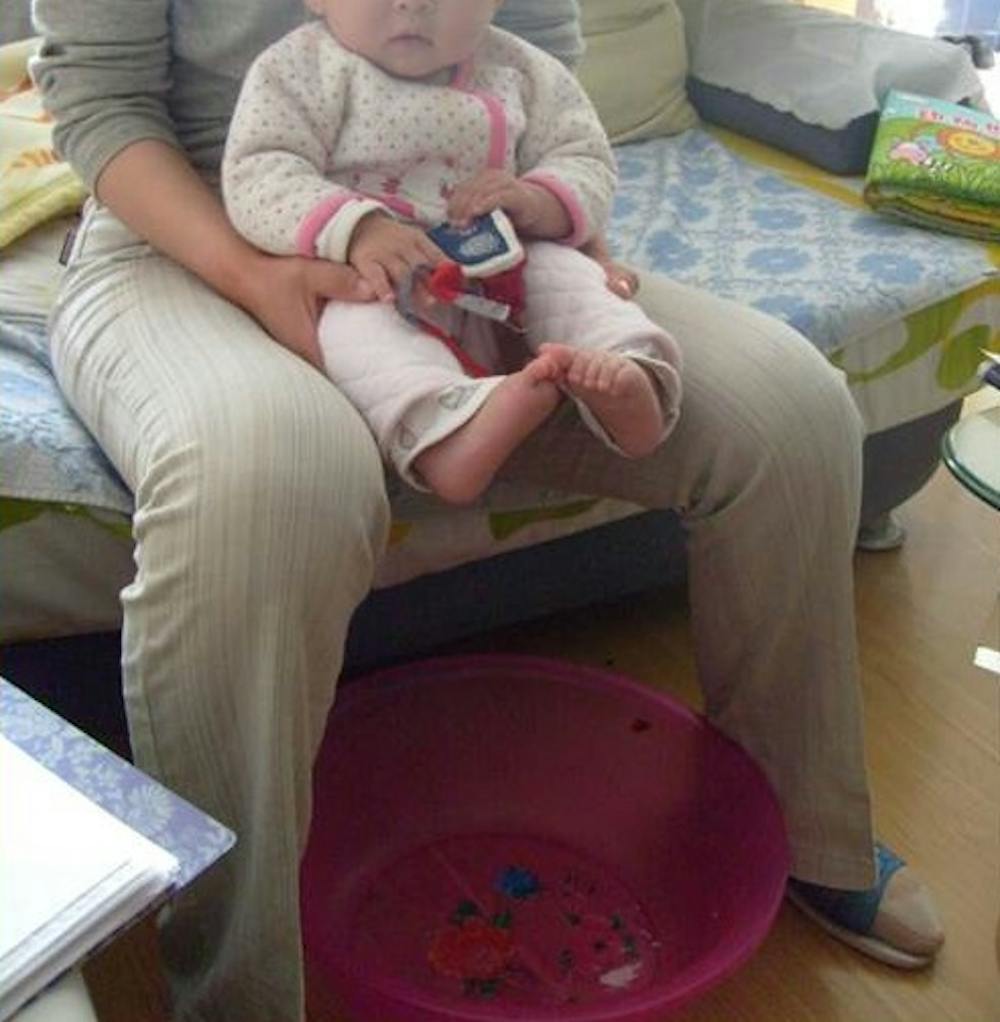 ‘Holding out’ over a basin as part of traditional hygiene practices.
Kelly Dombroski, Author provided
‘Holding out’ over a basin as part of traditional hygiene practices.
Kelly Dombroski, Author provided
Households without indoor toilets also use this method, including families who live in their shop and rely on public showers and toilets for hygiene.
This method is used by rich and poor families alike. Research by disposable nappy producers Proctor & Gamble estimated that Chinese consumers of disposable nappies use only one per day – or more accurately, per night. Even those who can afford disposable nappies tend to eschew them in favour of ba niao during daylight hours. Besides a lot less laundry, the reported benefits include less nappy rash, earlier toilet independence, and less crying and fussing.
Read more: Toilet training from birth? It is possible
Is this a realistic practice for countries seeking to quit disposable nappies? It may seem far from westernised norms, but my research has also analysed the content of Australian and New Zealand-based web forums and Facebook groups, with collectively around 2,000 members. These caregivers, mostly mums, are trying to work out the best way to introduce a similar practice to everyday life here, too.
They are inspired by the fact that this is possible in other parts of the world, and may indeed be a key to reducing the laundry load. And if they’re not quite ready to quit disposable nappies altogether, they might at least give up the weekly raid on the neighbours’ rubbish bins.
Authors: Kelly Dombroski, Senior Lecturer in Human Geography, University of Canterbury


 Daily Bulletin


