

Walking and cycling to work makes commuters happier and more productive
- Written by: Liang Ma, Vice-Chancellor's Postdoctoral Research Fellow, RMIT University

In Australia, more than 9 million people commute to work every weekday. The distance they travel and how they get there – car, public transport, cycling or walking – can influence their well-being and performance at work.
Our study, involving 1,121 full-time workers who commute daily to work, made several important findings:
- those who commute longer distances tend to have more days off work
- among middle-aged workers, those who walk or cycle performed better in the workplace
- Those who commute short distances, walk or cycle to work, are more likely to be happy commuters, which makes them more productive.
Read more: How the everyday commute is changing who we are
In Australia, full-time workers spend 5.75 hours a week on average travelling to and from work. Among them, nearly a quarter of commutes can be classed as lengthy (travel for 45 minutes or more one way).
Long commutes not only cause physical and mental strains on workers, but may also affect their work participation, engagement and productivity.
And Australia’s pervasive urban sprawl means most workers commute by car. But driving has been found to be the most stressful way to commute.
Driving to work is associated with a series of health problems and lower social capital (smaller social networks with less social participation), which all affect work performance and productivity.
What did the study look at?
Our research investigated how and to what extent our daily commuting can influence workplace productivity. We surveyed 1,121 employees from Sydney, Melbourne and Brisbane. These employees are all employed full-time, have a fixed place of employment, make regular commuting trips and work in different industries and occupations.
We found that workers with a long-distance commute have more absent days, as the graph below shows.
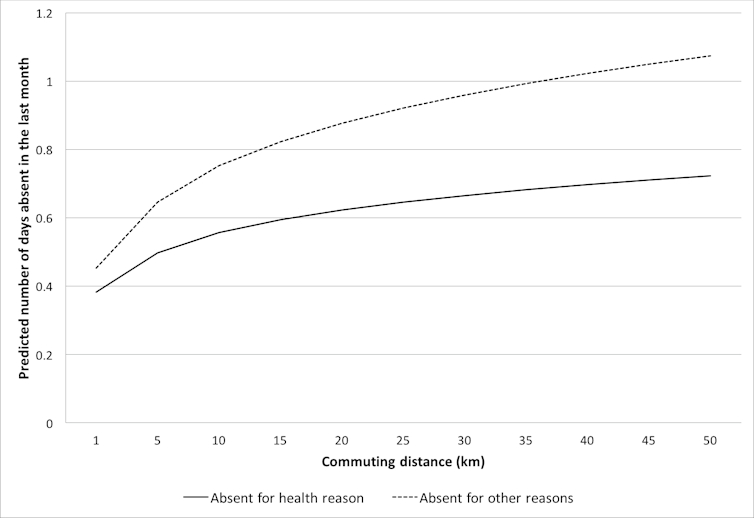 Predicted number of days absent from work with increasing commuting distance. Author provided
Two reasons can explain this result. First, workers with long commutes are more likely to become ill and be absent. Second, workers with long commutes receive less net income (after deducting travel costs) and less leisure time. Therefore, they are more likely to be absent to avoid the commuting cost and time.
The average commuting distance for Australian capital cities is about 15km. Workers with a commuting distance of 1km have 36% fewer absent days than those commuting 15km. Workers who commute 50km have 22% more absent days.
This study also finds that middle-aged (35-54) commuters who walk or cycle – known as active travel – have better self‐reported work performance than public transport and car commuters. This result may reflect the health and cognitive benefits of active travel modes.
Finally, this study finds the short-distance and active travel commuters reported they were relaxed, calm, enthusiastic, and satisfied with their commuting trips, and were more productive.
Read more: Commuters help regions tap into city-driven growth
How does commuting affect productivity?
Urban economic theory provides one explanation of the link between commuting and productivity. It argues that workers make trade-offs between leisure time at home and effort in work. Therefore, workers with long commutes put in less effort or shirk work as their leisure time is reduced.
Commuting can also affect work productivity through poorer physical and mental health. Low physical activity can lead to obesity as well as related chronic diseases, significantly reducing workforce participation and increasing absenteeism. While some use commuting to listen music and relax the mental stress associated with commuting can further affect work performance.
A growing number of studies have found active commuting by walking and cycling is perceived to be more “relaxing and exciting”. By contrast, commuting by car and public transport is more “stressful and boring”. These positive or negative emotions during the commute influence moods and emotions during the work day, affecting work performance.
Finally, commuting choice could influence work productivity through cognitive ability. Physical activity improves brain function and cognition, which are closely related to performance. So it’s possible that active travel commuters might have better cognitive ability at work, at least in the several hours after the intense physical activity of cycling or walking to work.
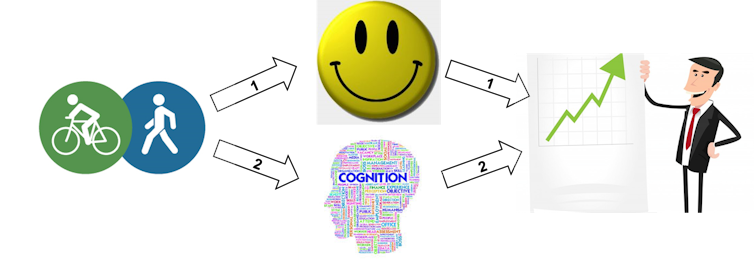 The pathways through which walking and cycling to work might influence productivity. authors
Read more: Stop working on your commute – it doesn't benefit anyone
What are the policy implications?
Employers should consider types of commuting as part of their overall strategies for improving job performance. They should aim to promote active commuting and, if possible, to shorten commuting time. For example, providing safe bike parking and showers at work could significantly increase cycling to work.
As for governments, in most states of Australia, only a tiny portion (less than 2%) of transport funding is devoted to bicycling infrastructure.
By contrast, in the Netherlands most municipalities have specific budget allocations to implement cycling policies. Australia should allocate more transport infrastructure funding to active travel, given the economic benefits of walking and cycling to work.
Read more: Cycling and walking are short-changed when it comes to transport funding in Australia
Authors: Liang Ma, Vice-Chancellor's Postdoctoral Research Fellow, RMIT University


 Daily Bulletin


