

Migrants who adapt to Australian culture say they're happier than those who don't
- Written by: Asanka Gunasekara, Lecturer in Management, Swinburne University of Technology
In a multicultural country like Australia, it’s easy for migrants to keep their heritage culture alive. But our recent research that surveyed more than 300 migrants found those who adapt to Australian society, called “Australian acculturation”, have greater personal well-being than those who don’t.
Personal well-being refers to a person’s quality of life, measured at two levels. The first: how satisfied they are with their life overall. And the second: how satisfied they are with specific life domains, such as achievements, relationships, health, safety, community connectedness and security.
Read more: How do we measure well-being?
We looked at the relationships between time in the host country, acculturation and personal well-being among non-Western skilled migrants in Australia. We found that migrants who reported having a higher personal well-being also had:
And we found that more time spent in Australia doesn’t necessarily lead to more personal well-being if skilled migrants don’t adapt to Australian culture.
Social connectedness
We measured personal well-being using the Australian Unity Personal Well-being Index (PWI), which measures the level of a person’s satisfaction using a points system from 0 to 100.
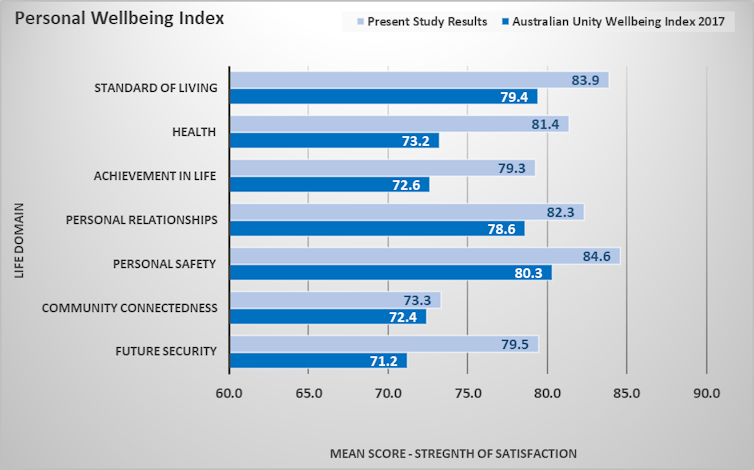 A chart from our study comparing the well-being of our sample of skilled migrants with the general population of Australia.
The average PWI of the Australian general population ranges from 74.2 to 76.8 out of 100, whereas the average PWI of our skilled migrant sample is higher, at 77.27.
Given the present study involved skilled migrants, it’s possible that their higher education, skills and salaries may have contributed to higher levels of personal well-being, compared to the Australian population as a whole.
Read more: Migrants are healthier than the average Australian, so they can't be a burden on the health system
Skilled migrants recorded the lowest score for the “community connectedness” domain, along with the rest of the Australian population. Community connectedness refers to the number and strength of connections a person has with others in their community.
Community connectedness may be lower because:
skilled migrants maintain close contact with ethnic and extended families
there are few opportunities for them to be involved in the wider Australian community or
they feel excluded from the wider community.
Biculturalism
Rather than acculturation, some skilled migrants will maintain their own culture, and add layers of cultural practices from their host country. For them, “biculturalism” – or being able to switch between host and heritage cultures – is more realistic.
Read more: Settling migrants in regional areas will need more than a visa to succeed
For example, an Indian family who moved to Melbourne will keep their culture alive through food, language and friendship circles, but might also go to the footy and support an AFL team.
Full acculturation, on the other hand, is when migrants abandon their heritage cultural practices and values when they adapt to the host culture.
For a first generation non-Western migrant, adapting to the Australian culture is even harder. Research has shown that acculturation into a Western country is unlikely for these people.
This is for a number of reasons, such as pride in their heritage culture, maintaining strong connections with relatives and friends, and the societies they move to allow them to maintain heritage cultural practices through multicultural policies.
Poor Australian acculturation can lead to social isolation
Most people migrate when they’re young, so they’re able to contribute to the socioeconomic well-being of the host country by bringing in much needed skills, knowledge, technology and investment to Australia.
But in any case, migrants grow old in a culture that’s not heritage to them, so Australian acculturation is important to help combat social isolation in their old age.
In fact, a 2015 study found older people from culturally and linguistically diverse backgrounds are at a greater risk of depression than Anglo-Australians.
So if our skilled migrant sample, with the average age of 38, are low-scoring in the “community connectedness” domain, they could fall into a social isolation trap as they age.
Read more: How cities help immigrants feel at home: 4 charts
Australia should make ageing in a new culture a more comfortable experience, and organisations – such as Australian Multicultural Community Services and Australian Multicultural Foundation – and the government should take more responsibility for their Australian acculturation, and encourage social participation.
Authors: Asanka Gunasekara, Lecturer in Management, Swinburne University of Technology


 Daily Bulletin


