

Indigenous art centres that sustain remote communities are at risk. The VET sector can help
- Written by: Pi-Shen Seet, Professor of Entrepreneurship and Innovation, Edith Cowan University
Among the many touching gifts following the March 2019 shootings in Christchurch, New Zealand, were two paintings by artists from South Australia’s remote Anangu Pitjantjatjara Yankunytjatjara (APY) Lands.
The paintings showed a honey grevillea shrub, a native Australian plant that produces long spikes of striking yellow and green flowers in winter. These canvasses depicted the sorrow of a people separated by sea and culture, but united in humanity.
Artworks such as these are an important source of creativity and identity for Indigenous Australians (a term used here to refer to Australia’s First Peoples or Aboriginal and Torres Strait Islander Peoples).
They date back around 40,000 years and include paintings, drawings, etchings, sculptures, screen printing, weaving, pottery, jewellery and other traditional artefacts such as spears, boomerangs, canoes and fish traps.
Indigenous art also provides important economic benefits. When the art market peaked in 2007, Indigenous art was estimated to generate some A$400-500 million a year. This supported 110 Indigenous art centres and about 5,000 art workers (artists).
Most Indigenous artworks are produced in around 90 art centres located in very remote regions of Australia. These centres represent a viable pathway to address the extreme economic exclusion experienced by residents of Australia’s remote Indigenous communities.
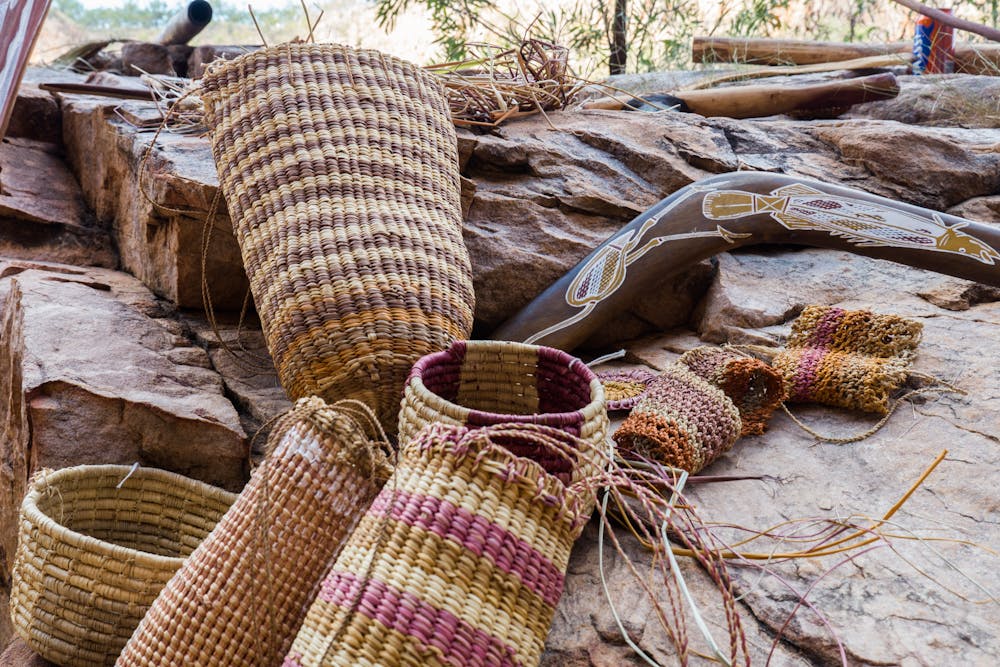 Indigenous artworks date back 40,000 years.
from shutterstock.com
Indigenous artworks date back 40,000 years.
from shutterstock.com
A 2012 government report noted “art sales (were) the primary or only source of non-government income” for remote Indigenous communities.
The art centres also provide meaningful employment opportunities for Indigenous women – who make up around 70% of artists.
But Indigenous art centres are facing significant challenges. Due to issues including the global financial crisis and quality control, average prices for paintings have almost halved since their peak. The Indigenous Australian art market is still rebuilding.
There is also a lack of appropriate apprenticeship programs for Indigenous artists, and effective management and salesmanship. The vocational education and training (VET) sector must work together with key members of remote Indigenous communities and the art sector to deliver training that addresses the needs of remote Indigenous artists.
Staffing issues and culture clashes
Remote Indigenous art centres are typically incorporated organisations whose members are artists. Members elect a governing body that employs staff. There is limited commercial experience among members.
This fact, combined with the nature of the Indigenous art market, which is volatile and reliant on one-to-one agreements between art centres and city galleries, means the board normally employs non-Indigenous managers to manage art centres.
Read more: For Aboriginal artists, personal stories matter
Most Indigenous art centres are in remote regions. The Australian Bureau of Statistics (ABS) classifies “remote” as four hours’ drive or more from an urban centre and “very remote” as more than four hours’ drive from a range of services with restricted accessibility by ordinary vehicles.
This poses challenges for attracting, retaining and training suitably qualified art centre managers. Most managers work for around two to three years before leaving.
They are mainly young women with fine arts degrees who have lived most of their lives in urban settings. They find it challenging to work across cultures. And these managers are often ill-prepared for their role, which includes many non-art-related tasks like developing viable business models.
 Most Indigenous art centres are located hours away from an urban centre.
from shutterstock.com
Most Indigenous art centres are located hours away from an urban centre.
from shutterstock.com
Art centre managers are also responsible for training Indigenous artists. A small minority of Indigenous artists do formal, vocationally related training with certificates in arts administration or visual arts.
But artists are more likely to do non-formal, on-the-job training and participate in workshops and artist-in-residence programs.
Much of this training adapts traditional skills of Indigenous Australians to produce commercial artworks. For example, artists from the Tjanpi Desert Weavers adapt traditional women’s skills such as spinning human hair to weaving in contemporary materials.
Read more: The Tjanpi Desert Weavers show us that traditional craft is art
How VET can help
Indigenous Australian artists are still heavily connected to traditional knowledge systems and practices and serve long cultural apprenticeships. But these are often not compatible with, nor recognised by, mainstream education or training systems.
Research shows the overwhelming majority of Indigenous artists receive irregular incomes and, over the course of their careers, small returns. For instance, only just over 5% of Indigenous artists receive A$100,000 or more over the length of their careers.
The often lengthy time it takes to make art, sell it and get paid for it also means some Indigenous artists have had negative experiences of the art market. This includes being exposed to exploitative art dealers who promise dubious incentives outside of the art centre system.
While most of the training of Indigenous artist is non-formal, governments and Indigenous art peak bodies have also recognised the importance of formal learning.
Most states offer VET-level qualifications in Aboriginal and Torres Strait Islander Cultural Arts but mainly at the certificate level. And not all these courses are available in remote communities and not all states subsidise students.
Read more: Rise of Indigenous art speaks volumes about class in Australia
A small number of artists aspire to become art centre managers. So they need more formal training in higher-level administrative and management positions. The VET sector should collaborate with various stakeholders to help more artists upgrade their skills via diploma and degree programs.
Over time, these artists can move into management positions in art centres (or other arts and cultural organisations). This would also help reduce the turnover problems experienced by the sector.
 The Indigenous art market generates millions of dollars a year.
Arnhem Land Aboriginal Injalak Arts & Crafts Centre (Screenshot)
The Indigenous art market generates millions of dollars a year.
Arnhem Land Aboriginal Injalak Arts & Crafts Centre (Screenshot)
A recent review of the Australian vocational education and training sector recognised the challenges Indigenous Australians face when engaging with vocational education, particularly in rural and remote areas. Some factors in this included low levels of basic literacy and numeracy, and training methods not tailored to meet the needs of some Indigenous Australian learners, particularly in remote areas.
Without waiting for the government to carry out the review’s recommendations, some Indigenous arts bodies have already implemented innovations, working with art centres and the VET sector to reconcile accredited and non-accredited training.
One example is Desart (Alice Springs, NT), a peak body for Central Australian Indigenous art centres, which facilitates the Aboriginal Arts Worker Program. This coordinates training and provides support for artists in the area.
Desart’s Art Worker Program offers these artists a customised program that includes accredited training co-designed and delivered in partnership with the Batchelor Institute over four weeks per year. This is supplemented by non-accredited training, which includes workshops delivered at the art centre.
Initiatives such as these, which involve collaboration between the Indigenous art industry, the VET sector and government, are ideal examples for government-funded pilot programs in remote Indigenous communities. These models will be increasingly important if we want to help keep remote communities afloat.
Tim Acker, Principal and Lead Consultant with Tracker Development, was also a co-author for this article.
Authors: Pi-Shen Seet, Professor of Entrepreneurship and Innovation, Edith Cowan University


 Daily Bulletin


