

A new Australian film set in an immigration detention centre is a jarring mix of violence, satire and humanism
- Written by: Alicia Byrnes, PhD Candidate and Sessional Tutor, Screen and Cultural Studies, University of Melbourne
Review: Below, Melbourne International Film Festival
In a pivotal scene in Maziar Lahooti’s provocative but thoughtful satire, Below, Iranian refugee and conscripted fighter Azad (Phoenix Raei) decries public ignorance of the realities of detention centres.
“People don’t want to see,” he tells the white Australian guard, Dougie (Ryan Corr), on their way to a match in the detention centre’s fight club. Azad’s line seems emblematic of Below’s own mantra, both with regard to the current refugee crisis and the treatment of the issue on film. Yet paradoxically, Below’s insistence on expressing the severity of our detention system actually dilutes its message.
Below premiered at MIFF this week as a product of the festival’s Premier Fund. Its story was adapted for the screen by Perth playwright, Ian Wilding, from his play of the same name. Set in a not-too-distant future, the film centres on Dougie, a scheming man-child whose latest online venture has left him in debt. His stepfather, Terry (Anthony LaPaglia, always welcome, though here with a curious accent), thus demands that Dougie take a job with him at a detention centre located beyond the recently-moved Australian border.
The trailer for Below.When Dougie learns of a fight club run by the guards involving the detainees, he sees an opportunity to use his web smarts for profit. However, a fight that ends tragically prompts Dougie to reassess his involvement in the detention system.
The Norwegian-born, Iranian-Australian Lahooti is uniquely suited to bring nuance to Wilding’s story. Growing up, the director’s mother worked in detention centres as a language interpreter, and his family regularly fostered refugees on bridging visas in their home.
Lahooti is duly intent on highlighting the fundamental kinship between Australian citizens and refugees in terms of their shared humanity. Lahooti’s lived experience and humanist message resound in Below’s more dramatic moments.
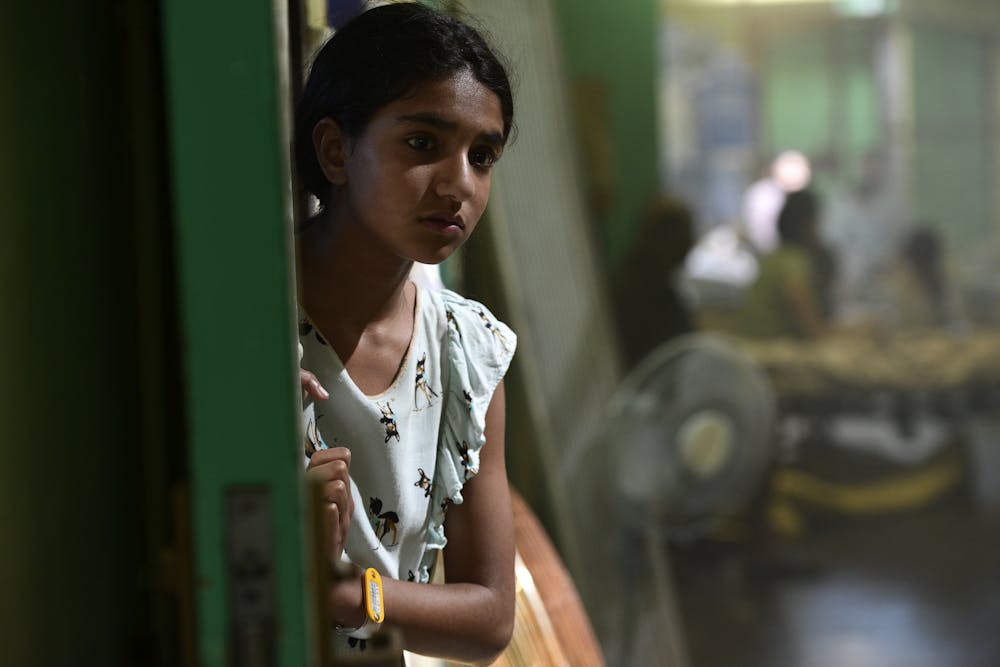 Below is both insightful and brash in tone.
Melbourne International Film Festival
Below is both insightful and brash in tone.
Melbourne International Film Festival
The confrontation between Azad and Dougie, where we see the first chink in the latter’s flippant posture, is exemplary. So is a later scene, where a fight-gone-wrong reveals an uncomfortable truth about the disposability of refugee lives in the eyes of the detention guards.
The film is also insightful in its commentary on the online world, which simultaneously makes people more curious about the oddities of human behaviour and more inclined to treat others as objects. The veracity of these narrative threads indicates a noble sentiment underpinning the film’s darkly comedic facade.
Below largely operates by the logic that we need to be agitated into seeing the realities of the refugee crisis. This logic is evidenced by the film’s heightened tonal register. It has an energetic pace and uses highly contrasted images, a compelling synth score, and a series of on-screen web graphics suggestive of Dougie’s interiority.
The logic is also evident in the film’s brash approach to violence. Below begins with a confronting display of violence and depicts a series of discomfiting fights within the fight club at the centre.
 Anthony LaPaglia and Ryan Corr in Below.
Melbourne International Film Festival
Anthony LaPaglia and Ryan Corr in Below.
Melbourne International Film Festival
I suspect that Lahooti sought to administer brutality in homeopathic doses — just enough to coax us into recognition — but this impulse often seems to overwhelm, rather than complement, the film’s central message.
The fight scenes are highly stylised, featuring intermittent use of slow motion and close ups that render the violence more gratuitous than affecting. In this same vein, Below contains a number of distasteful jokes. At one point Dougie suggests planting hidden cameras in the breastfeeding rooms of public spaces; later he likens day-to-day work in the detention centre to “a Holocaust movie”. These lines presumably aim to critique Western prejudice by recreating it, but altogether sit awkwardly with the film’s humanist mission.
Cinema has a long history of grappling with uncomfortable issues through the provocation of shock, but I question the efficacy of Below’s particular methods.
The film’s shock tactics often feel manufactured, and risk exploiting the refugee crisis as mere backdrop. Likewise, a jarring shift in tone towards the end left me wondering whether I had misinterpreted the film’s aims, or whether I could take any of its sentiments in earnest.
Below’s central conceit works productively as an allegory for the idleness with which our detention system plays with human lives, but this serious issue requires equally sensitive handling.
Authors: Alicia Byrnes, PhD Candidate and Sessional Tutor, Screen and Cultural Studies, University of Melbourne


 Daily Bulletin


