

Australia wants to install military technology in Antarctica – here's why that's allowed
- Written by: Tony Press, Adjunct Professor, Institute for Marine and Antarctic Studies, University of Tasmania
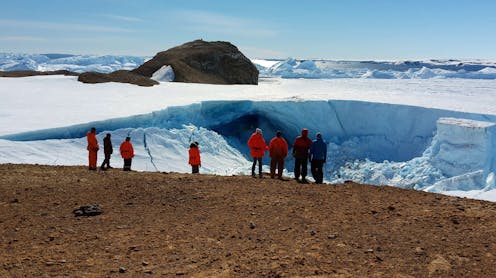
This week, the ABC revealed that the Australian Defence Force wants to roll out military technology in Antarctica.
The article raises the issue of what is, or is not, legitimate use of technology under the Antarctic Treaty. And it has a lot to do with how technology is used and provisions in the treaty.
The Antarctic Treaty was negotiated in the late 1950s, during the Cold War. Its purpose was to keep Antarctica separate from any Cold War conflict, and any arguments over sovereignty claims.
The words used in the treaty reflect the global politics and technologies back then, before there were satellites and GPS systems. But its provisions and prohibitions are still relevant today.
The opening provision of the Antarctic Treaty, which came into force in 1961, says:
Antarctica shall be used for peaceful purposes only. There shall be prohibited, [among other things], any measures of a military nature, such as the establishment of military bases and fortifications, the carrying out of military manoeuvres, as well as the testing of any type of weapons.
The treaty also prohibits “any nuclear explosions in Antarctica” and disposal of radioactive waste. What the treaty does not do, however, is prohibit countries from using military support in their peaceful Antarctic activities.
Many Antarctic treaty parties, including Australia, New Zealand, the United Kingdom, the US, Chile and Argentina, rely on military support for their research. This includes the use of ships, aircraft, personnel and specialised services like aircraft ground support.
In fact, the opening provision of the treaty is clarified by the words:
the present Treaty shall not prevent the use of military personnel or equipment for scientific research or for any other peaceful purpose.
It would be a breach of the treaty if “military exercises” were being conducted in Antarctica, or if military equipment was being used for belligerent purposes. But the treaty does not deal specifically with technology. It deals with acts or actions. The closest it gets to technology is the term “equipment” as used above.
Dual use technology
So-called “dual use” technology – which that can be used for both peaceful and military purposes – is allowed in Antarctica in support of science.
Read more: For the first time, we can measure the human footprint on Antarctica
The term is often used to describe technology such as the widely-used GPS, which relies on satellites and a worldwide system of ground-based receiving stations. Norway’s “Trollsat”, China’s “Beidou”, and Russia’s “GLONASS” systems are similar, relying on satellites and ground stations for their accuracy.
What’s more, modern science heavily relies on satellite technology and the use of Antarctic ground stations for data gathering and transmission.
And scientific equipment, like ice-penetrating radars, carried on aircraft, drones, and autonomous airborne vehicles are being used extensively to understand the Antarctic continent itself and how it’s changing.
Much, if not all, of this technology could have “dual use”. But its use is not contrary to the Antarctic Treaty.
In fact, the use of this equipment for “scientific research” or a “peaceful purpose” is not only legitimate, it’s also essential for Antarctic research, and global understanding of the health of our planet.
Read more: The benefits – and pitfalls – of working in isolation
The technologies Australia deploys in Antarctica all relate to its legitimate Antarctic operations and to science.
There are also facilities in Antarctica used to monitor potential military-related activities elsewhere in the world, such as the monitoring stations used under the Comprehensive Nuclear Test Ban Treaty.
The circumstances under which modern technology would, or could be, used against the provisions of the Antarctic Treaty have not been tested. But the activity would have to go beyond “dual purpose” and not be for science or peaceful purposes.
Science in Antarctica is open to scrutiny
Science in Antarctica is very diverse, from space sciences to ecosystem science, and 29 countries have active research programs there.
And since Antarctica plays a significant role in the global climate system, much modern Antarctic research focuses on climate science and climate change.
But there has been speculation about whether Antarctica is crucial to the development of alternatives to GPS (for example, by Russia and China) that could also be used in warfare as well as for peaceful purposes. It’s unclear whether using ground stations in Antarctica is essential for such a purpose.
For instance, Claire Young, a security analyst from the Australian Strategic Policy Institute, said the accuracy of China’s Beidou satellite has already been improved by international testing, so testing in Antarctica will make very little difference.
Read more: Remembering Antarctica's nuclear past with 'Nukey Poo'
This leads to another important provision of the Antarctic Treaty.
The treaty foreshadowed compliance problems in the remote and hostile continent by including an open ended provision for any Antarctic Treaty Party to inspect any Antarctic facility.
In other words, any party has complete freedom to access all parts of Antarctica at any time to inspect ships, aircraft, equipment, or any other facility, and even use “aerial observations” for inspection. This means the activities of all parties, and all actions in Antarctica, are available for open scrutiny.
This inspection regime is important because inspections can be used to determine if modern technology on the continent is, in fact, being used for scientific or peaceful purposes, in line with the provisions of the treaty.
Authors: Tony Press, Adjunct Professor, Institute for Marine and Antarctic Studies, University of Tasmania


 Daily Bulletin


