

Trees can add $50,000 value to a Sydney house, so you might want to put down that chainsaw
- Written by: Sara Wilkinson, Associate Professor, School of the Built Environment, University of Technology Sydney
Sydney’s Inner West Council has a new policy that it is reported means “residents will no longer need to seek council approval to prune or remove trees within three metres of an existing home or structure”. Hold on, don’t reach for that chainsaw yet, because research shows good green infrastructure – trees, green roofs and walls – can add value to your home.
Green infrastructure offers significant, economic, social and environmental benefits. Urban greening is particularly important in dense urban areas like Sydney’s Inner West. Among its benefits, green infrastructure:
Some of these benefits accrue to owners/occupiers, whereas others provide wider societal benefits.
Read more: Higher-density cities need greening to stay healthy and liveable
A 2017 study focusing on three Sydney suburbs found a 10% increase in street tree canopy could increase property values by A$50,000 on average. And the shading effect of trees can reduce energy bills by up to A$800 a year in Sydney. So retaining your green infrastructure – your trees, that is – can deliver direct financial gains.
On a larger scale, a collaborative project with Horticulture Innovation Australia Limited compared carbon and economic benefits from urban trees considering different landuses along sections of two roads in Sydney. Higher benefits were recorded for the Pacific Highway, with 106 trees per hectare and 58.6% residential land use, compared to Parramatta Road, with 70 trees per hectare and 15.8% residential.
For the Pacific Highway section, total carbon storage and the structural value of trees (the cost of replacing a tree with a similar tree) were estimated at A$1.64 million and A$640 million respectively. Trees were also valuable for carbon sequestration and removing air pollution.
Tree species, age, health and density, as well as land use, are key indicators for financial and wider ecosystem benefits. Specifically, urban trees in private yards in residential areas are vital in providing individual landowner and collective government/non-government benefits.
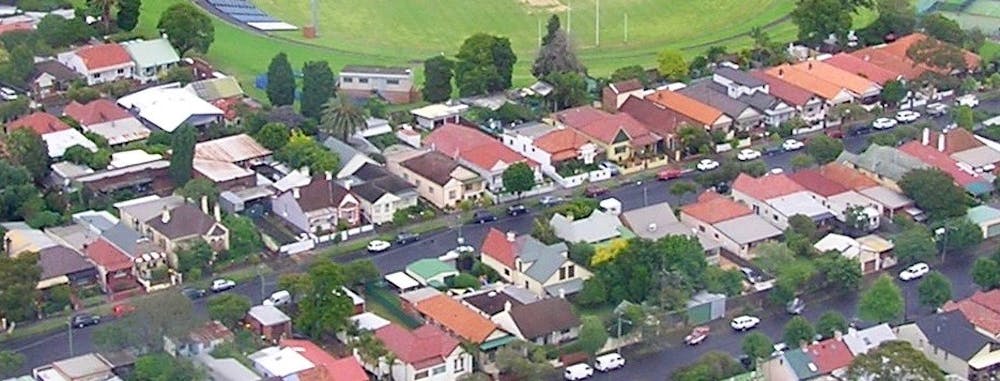 Take away the trees close to these houses in Marrickville, in Sydney’s Inner West, and how much would be left?
Graeme Bartlett/Wikipedia, CC BY-SA
Take away the trees close to these houses in Marrickville, in Sydney’s Inner West, and how much would be left?
Graeme Bartlett/Wikipedia, CC BY-SA
Challenges of growth
As populations grow, cities increase density, with less green infrastructure. The loss of greenery affects the natural environment and both human and non-human well-being.
Read more: We're investing heavily in urban greening, so how are our cities doing?
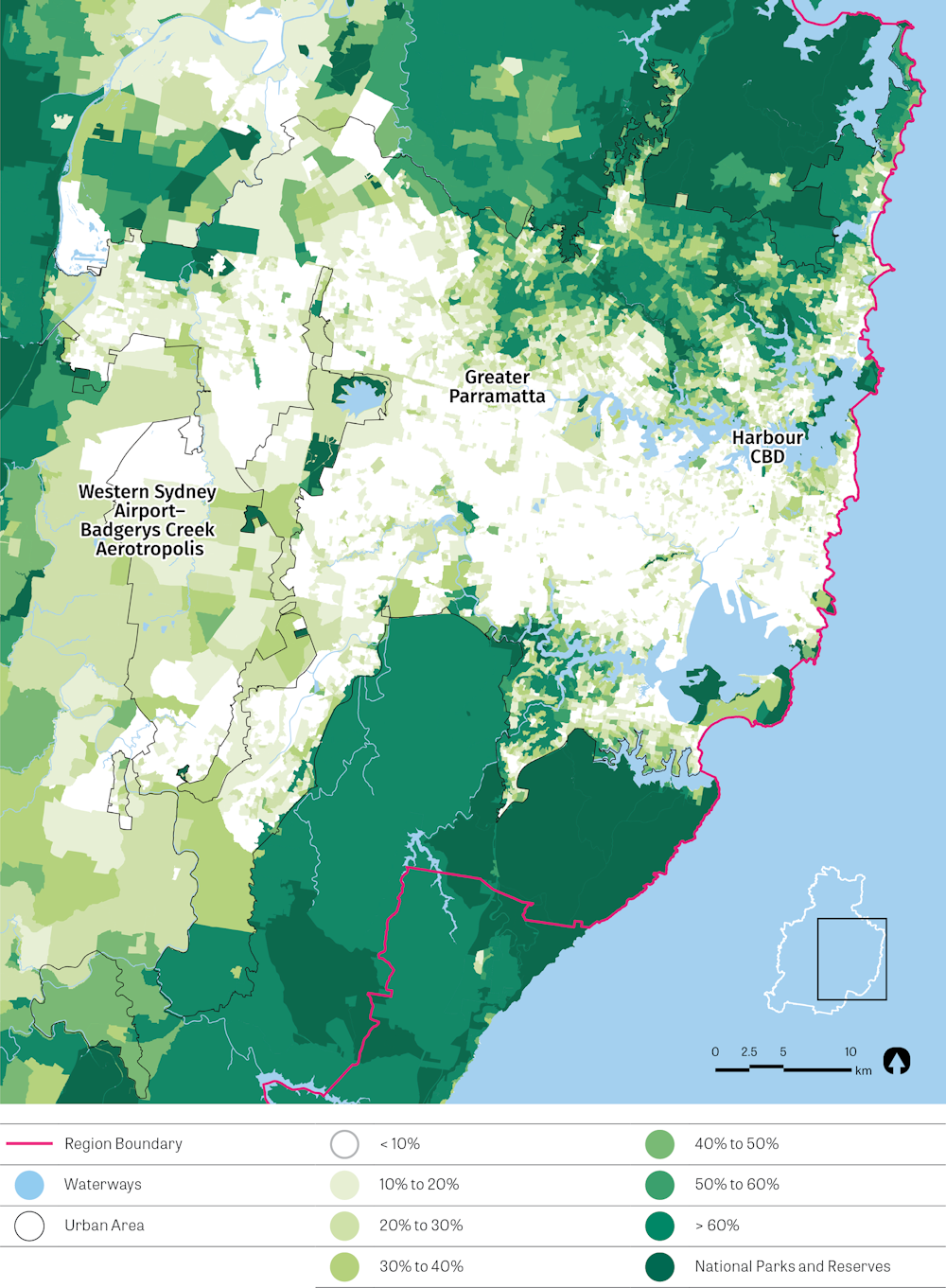 Tree canopy cover across Greater Sydney plummets closer to the city centre.
© State of New South Wales through the Greater Sydney Commission. Data: SPOT5 Woody Extent and Foliage Projective Cover (FPH) 5-10m, 2011, NSW Office of Environment and Heritage
Tree canopy cover across Greater Sydney plummets closer to the city centre.
© State of New South Wales through the Greater Sydney Commission. Data: SPOT5 Woody Extent and Foliage Projective Cover (FPH) 5-10m, 2011, NSW Office of Environment and Heritage
Trees and other green infrastructure reduce some impacts of urban density. However, policies, government incentives and national priorities can produce progress in urban greening or lead to setbacks. In the case of the Inner West Council, for instance, the inability to fund monitoring of changes in tree cover could lead to reductions at the very time when we need more canopy cover.
Key concerns include installation and maintenance costs of green infrastructure (trees, green roofs and walls) in property development, and tree root damage. Knowledge and skills are needed to maintain green infrastructure. As a result, developers often consider other options more feasible.
In the short and long term, multiple performance benefits and economic and environmental values are needed to establish the viability of green infrastructure.
Read more: Australian cities are lagging behind in greening up their buildings
Learning from Stockholm
Stockholm shares many issues found in Australian cities. Stockholm houses over 20% of Sweden’s inhabitants, is increasing in density and redeveloping land to house a growing population. Aiming to be fossil-free by 2050, Stockholm acknowledges the built environment’s role in limiting climate change and its impacts.
In a research project we intend to use virtual reality (VR) and electroencephalogram (EEG) technology to assess perceptions of green infrastructure and reactions to it in various spaces.
Our project combines VR with EEG hardware, which measures human reactions to stimuli, to learn how people perceive and value green infrastructure in residential development.
Identifying all the value of green infrastructure
The many benefits of green infrastructure are both tangible and non-tangible. Economic benefits include:
- those that directly benefit owners, occupants or investors – stormwater, increased property values and energy savings
- other financial impacts – greenhouse gas savings, market-based savings and community benefits.
Read more: If planners understand it's cool to green cities, what's stopping them?
The various approaches to evaluating net value present a challenge in quantifying the value of green infrastructure. The most common – cost-benefit analysis, triple bottom line, life cycle assessment and life cycle costing – are all inadequate for evaluating trade-offs between economic and environmental performance. Conventional cost-benefit analysis is insufficient for investment analysis, as it doesn’t include environmental costs and benefits.
This is salient for green infrastructure, as owners/investors incur substantial direct costs, whereas various shareholders share the value. Perhaps, in recognition of the shared value, a range of subsidies could be adopted to compensate investors. Discounted rates anyone?
Recent efforts to evaluate the business case for green infrastructure include attempts to identify and quantify the creation of economic, environment and community/social value. However, an approach that includes a more comprehensive set of value drivers is needed to do this. This is the gap we aim to fill.
The results of experiments using VR and EEG technology and semi-structured interviews will provide a comprehensive understanding of green infrastructure. This will be correlated with capital and rental values to determine various degrees of willingness to pay.
With this knowledge, property developers in Sweden and Australia will be able to make a more informed and holistic business case for increasing green infrastructure for more liveable, healthy cities.
Maybe we can then persuade more people, including those in the Inner West, to hang onto their trees and leave the chainsaws in the garage.
Authors: Sara Wilkinson, Associate Professor, School of the Built Environment, University of Technology Sydney


 Daily Bulletin


