

Global bank urges cities to invest in new infrastructure to adapt to climate change
- Written by: Elisa Palazzo, Senior Lecturer, Faculty of Built Environment, UNSW
The impacts of climate change on weather, sea levels, food and water supplies should be seen as an investment opportunity for our cities, says global investment banking firm Goldman Sachs.
In a report out last month the bank says cities need to adapt to become more resilient to climate change and this could “drive one of the largest infrastructure build-outs in history”.
The bank says cities will be on the frontline of any need to adapt because they are home to more than half the world’s population and generate roughly 80% of global GDP.
Read more: A landmark report confirms Australia is girt by hotter, higher seas. But there's still time to act
The state of the debate
The report comes at a time when scepticism and wait-and-see approaches are still permeating the debate on climate action globally. The discussion on reducing emissions is dogged by disagreement on targets and actions to be undertaken.
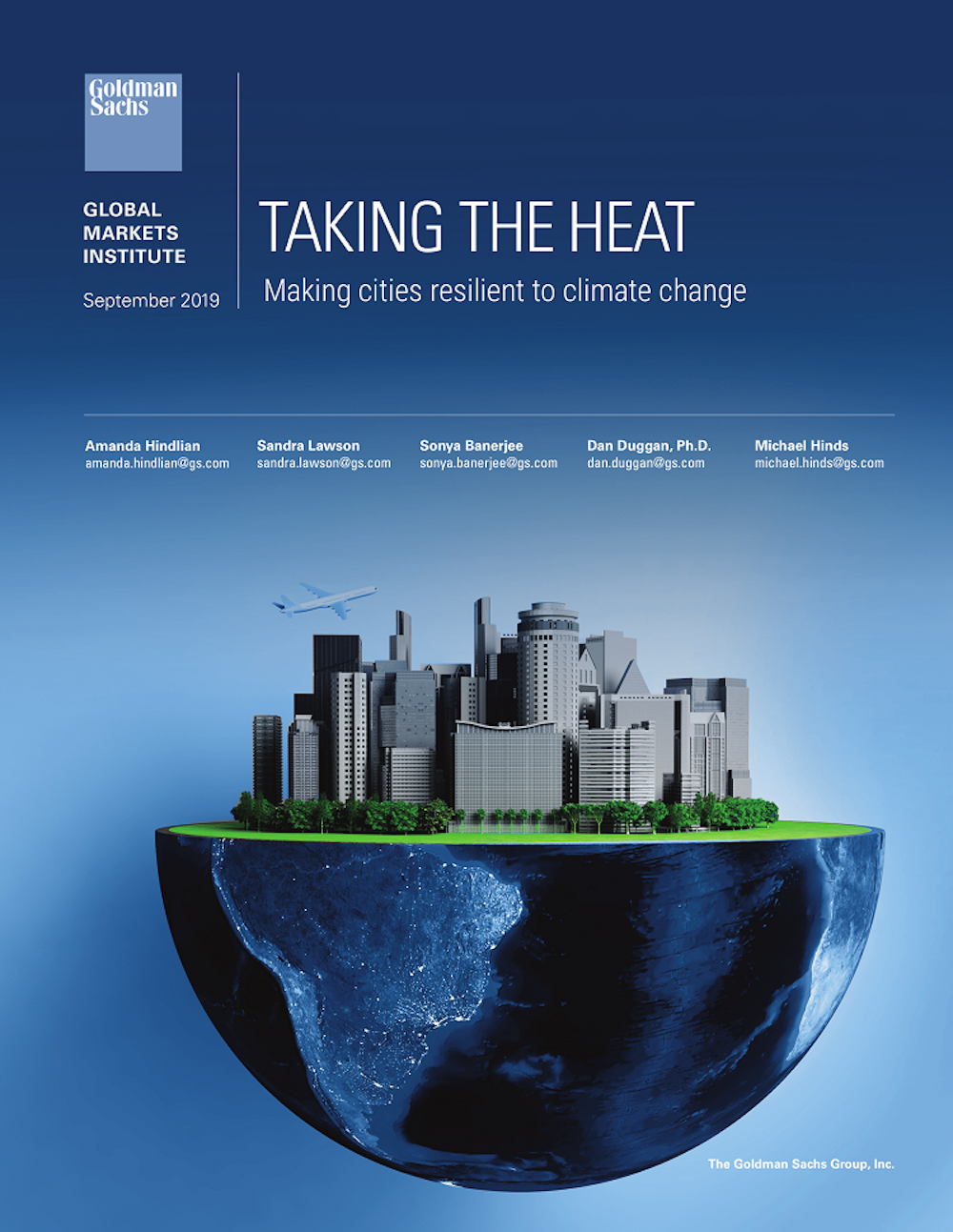 Report cover.
Goldman Sachs
Report cover.
Goldman Sachs
On the contrary, less emphasis has been placed on adapting to global warming, the consequences of which will play out for decades to come even if we meet the goals of the Intergovernmental Panel on Climate Change (IPCC).
Goldman Sachs has already said it acknowledges the scientific consensus that climate change is a reality and human activities are responsible for increasing concentrations of greenhouse gases in Earth’s atmosphere.
Much global attention has focused so far on the need for climate change mitigation and the reduction of CO₂ emissions. But the bank’s latest report addresses the urban adaptation strategies that are urgently required:
Greater resilience will likely require extensive urban planning, with investments in coastal protections, climate-resilient construction, more robust infrastructure, upgraded water and waste-management systems, energy resilience and stronger communications and transportation systems.
It acknowledges mitigation measures are essential to reduce global temperature in the medium and long term. But it argues we need to act immediately to minimise the current and future effects of climate change in urban areas.
The question is, why would a bank would endorse such a vision?
Banking on climate change
The bank’s report is a collection of data and analysis on climate change from well-known sources, such as the IPCC, and a detailed list of expected impacts on cities.
For example, higher temperatures, more frequent and intense storms, and rising sea levels could affect economic activity, damage infrastructure and harm vulnerable residents.
Does the report represent a last call to brace for impact? Or is a more nuanced and somehow optimistic view of the process emerging?
In reality, it’s not surprising this call is coming from an international financial institution such as Golden Sachs. This report needs be read in parallel with the environmental policy framework of the bank which is its “commitment to addressing critical environmental issues”.
The latest report identifies urban adaptation responses and initiatives as market solutions and financial opportunities. It clearly points out where investments should be addressed.
The directions outlined range over infrastructural initiatives to measures that require financial investment. Our cities need better coastal protection, more resilient buildings and open spaces, sustainable water and waste management, and upgraded transport systems.
A call for action
There is a positive takeaway emerging from the bank’s viewpoint which is a pragmatic call for action.
This could reinstate a more optimistic view of climate change. It could overcome the wait-and-see approach by moving the discussions beyond mitigation only.
And the report has the merit to outline some major challenges emerging from the need of financing a comprehensive urban adaptation.
Read more: Design for flooding: how cities can make room for water
First, the need for innovative sources of financing and new ways to support climatic transition.
Secondly, the need to look at equity issues emerging from an adaptation process. For example, should a city strengthen flood defences in the CBD or should it upgrade public housing in flood-prone areas? Given the scale of the aims we need to evaluate carefully where best to invest the limited resources available.
But in this respect, no solutions are proposed.
This report is one of the many financial reports on climate change we have seen recently, about the risks and opportunities for the banking and insurance system. It’s probably the first to acknowledge clearly the need for comprehensive adaptation investments to make our cities more resilient.
But in concentrating on the infrastructure needs for cities, the report seems to miss the big picture.
There is still a need to understand how more integrated actions will include the social and environmental dimensions of adapting to climate change to create more sustainable and equitable cities.
Authors: Elisa Palazzo, Senior Lecturer, Faculty of Built Environment, UNSW


 Daily Bulletin


