

How NZ's colonial government misused laws to crush non-violent dissent at Parihaka
- Written by: Alexander Gillespie, Professor of Law, University of Waikato
This week, Māori in the Taranaki region remembered the “day of plunder” – the 1881 government invasion of Parihaka, the small settlement that had come to symbolise peaceful resistance to the confiscation of Māori land.
It was one of the most brutal events in New Zealand’s past. Government troops marched into Parihaka and took control of the settlement. They systematically destroyed the community’s ability to sustain itself, suspending the ordinary course of law and imprisoning people without trial for participating in what was a justified act of non-violent resistance.
Almost 140 years later, New Zealand is beginning to make amends for this low point of civil liberties, biculturalism and tolerance in the history of the nation. The Crown has formalised its apology with the signing of the Te Pire Haeata ki Parihaka/Parihaka Reconciliation Act last week. A succession of recent governments acknowledged and apologised for “unconscionable actions at Parihaka” and a NZ$9 million reconciliation agreement was signed last year “to heal the relationship between Parihaka and the Crown”.
While it is important that we apologise and reconcile, it is equally important that we learn from the experience so it is never repeated. This is why I have looked back at how law has been wrongfully applied as an instrument of power to crush non-violent dissent.
Read more: Learning the Land: Walking the talk of Indigenous Land acknowledgements
Justifiable non-violent action
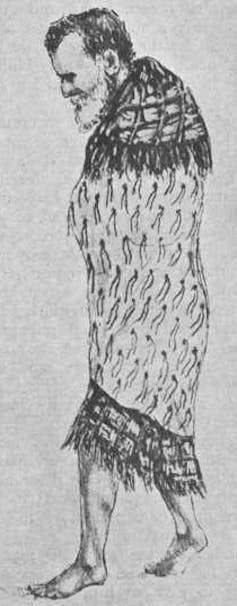 Te Whiti o Rongomai was one of the leaders of peaceful protests at Parihaka.
Wikimedia Commons, CC BY-ND
Te Whiti o Rongomai was one of the leaders of peaceful protests at Parihaka.
Wikimedia Commons, CC BY-ND
This story began in 1866 when Te Whiti o Rongomai and Tohu Kākahi established a settlement at Parihaka on land confiscated by the government in the 1860s as a penalty against “rebels” in the Taranaki wars. Te Whiti and Tohu began to develop a community which adopted non-violent measures to resist further land loss. It quickly grew to more than 2,000 inhabitants.
Matters started to come to a head when Governor Grey’s government began opening the area for European settlement in 1878. Te Whiti resisted, rightly claiming that Māori land reserves promised in 1865 within the confiscations process had not been set aside.
Accordingly, after surveyors failed to mark out reserves promised to Māori in southern Taranaki, in March 1879 Te Whiti ordered the surveyors to be peacefully evicted. In May of the same year, followers of Te Whiti and Tohu began to plough land across the disputed areas, as an assertion of their rights to it. By the end of July, 182 ploughmen had been arrested.
Worst land laws in NZ’s history
The government responded in early August with the Māori Prisoner Trials Acts. This enabled their continued imprisonment “for offences against public order” until a date was set for their trial.
The crime of removing survey pegs or ploughing was liable for a penalty of up to two years in jail. The date for trial was continually postponed and the numbers continued to build up. Between July and September 1880, 223 more Māori were arrested for placing fences across the road in an attempt to protect their cultivations.
Only 59 fencers received a trial, but all were sent hundreds of kilometres away to prisons in the South Island. In late July, a new Māori Prisoners Act of 1880 deemed it lawful to hold people in custody. To avoid any confusion (or questioning of what was going on), a text was added that said:
All the said Natives so committed for and waiting trial … shall be deemed and taken to have been lawfully arrested and to be in lawful custody, and may be lawfully detained.
The West Coast Settlement Act 1880 allowed any armed constable to arrest without warrant anyone interfering with surveys, engaged in unlawful ploughing or fencing, or obstructing a road.
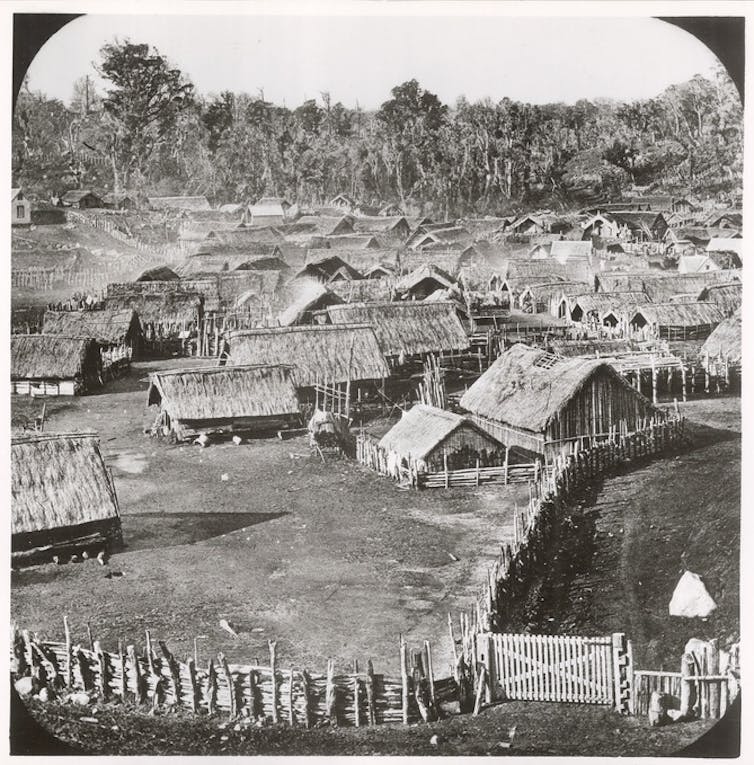 The settlement of Parihaka.
Wikimedia Commons, CC BY-ND
The settlement of Parihaka.
Wikimedia Commons, CC BY-ND
In 1881, a commission set up to examine the matter concluded that the Crown had failed to fulfil promises about Māori reserves. It recommended some be granted. The government started creating new reserves by late September 1881, but these were not returned to Māori outright and instead placed under the administration of a public trustee. Many were sold or leased in perpetuity by European farmers.
The new law did not resolve the situation. People in Parihaka continued to erect fences around traditional cultivation sites. The government decided to use direct action.
Fearing that the non-violent resistance was a prelude to armed conflict, the government called up 31 units of the volunteer militia and five companies of the armed constabulary and a naval brigade (655 troops and nearly 1,000 settler volunteers). They entered the site on November 5 1881.
Read more: Why it's time for New Zealanders to learn more about their own country's history
Passive, peaceful resistance
The troops found the road blocked by 200 children singing songs. The troops carried groups of older girls off the road and finally met residents sitting in the centre of the marae (meeting area). After reading out the Riot Act and telling those gathered to disperse, some 1,600 Parihaka inhabitants were expelled and dispersed throughout Taranaki without food or shelter.
The remaining 600 residents were issued with government passes to control their movement. Soldiers then destroyed most of the buildings at Parihaka. The government issued an indemnity order for all of those acting on behalf of the Crown at Parihaka.
Te Whiti and Tohu were arrested and charged with sedition for saying that “the land belongs to me”. They were held without trial for 16 months. With the West Coast Peace Preservation Act of 1882, the Crown decided not to prosecute the case, but the governor was given the right to retain them in custody, or free them with, or without, conditions if deemed necessary.
Local Māori were also prohibited from gathering in groups of more than 50. Anyone threatening to breach the peace could be jailed for 12 months.
A few months later the government gave itself the authority to proclaim amnesties for “offences … more or less of a political character … during the insurrections … committed by Māoris”, but Te Whiti and Tohu were not covered by this. Not until 1883 was a truly general political amnesty issued for all Māori in this matter – as if it was them who were at fault.
Authors: Alexander Gillespie, Professor of Law, University of Waikato


 Daily Bulletin


